
Table of Contents
- Why Older Vehicles Develop Intermittent Electrical Faults
- The Role of Battery and Charging Systems in Voltage Irregularities
- Signs of a Bad Car Ground Wire and Loose Ground Connections
- Automotive Electrical Diagnostic Tools for Fault Finding
- Environmental and Age-Specific Causes of Intermittent Electrical Faults
- Auto Electrical Repair Mildura: When to Book a Professional
- Preventative Maintenance Schedules and Safety Risks
- Frequently Asked Questions
Last Updated: September 10, 2026
Why Older Vehicles Develop Intermittent Electrical Faults
Intermittent electrical faults in older vehicles almost always trace back to the same handful of causes: degraded wiring, corroded connections, failing grounds, and components that work fine cold but break down under heat. At Mallee Auto & Agricultural Services in Mildura, Victoria, we see these faults weekly, and the pattern rarely surprises us.
Age is the primary driver. Wiring insulation hardens, cracks, and loses its ability to protect copper conductors. Connector pins oxidise. Ground points that were tight from the factory work loose after years of vibration on rough roads.
The frustrating part is timing. A fault that appears only on hot afternoons or over corrugations is genuinely difficult to catch, because the circuit tests perfectly when you finally get it to a workshop.
Intermittent faults are almost never random. They follow conditions: heat, vibration, moisture, or load. Identifying the condition is half the diagnosis.
How Age and Heat Break Down Automotive Circuitry
Heat accelerates every failure mode in automotive circuitry. Under-bonnet temperatures in a Mildura summer push insulation past its design limits, and decades-old wiring simply wasn’t built for it (sae.org).
Insulation breakdown exposes conductors to moisture and vibration. Once copper corrodes, resistance climbs, voltage drop increases, and components downstream start misbehaving. An alternator output fluctuation or a slow starter motor often traces back to a wiring loom problem rather than the component itself.
The Role of Battery and Charging Systems in Voltage Irregularities
Voltage irregularities are the most common electrical symptom owners describe, and the charging system is where diagnosis should start. A tired battery masks itself as a dozen other faults.
Battery health declines gradually. A battery that still cranks on a warm morning can fail to hold voltage under load, causing flickering lights, resetting electronics, and hard starting (batterycouncil.org). Testing battery health under load, not just at rest, is essential.
Alternator Output Fluctuation and Battery Health
Alternator output fluctuation shows up as dimming lights at idle, a battery warning light that flickers, or a battery that keeps going flat despite regular driving. Worn brushes, failing diodes, or a slipping belt all produce the same symptom from the driver’s seat.
A common mistake is replacing the alternator when the real fault is a corroded charging circuit connection. Test the circuit before condemning the component.
Signs of a Bad Car Ground Wire and Loose Ground Connections
A loose ground connection is the single most overlooked cause of intermittent electrical faults. Grounds carry current back to the battery, and when they degrade, every circuit on that ground path becomes unreliable.
Signs of a bad car ground wire include:
- Lights that dim or flicker when other accessories switch on
- Multiple unrelated systems failing at once
- Faults that appear over bumps and disappear on smooth road
- A starter motor that clicks rather than cranks
- Accessories that work only when the vehicle is stationary
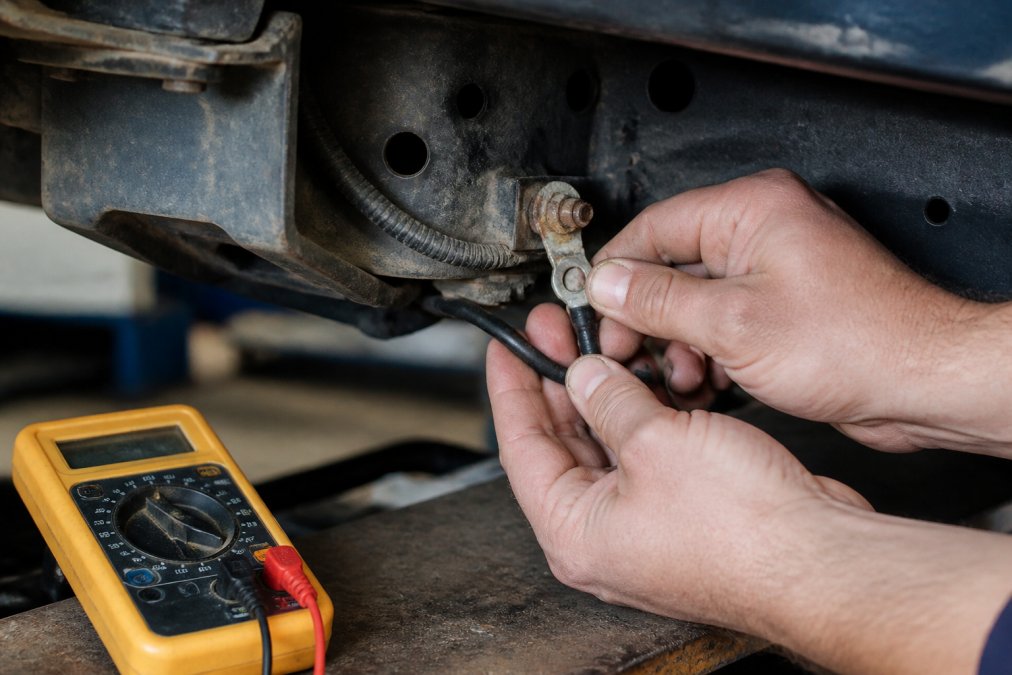
Terminal oxidation at the battery posts produces identical symptoms. Cleaning and re-torquing grounds costs very little and resolves a surprising share of complaints.
Automotive Electrical Diagnostic Tools for Fault Finding
Automotive electrical diagnostic tools range from a basic multimeter to a full diagnostic scan tool, and the right choice depends on whether the fault is stored, live, or load-dependent. Getting this wrong is why so many intermittent faults get misdiagnosed.
A multimeter measures voltage, resistance, and continuity. For intermittent faults, its most useful function is the voltage drop test: you load the circuit and measure how much voltage is lost across a connection or cable. A healthy circuit loses very little; a corroded ground or chafed cable can lose enough to starve a component without ever blowing a fuse (nhtsa.gov). A multimeter also confirms continuity on a suspect earth strap, but it cannot tell you how a circuit behaves under heat or vibration.
A clamp meter measures current without breaking the circuit, which makes it the correct tool for parasitic battery drain. The routine is systematic: everything off, doors closed, key out, then measure current at the battery cable and pull fuses one at a time until the draw drops. Guesswork here wastes hours.
A diagnostic scan tool reads fault codes and live data from the ECU. On older vehicles with limited modules, its value is narrower than owners expect, many pre-CAN-bus systems store no code for a wiring fault at all. On vehicles with body control modules and CAN-bus networks, live data becomes essential because a single module can log a fault that another module actually caused.
DIY Checks vs Professional Diagnosis
DIY checks suit simple, reproducible faults: a blown fuse, a visibly corroded terminal, a loose earth strap, a relay you can swap with an identical one nearby. These are worth doing first because they cost nothing and resolve a meaningful share of complaints.
Anything intermittent, multi-system, or linked to the ECU needs proper fault finding. The reason is that intermittent faults often leave no code at all, the module only logs a fault when the condition is present, and by the time the vehicle reaches a workshop the circuit tests perfectly. Without a scan tool capable of live data logging and a wiring diagram showing shared grounds and splices, you are chasing symptoms rather than causes.
A common pattern in older vehicles is a fault that only appears when the engine bay is hot. A basic multimeter read cold will show nothing. A technician using a scan tool with data logging, or a multimeter with a min/max recording function, can capture the voltage dip as it happens.
Replacing components before testing the circuit is the most expensive mistake in auto electrical work. Confirm the fault with a meter first, or you’ll pay twice.
If you are booking a diagnosis, write down the exact conditions: time of day, ambient temperature, road surface, which accessories were on, and whether the fault clears on its own. That single note can cut diagnostic time substantially.
Environmental and Age-Specific Causes of Intermittent Electrical Faults
Regional conditions shape which faults appear and when. In the Mallee, heat and dust do most of the damage, with occasional heavy rain finishing the job. Understanding the mechanism matters, because it tells you where to look first.
Heat and thermal cycling. Under-bonnet temperatures in a Mildura summer routinely push past what decades-old insulation was designed to tolerate. The damage is not a single event, it is thousands of heat-and-cool cycles. PVC and older rubber insulation hardens, loses plasticiser, and eventually cracks. Once cracked, the conductor is exposed to moisture and vibration, and copper begins to corrode. Corroded copper has higher resistance, which means more voltage drop, which means the component downstream misbehaves. An alternator that tests fine on the bench can still undercharge in the vehicle because the charging cable itself is the restriction.
Dust and abrasion. Fine Mallee dust works into sealed plugs, relay sockets, and connector pins. It is mildly abrasive, so vibration turns it into a slow grinding paste that wears through plating on terminals. Once the plating is gone, dissimilar metals meet, and galvanic corrosion begins. This is why a connector can look clean from the outside and still show high resistance on a voltage drop test.
Water ingress. Occasional heavy rain finds its way into fuse boxes, relay panels, and footwell connectors through degraded seals and blocked drains. Water alone is bad; water plus dust plus heat is worse, because the residue holds moisture against the pins. Corrosion then spreads along the connector, sometimes into adjacent circuits, which is how a single water leak produces multiple unrelated symptoms.
Vibration and chafing. Rough roads and decades of movement wear through loom tape and conduit. The classic failure point is where the harness passes through a bulkhead grommet or rubs against a chassis rail. The fault is often position-dependent: it appears over corrugations and disappears on smooth bitumen.
Traditional Harness Faults vs CAN-Bus Era Faults
Vehicle age changes the failure mode, and this is where many generic guides fall short.
Older vehicles, pre-CAN-bus, roughly pre-2006 for many Australian makes, rely on traditional wiring harnesses with discrete circuits, mechanical relays, and simple earth returns. The dominant faults are physical: cracked insulation, oxidised connector pins, failed relays, corroded earth points, and chafed loom sections. Diagnosis is largely electrical and mechanical, and a wiring diagram plus a multimeter resolves most cases.
Newer vehicles add CAN-bus networks and body control modules. Here the dominant faults shift toward sensor drift, module communication errors, and voltage-sensitive electronics that misbehave when supply voltage sags. A marginal earth on a CAN-bus vehicle can produce a cascade of unrelated module faults, because the modules share a reference voltage. This is why a fault that looks like a failed module is often a corroded ground.
For owners of older utes, tractors, and farm trucks in the Mallee, the practical takeaway is that the fault is most likely physical and findable, provided the technician tests the circuit under the conditions that trigger it, rather than on a cool morning in a quiet workshop.
Heat, dust, water, and vibration do not create new fault types. They accelerate the same four mechanisms, insulation breakdown, connector oxidation, earth degradation, and chafing, that have always caused intermittent faults in older vehicles.
Auto Electrical Repair Mildura: When to Book a Professional
Book professional auto electrical repair in Mildura when a fault is intermittent, affects multiple systems, or involves the ECU or charging system. These are the cases where guesswork costs the most.
If you’re searching for auto electrical repair near me and your vehicle has already had parts thrown at the problem, stop. A proper diagnostic session with modern scan tools will find the cause faster than another round of replacement parts. Our team works on everything from passenger cars to tractors and farm trucks, so downtime stays short during harvest.
Before booking, note the exact conditions when the fault appears: time of day, temperature, road surface, and which accessories were on. That detail shortens diagnosis significantly.
Preventative Maintenance Schedules and Safety Risks
Preventative maintenance is the cheapest insurance against electrical failure. A simple schedule catches most problems before they strand you.
| Interval | Check | Why It Matters |
|---|---|---|
| Every service | Battery terminals and earth straps | Prevents voltage drop and hard starting |
| Every 20,000 km | Charging system output | Catches alternator fluctuation early |
| Every 40,000 km | Wiring loom and connector pins | Finds chafing and corrosion |
| Annually, before summer | Battery load test and fuse box inspection | Heat exposes weak batteries and connections |
| Before harvest or heavy use | Full electrical inspection | Avoids costly downtime |
Ignored electrical faults are a genuine vehicle safety risk. Failing lights, intermittent wipers, and stalling are hazards, and a short circuit can damage the ECU or start a fire. Fault finding isn’t optional maintenance.
Intermittent electrical faults rarely fix themselves, and they tend to fail at the worst possible moment. If your vehicle, tractor, or farm truck has a fault you can’t pin down, Mallee Auto & Agricultural Services can help. Our skilled mechanics use modern diagnostic tools for accurate issue detection, offer fair pricing with no hidden charges, and provide pensioner discounts for local residents. Get started with Mallee Auto & Agricultural Services and keep your vehicle running safely and reliably.
Frequently Asked Questions
Why do older cars develop intermittent electrical problems?
Age degrades every part of a vehicle’s electrical system. Insulation becomes brittle and cracks, connector pins oxidise, and ground points accumulate corrosion. Wiring harnesses rub against metal surfaces until strands break inside the loom, creating open circuits that reconnect when the vehicle vibrates. Heat from the engine bay accelerates insulation breakdown on older automotive circuitry. These combined factors mean intermittent electrical faults in older vehicles are rarely caused by one single failure, which is why proper fault finding matters.
What are the most common signs of a bad car ground wire?
Flickering lights that brighten or dim with engine revs, a starter motor that cranks slowly despite a healthy battery, and electrical accessories that work intermittently are classic signs of a bad car ground wire. You may also notice voltage drop across the chassis when tested with a multimeter. Terminals may look fine visually while corrosion hides underneath. A loose ground connection forces current to find alternative paths, which stresses other components.
Can corroded battery terminals cause intermittent electrical faults?
Yes. Terminal oxidation creates resistance that varies with temperature and vibration, so your vehicle may start fine in the morning and fail after a short drive. Corrosion between the terminal and post interrupts electrical continuity just enough to cause voltage irregularities without fully disconnecting. Cleaning terminals is a quick check, but if corrosion returns quickly, the underlying charging system or battery health needs professional diagnosis.
Are intermittent electrical faults dangerous to drive with?
They can be. Flickering lights, random stalling, and failing sensors affect vehicle safety directly. An intermittent fault in the wrong circuit can disable indicators, brake lights, or engine management at the worst moment. Parasitic battery drain may leave you stranded. Ignoring these issues often leads to cascading damage in the wiring loom and more expensive repairs. Book a diagnostic check rather than waiting for the fault to become permanent.
