
Table of Contents
- What a Professional Car Diagnosis Actually Delivers
- Professional vs DIY Car Diagnostic Tools: Where the Gap Shows
- Car Diagnostic Test Cost in Australia: What Drives the Fee
- How Long Does a Car Diagnostic Take?
- Symptoms That Justify Professional Diagnosis (and What a Scan Misses)
- The Cost-Benefit Case by Vehicle Age and Type
- Frequently Asked Questions
Last Updated: September 17, 2026
What a Professional Car Diagnosis Actually Delivers
Is professional car diagnosis worth it? For most modern vehicles, yes. A professional car diagnosis delivers far more than a fault code readout: it combines live sensor data, system analysis and human interpretation to pinpoint the actual cause of a problem rather than just its symptom.
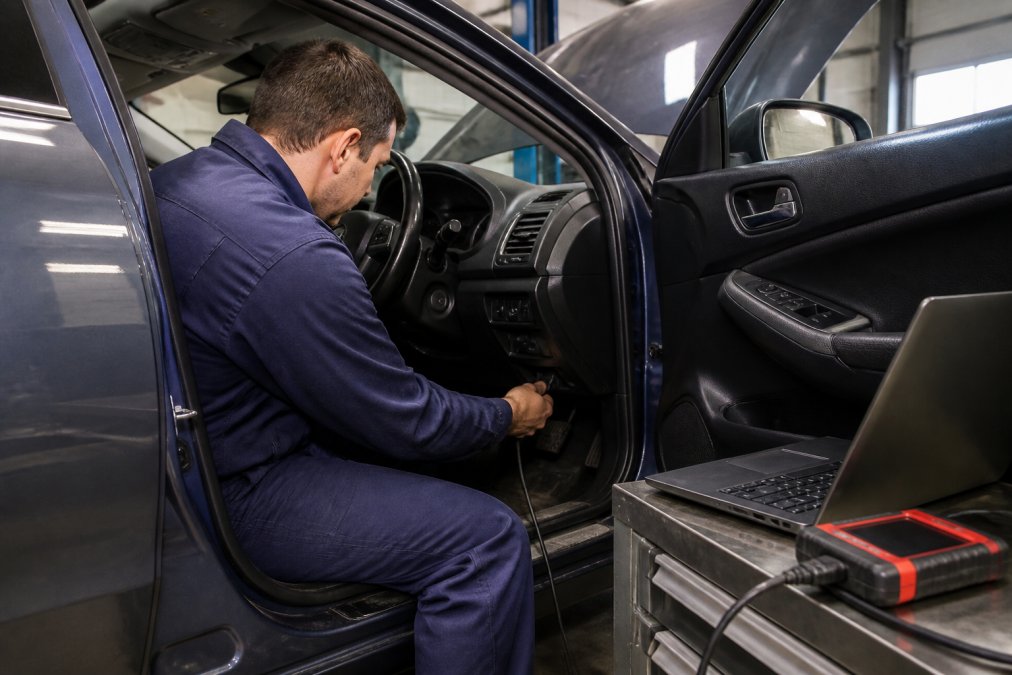
At Mallee Auto & Agricultural Services in Mildura, Victoria, we see the difference daily. A scan tool might flag a misfire on cylinder three. A trained technician works out whether that misfire comes from a failing coil, a worn spark plug, a vacuum leak or a wiring fault. Those are four different repairs with four very different bills.
A professional car diagnosis is the process of using diagnostic equipment and technician expertise together to identify the root cause of a vehicle fault, not merely the code it triggers.
That distinction matters. Fault codes point to a circuit or system, not a specific failed part. According to the Australian Automotive Aftermarket Association, modern vehicles run dozens of interconnected systems, and misreading a code often leads to replacing parts that were never faulty.
Beyond Reading Fault Codes: Data Interpretation and System Analysis
Anyone can buy a reader. Interpretation is the skill. A technician cross-references fault codes against real-time data, checks freeze-frame conditions and tests components in sequence. This system analysis is what separates a guess from a diagnosis.
Ask for the diagnostic report, not just a verbal summary. A written report showing the codes found, the live data checked and the test results gives you a clear record and makes any second opinion far easier.
Professional vs DIY Car Diagnostic Tools: Where the Gap Shows
The gap between professional and DIY car diagnostic tools shows up in three places: coverage, live data and interpretation. A basic handheld reader covers engine codes only. Professional equipment reads transmission, ABS, airbag, body control and, on many vehicles, manufacturer-specific modules a consumer tool cannot access.
- Coverage: Consumer tools typically read generic powertrain codes; professional scan tools read all major modules.
- Live data: Professional equipment streams real-time sensor values while the engine runs; most budget readers cannot.
- Bidirectional control: Professional tools can command components on and off to confirm a fault; DIY readers only listen.
- Software updates: Manufacturers release new firmware and code definitions regularly, and professional workshops keep their tools current.
The Limits of Consumer-Grade OBD2 Scanners
An OBD2 scanner is a useful first step, not a verdict. Consumer-grade units often miss manufacturer-specific codes, cannot perform sensor calibration and give no context for when a fault occurred. Relying on one alone frequently means replacing a good part and still facing the same dashboard warning.
Clearing a check engine light to make it disappear does not fix anything. The underlying fault stays logged, and on many vehicles it returns within a few drive cycles, sometimes alongside a worse problem.
Car Diagnostic Test Cost in Australia: What Drives the Fee
Car diagnostic test cost in Australia depends on the depth of the test, the vehicle and how long fault-finding takes. A quick code read is one thing. A full system analysis with live data, road testing and component checks is another. Labour time is the biggest driver, followed by how many modules need scanning and whether the fault is intermittent.
Why the Diagnostic Fee Is Not Just a Reading Charge
The fee pays for a technician’s time, equipment and expertise, not a plug-in-and-print service. A tricky intermittent fault can take an hour of testing to isolate. That hour often saves several hundred dollars in parts that would otherwise be swapped on suspicion.
- A diagnostic fee buys you information, the technician’s time to find the root cause. It is charged whether or not you proceed with the repair.
- A repair fee buys you a fix, parts and labour to correct a fault that has already been identified.
Before you authorise any diagnostic work, ask three questions: What is the diagnostic fee? Is it credited toward the repair if I proceed? And will I receive a written report showing the codes found and the tests performed? A workshop that answers all three clearly is one worth using.
What Can Push a Diagnostic Bill Higher in Mildura
Mildura’s climate and driving patterns affect how long a diagnosis takes. Summer temperatures regularly exceed 40°C, which stresses sensors, batteries and wiring harnesses in ways that can produce intermittent faults, the hardest kind to pin down. A vehicle that has spent years on dusty rural roads can also present with connector corrosion or rodent damage to wiring that mimics an electronic fault.
A diagnostic fee is not a penalty, it is the cost of not guessing. The question is not whether the fee is worth paying, but whether the workshop credits it, documents it and uses it to find the cause rather than just the code.
How Long Does a Car Diagnostic Take?
How long a car diagnostic takes ranges from about 30 minutes for a simple code read to several hours for an intermittent fault. Most straightforward diagnoses finish within an hour. Complex electrical or drivability issues take longer because the technician has to recreate the conditions that trigger the fault.
| Fault Type | Typical Time | What’s Involved |
|---|---|---|
| Stored code read | 30-45 minutes | Scan, clear, verify |
| Drivability fault | 1-2 hours | Live data, road test |
| Intermittent electrical | 2+ hours | Wiring checks, recreate fault |
| Pre-purchase inspection | 1-1.5 hours | Full system scan, report |
Symptoms That Justify Professional Diagnosis (and What a Scan Misses)
Symptoms that justify professional diagnosis include a flashing check engine light, rough idling, unexplained fuel economy drops, transmission shuddering, warning lights that return after clearing and any new noise under load. A scan alone misses mechanical faults with no electronic signature, such as a worn bearing, a failing fuel pump on its way out or a vacuum leak that has not yet tripped a code.
The Cost-Benefit Case by Vehicle Age and Type
The cost-benefit case for professional car diagnosis shifts with vehicle age and type. Newer vehicles, with dense electronics and emissions testing requirements, almost always justify professional diagnosis because a misread fault can cascade into expensive damage. Older, simpler vehicles sometimes suit a basic check first.
New Vehicles Under Warranty
For a car still covered by a manufacturer’s warranty, professional diagnosis is almost always worth it, but for a different reason than most people assume. Modern vehicles under warranty are packed with interconnected modules, and an unauthorised repair or a cleared code can complicate a warranty claim. A documented professional diagnosis gives you a paper trail that supports the claim rather than undermining it.
Vehicles Out of Warranty, Roughly 5-15 Years Old
This is where the cost-benefit calculation gets genuinely interesting. These vehicles are old enough to have real faults but new enough that repair costs rarely exceed the vehicle’s value. Professional diagnosis is usually worth it here because the alternative, parts-swapping on suspicion, is exactly the pattern that turns a $300 fault into a $1,200 repair bill.
Older Vehicles and Vehicles You Are Deciding Whether to Keep
Professional diagnosis is not worth it when the repair cost clearly exceeds the vehicle’s value and you are deciding whether to scrap it anyway. It is also hard to justify on a very old vehicle with a fault you have already chosen to live with.
Agricultural and Heavy Equipment in the Mallee
For agricultural machinery, the case is stronger still. A tractor or truck off the road during harvest costs far more in lost time than any diagnostic fee. We handle heavy equipment diagnostics for Mallee region farmers precisely because downtime is the real expense.
The question is not ‘is professional diagnosis worth it?’ in the abstract. It is ‘what is at stake if I get this wrong?’ Match the diagnostic spend to the value of the vehicle, the cost of the potential repair, and the cost of the downtime. That calculation almost always favours a proper diagnosis.
Frequently Asked Questions
Is a $200 diagnostic fee normal in Australia?
Diagnostic fees vary by workshop, vehicle type and how deep the testing goes. A simple fault-code scan sits at the lower end; a full system analysis with road testing and sensor checks sits higher. The fee usually reflects technician time and equipment, not just plugging in a scanner. Ask what the fee includes before booking, and confirm whether it comes off the repair bill if you proceed with the work.
How accurate are professional diagnostic tools compared to cheap DIY scanners?
Consumer OBD2 scanners read fault codes but cannot always interpret them. A code pointing to a sensor may actually stem from a wiring harness fault, low voltage or a mechanical issue elsewhere. Professional equipment reads live data, runs actuator tests and checks multiple modules, so the technician can confirm the cause rather than replace parts by guesswork. That accuracy is what separates diagnosis from code reading.
Why does a mechanic charge for a diagnostic if I already know the check engine light is on?
The light tells you something is wrong, not what. A diagnostic test identifies which component failed, why it failed and whether it is safe to drive. That step prevents unnecessary repairs and repeat visits. It also protects you: a documented diagnostic report shows exactly what was tested and found, so you can see the reasoning behind any recommended repair before you approve it.
How long does a car diagnostic take, and can it be done while I wait?
A basic scan takes 15 to 30 minutes. A full diagnostic with road testing, live data logging and multi-system checks often runs one to two hours, and intermittent faults can take longer. Many workshops can complete standard diagnostics while you wait, but book ahead so a bay and technician are available. For farm machinery or heavy vehicles, allow extra time because access and testing take longer.
Modern vehicles are complex enough that guessing at faults gets expensive fast, and that is the real answer to whether professional car diagnosis is worth it. If you are searching for a trustworthy car diagnosis near me in Mildura, Mallee Auto & Agricultural Services offers skilled mechanics, modern diagnostic tools, fair pricing with no hidden charges and pensioner discounts. Get started with Mallee Auto & Agricultural Services and keep your vehicle running smoothly, safely and efficiently.
