
Table of Contents
- Start With Your Owner’s Manual and Logbook Service Schedule
- Watch Your Dashboard Warning Lights and Act Early
- A Car Maintenance Checklist for Regional Driving
- How to Find a Reliable Mechanic in Mildura
- Signs of a Dishonest Mechanic and How to Protect Yourself
- Use Digital Diagnostic Tools to Verify What Your Car Needs
- Frequently Asked Questions
Last Updated: September 21, 2026
Start With Your Owner’s Manual and Logbook Service Schedule
The fastest way to avoid unnecessary car repairs is to follow the service schedule the manufacturer built for your vehicle. That schedule lives in two places: your owner’s manual and your logbook.
Here’s what your logbook actually protects:
- Warranty compliance, a full logbook service history keeps your new-car warranty valid
- Resale value, buyers pay more for a documented service record
- Service intervals, the maker knows your engine’s real needs, not a generic guess
Photograph every stamped logbook page and keep the receipts. If a workshop ever questions your service history, you’ll have proof in seconds.
Watch Your Dashboard Warning Lights and Act Early
A dashboard warning light is your car telling you something specific. Ignoring it is how small faults become expensive ones. But acting on it blindly is how you end up paying for parts you never needed.
Here’s the short version:
- Red oil pressure light, pull over and switch off the engine. Driving on low oil pressure can destroy an engine in minutes.
- Amber check engine light, steady means get it scanned soon. Flashing means stop driving and call a mechanic.
- Red temperature warning, overheating warps cylinder heads. Stop, let it cool, check coolant levels.
- Amber ABS or traction light, your brakes still work, but the safety system needs a look.
- Amber tyre pressure light, check pressures cold against the placard in your owner’s manual before assuming a sensor fault.
- Amber battery or charging light, the alternator may not be charging. Get it tested before the battery is replaced unnecessarily.
Know the codes before you approve the work
When a workshop scans your car, it reads trouble codes from the OBD-II system. These are standardised across makes and models, so you can look them up yourself. A few common ones you may see on a job sheet:
- P0300 to P0308, engine misfire detected. Could be a spark plug, coil, injector, or a vacuum leak. It does not automatically mean “replace all coils”.
- P0420, catalyst efficiency below threshold. Often blamed on the catalytic converter, but a faulty oxygen sensor or an exhaust leak can trigger the same code.
- P0171 or P0172, fuel system too lean or too rich. Frequently a dirty mass airflow sensor or a vacuum leak rather than a failed fuel pump.
- P0442 or P0455, evaporative emissions leak. A loose or worn fuel cap is a common cause before any part replacement is justified.
Never let a workshop replace parts based on a warning light or a code alone. Ask for the trouble codes in writing and ask what test confirmed the faulty part. A light can mean a loose sensor wire, not a failed component.
What to do when the light comes on
- Note the colour and whether it is steady or flashing. Flashing amber means stop driving.
- Check the obvious first. Fuel cap tight, oil and coolant levels correct, tyre pressures set.
- Get the codes read. Many workshops will scan for a modest diagnostic fee, and some auto parts stores in regional Victoria will read codes for free.
- Write the codes down before anyone clears them. Clearing codes wipes the evidence trail.
- Compare the codes to the quote. If the codes point to a misfire and the quote is for a full transmission service, ask why.
- Get a second opinion on anything over a few hundred dollars. A second scan and inspection is cheap compared with an unnecessary repair.
Keep a photo of the dashboard with the light illuminated and the odometer reading. It helps a mechanic understand when the fault started and whether it is intermittent.
A Car Maintenance Checklist for Regional Driving
Regional driving around Mildura is hard on vehicles. Red dust, long highway runs, hot summers, and rough farm tracks all speed up wear.
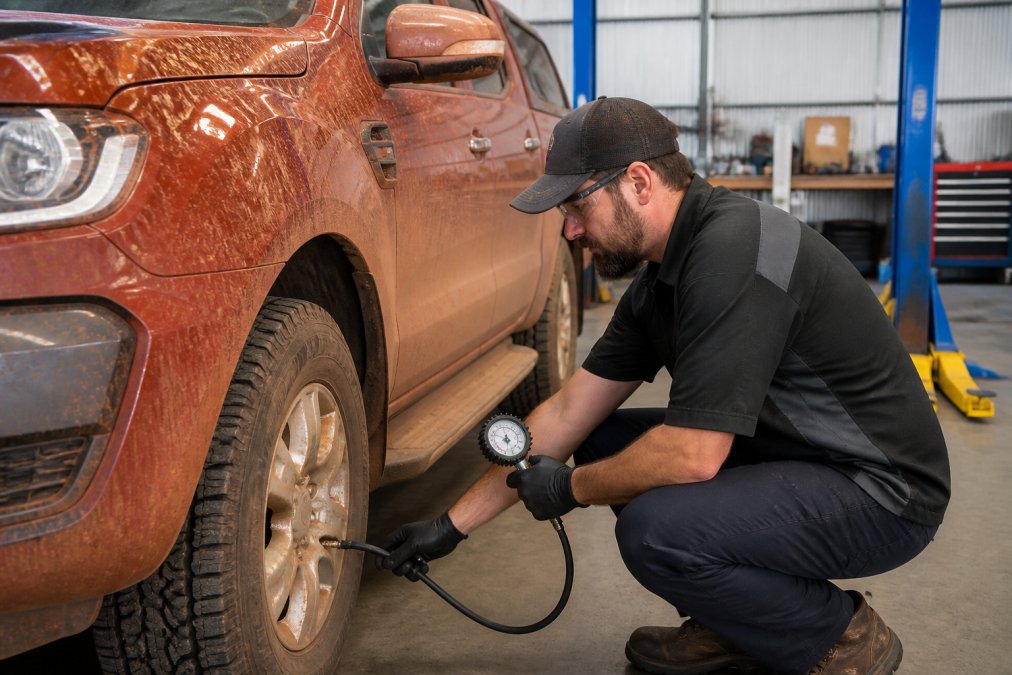
Monthly checks:
- Tyre pressure, including the spare, set to the placard in your owner’s manual
- Engine oil level on the dipstick, cold
- Coolant level in the overflow bottle
- Wiper rubbers, cracked by sun and dust
- All lights, including brake and indicator bulbs
Every six months:
- Wheel alignment and balance, especially after corrugated roads
- Brake pad wear inspection
- Battery terminals, cleaned and tight
- Air conditioning service before summer
Yearly or per logbook:
- Transmission fluid and filter per schedule
- Full mechanical inspection
- Fluid contamination check on brake and power steering fluid
The cheapest repair is the one you never need. Monthly tyre and fluid checks catch most problems before they cost real money.
How to Find a Reliable Mechanic in Mildura
Finding a reliable mechanic in Mildura comes down to proof, not promises. A good workshop shows you the problem, explains the fix, and puts it in writing.
Start with these questions before you book:
- Do you provide a written estimate before starting work?
- Will you show me the worn parts you replace?
- Do you use a diagnostic scan tool, and can I see the trouble codes?
- What’s your policy if a repair doesn’t hold up?
Signs of a Dishonest Mechanic and How to Protect Yourself
The clearest signs of a dishonest mechanic are pressure, vagueness, and surprise add-ons. If any of those show up, slow down.
Watch for these red flags:
- Additives and flushes pushed hard, fuel additives and engine flush are rarely needed on a healthy engine. They’re an easy upsell.
- No written estimate, a real quote is on paper, itemised, before work starts.
- Refusal to show parts, a genuine mechanic keeps worn parts for you to see.
- Diagnostic fee with no explanation, a diagnostic fee is fine, but you should know what it covers.
- Vague answers about trouble codes, ask for the OBD-II scan tool readout. It’s your right to see it.
- Pressure to decide on the spot, a legitimate repair can usually wait long enough for you to get a second opinion.
Know the difference between a quote and an estimate
This is the single most useful distinction for avoiding an unnecessary repair bill in Victoria.
- A quote is a fixed price for specified work. If the final bill is higher for the same work, the business generally cannot charge the extra without your agreement.
- An estimate is a reasonable approximation. The final cost can vary, but only within reason, and you should be told before the cost climbs significantly.
Your rights under Australian Consumer Law
In Victoria, repairs are covered by the consumer guarantees in the Australian Consumer Law, administered nationally by the ACCC and enforced locally by Consumer Affairs Victoria. In practice, this means:
- Services must be carried out with due care and skill.
- Services must be fit for the purpose you made known to the business.
- If a repair fails or you are charged for work that was not needed, you are entitled to a remedy, a redo, a refund, or compensation in some cases.
- You have the right to choose your own repairer. Getting a service or repair done by an independent mechanic does not, by itself, void your new-car warranty, provided the work is done to the manufacturer’s specification and you keep records.
How to build a paper trail that protects you
- Get the estimate or quote in writing before work starts, itemised by parts and labour.
- Ask for the trouble codes to be written on the invoice.
- Ask for the worn parts back or photographed if you cannot take them.
- Keep every invoice, text message, and email. That paper trail is what makes a complaint stick.
- If a repair fails, go back to the same workshop first. Give them the chance to remedy it before escalating.
- If that fails, contact Consumer Affairs Victoria. They can advise on your options and, where appropriate, help you pursue a remedy.
If a workshop tells you that using an independent mechanic will void your new-car warranty, ask them to show you where the manufacturer’s terms say that. In most cases, the warranty requires the work to be done to specification, not that it be done by a dealership.
A trustworthy mechanic answers all four questions at the top of this section without flinching. A dishonest one gets vague. The difference is rarely about price, it is about whether they will put their diagnosis and their quote in writing.
Use Digital Diagnostic Tools to Verify What Your Car Needs
Modern cars run on computers, and those computers store fault data. Digital diagnostic tools let you read that data before you approve any repair.
- Buy or borrow a basic OBD-II scan tool. Handheld units are cheap and easy to use.
- Plug it into the port under the steering column. It’s usually within reach of the driver’s seat.
- Read the trouble codes. Write them down. They look like “P0301” or “P0420”.
- Look up what each code means. A code points to a system, not always a specific part.
- Compare the codes to the mechanic’s quote. If the codes don’t match the work proposed, ask why.
- Clear the codes only after the repair. Clearing them early wipes the evidence.
Frequently Asked Questions
How to avoid getting ripped off by a mechanic?
Ask for a written estimate before any work begins and request that the mechanic shows you the worn or faulty parts. A trustworthy mechanic will explain what needs fixing and why, without pressure. Get a second opinion if the quote seems high, and check that the workshop follows the manufacturer’s logbook service schedule rather than pushing extra flushes or additives you did not ask for.
What are the signs of a dishonest mechanic?
Watch for vague explanations, refusal to provide a written estimate, pressure to approve work immediately, and recommendations for services your owner’s manual does not list. A mechanic who cannot show you the faulty part or explain the diagnostic trouble codes is a red flag. Legitimate workshops will happily walk you through the findings and give you time to decide.
How often should I service my car in regional Victoria?
Follow the service intervals in your owner’s manual, which are typically every 10,000 to 15,000 kilometres or every 12 months, whichever comes first. Regional driving in areas like Mildura involves dust, heat, and long distances, so checking fluids, tyre pressure, and brakes between services is wise. Sticking to the logbook schedule protects your warranty and prevents small issues from becoming expensive repairs.
What is the most neglected car maintenance?
Tyre pressure and condition are commonly overlooked, yet they affect safety, fuel use, and tyre life. Checking coolant levels, brake pad wear, and wiper rubbers also gets pushed aside. A simple monthly walk-around using a car maintenance checklist for regional driving can catch these early, saving you from unnecessary car repairs down the track.
