
Table of Contents
- Why Farm Equipment Downtime Costs More Than the Repair Bill
- Build a Preventative Maintenance Schedule Around Engine Hours, Not the Calendar
- Your Pre-Season and Mid-Season Preventive Maintenance Checklist for Tractors
- Is Synthetic Oil Worth It for Farm Vehicles?
- Stop Wear and Corrosion Before It Stops You
- When to Call Farm Machinery Repair Services in Mildura
- Using Telematics and Automated Systems on Older Machinery
- Conclusion
- Frequently Asked Questions
Last Updated: September 24, 2026
Why Farm Equipment Downtime Costs More Than the Repair Bill
Farm equipment downtime is the period a machine sits unusable because of a breakdown, waiting on parts, or an overdue service. The repair invoice is the smallest part of the cost. Lost harvest hours, hired-in replacements, and delayed sowing carry the real weight.
Build a Preventative Maintenance Schedule Around Engine Hours, Not the Calendar
Preventative maintenance works best driven by engine hours, because a tractor working 10-hour days through harvest accumulates wear far faster than one doing odd jobs. Calendar-based servicing quietly fails the hardest-working machines on your property.
Setting Service Intervals for Tractors, Headers and Trucks
Manufacturers publish service intervals in the operator’s manual, but those figures are a starting point. Shorten intervals for machines working in dust, heat, or continuous load, most of a Mallee harvest.
- Tractors: track engine hours and service at the manual’s interval, or sooner in heavy draft work
- Headers: check belts, chains, and knife sections every day during harvest
- Trucks: service on kilometres, and inspect brakes and tyres weekly during cartage
Keeping Maintenance Logs That Actually Get Used
A maintenance log only works if it takes seconds to fill in. Elaborate record-keeping systems collapse within a month; a whiteboard in the shed plus a notebook in the cab beats software nobody opens.
Write the next service hour on a sticker inside the cab door. Whoever climbs in next sees it immediately, and nothing gets missed when multiple operators share a machine.
Your Pre-Season and Mid-Season Preventive Maintenance Checklist for Tractors
A pre-season and mid-season inspection catches wear before it becomes a breakdown mid-season. This checklist takes about an hour per machine.
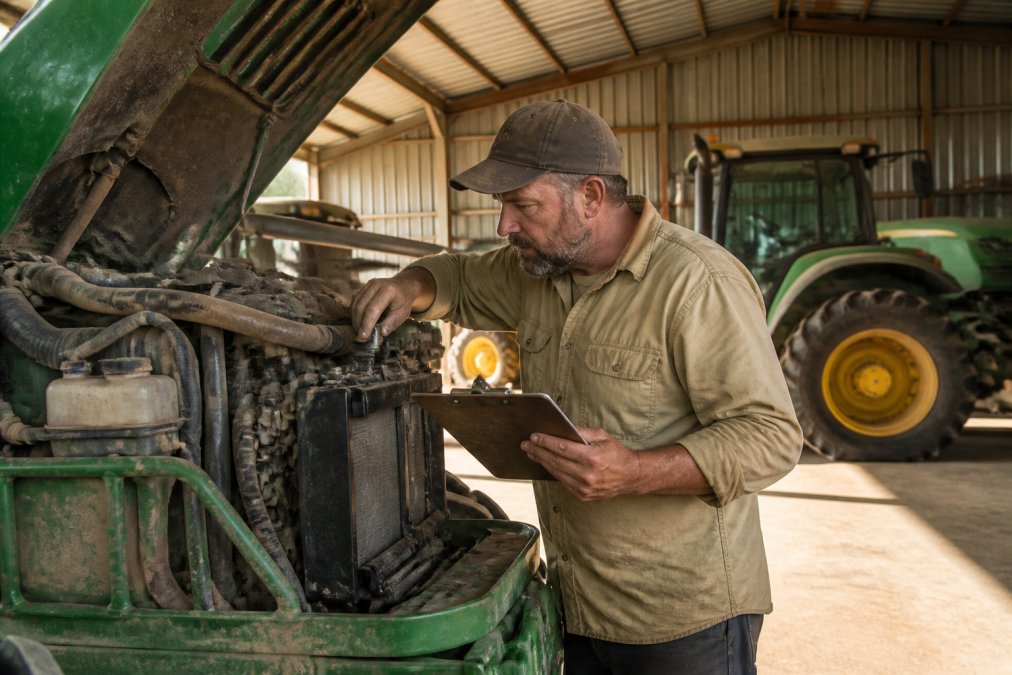
Pre-season checklist:
- Check engine oil, coolant, and hydraulic fluid levels
- Inspect belts, hoses, and filters for cracking or residue build-up
- Grease all pivot points and lubrication schedules per the manual
- Test brakes, lights, and safety guards
- Check tyre pressure and look for sidewall damage
- Confirm battery terminals are clean and tight
Mid-season checklist:
- Re-check fluid levels daily
- Inspect wear parts: knife sections, concaves, and tyres
- Clear crop residue from around the engine and exhaust
- Listen for new noises and investigate immediately
Daily Checks Operators Should Run Before Every Start
Operator training is the cheapest downtime insurance you can buy. A five-minute daily walk-around routinely catches loose guards, low oil, and hydraulic leaks before they become mechanical failure.
Is Synthetic Oil Worth It for Farm Vehicles?
Synthetic oil is worth it for farm vehicles working in extreme heat, heavy load, or long service intervals, because it resists breakdown better than mineral oil. For light-use machines on short intervals, the extra cost is harder to justify.
Why Heat and Dust Change the Calculation in the Mallee
Mineral oil oxidises faster as sump temperatures climb, and in continuous load under a Mildura summer it can lose viscosity well before the calendar interval is up. Synthetic base stocks hold film strength across a wider temperature band, which matters most on machines that run hot and sit overnight in a dusty shed.
Matching Oil to Engine Hours, Not the Calendar
If servicing already runs on engine hours, the oil decision is simpler. A machine accumulating 250+ hours in a harvest window is a candidate for synthetic; a ute doing 60 hours a year on short trips is not.
Where it pays off:
- High-hour machines in continuous load through summer
- Headers, tractors and trucks working in dust and heat
- Machines on extended service intervals where you want a safety margin
- Equipment with turbochargers or high compression that runs hot
Where it does not:
- Low-use vehicles on frequent oil changes
- Older engines with existing leaks, where synthetic can find its way out faster
- Machines with worn rings or valve guides, where the oil consumption outweighs the protection
If you are unsure, run one machine on synthetic for a season and compare oil analysis results against your mineral-oil baseline. Oil sampling is cheap compared to an engine rebuild, and it gives you evidence rather than a guess.
What to Check Before You Switch
Before changing oil type, confirm the manufacturer’s specification in the operator’s manual. Some older engines specify a viscosity grade or API classification a modern synthetic may not match, and the wrong spec can void a warranty or accelerate seal wear. If the manual is missing, a dealer or local workshop can confirm the correct specification.
The Trade-Off in Plain Terms
Synthetic oil costs more per litre. The question is whether it saves more through fewer oil changes, less wear, and fewer unplanned shutdowns during harvest. For a machine running hard in heat and dust, the maths usually favours synthetic; for light work serviced often, mineral oil remains reasonable.
Stop Wear and Corrosion Before It Stops You
Corrosion prevention and wear-part management separate a fleet that lasts from one that eats money. Pivot points, bearings, and electrical connections fail first in dusty, hot conditions, cheap to protect, expensive to replace mid-season.
Dust: The Abrasive That Gets Everywhere
Mallee topsoil is fine and mobile, working into sealed bearings, past worn dust boots, and into air intakes faster than most operators expect. The result is accelerated wear on pivot pins, bushings, and any sliding surface.
The countermeasures are straightforward but must be done often:
- Grease pivot points on schedule, and grease until clean grease purges from the joint, not just until the gun feels resistance
- Check and replace dust boots and seals before they split, not after
- Clean around filler caps and dipsticks before opening them, so dust does not drop into the sump or hydraulic tank
- Blow out radiator cores and air filter housings regularly during harvest, when dust load is highest
Heat: What It Does to Seals, Hydraulics and Batteries
Sustained 40-degree days shorten the life of rubber seals, hydraulic hoses, and batteries. Hot hydraulic oil oxidises faster and loses lubricity, accelerating pump and valve wear, while battery electrolyte evaporates and terminals corrode.
Practical steps:
- Check hydraulic oil condition and temperature during heavy work, and clean coolers so they can do their job
- Inspect hoses for cracking and chafing before summer, not during it
- Keep battery terminals clean and tight, and check electrolyte levels on serviceable batteries
- Park machinery under cover where possible, because UV degrades rubber and plastic components
Irrigation Moisture: The Corrosion Driver Most Guides Ignore
If machinery works near irrigation channels, pivots, or wet ground, moisture exposure is a bigger corrosion driver than rainfall. Damp steel, condensing electrical connectors, and water-ingress bearings all fail earlier than on dry-land operations.
- Rinse and dry machinery that has been working in wet or muddy conditions, then re-grease
- Use dielectric grease on electrical connectors exposed to moisture
- Check wheel bearings and sealed hubs after any period of working in water
- Inspect the underside of headers and implements, where moisture and crop residue combine to trap corrosion
Managing Spare Parts Inventory for Critical Wear Parts
Spare parts inventory is a balancing act, and in regional Victoria lead time changes the maths. Hold too little and a bearing stops harvest; hold too much and cash sits on a shelf. Stock the parts that fail often and take days to source.
| Part Type | Stock Level | Why |
|---|---|---|
| Filters and belts | High | Cheap, fail often, easy to store |
| Bearings and seals | Medium | Common failure points, short lead time |
| Knife sections and guards | High during harvest | Wear fast, stop the header |
| Hydraulic hoses | Medium | Field-repairable but slow to source |
| Major components | None | Order on failure, too costly to hold |
Planning Around Regional Parts Lead Times
One of the most underrated downtime risks for Mallee and Mildura growers is the wait for parts. A bearing that is a same-day pickup in a capital city can be a two- or three-day wait from Melbourne or Adelaide, landing squarely in the middle of harvest.
Dust, heat and moisture each attack different parts of your machinery. Grease, cooling and drying routines address all three, and a small, well-chosen spare parts shelf covers the gap when a part has to travel.
When to Call Farm Machinery Repair Services in Mildura
Guessing at an electronic or hydraulic fault can turn a minor repair into a major one. If you have replaced a part and the fault remains, stop and get it diagnosed properly.
This is where a local workshop earns its keep. Mallee Auto & Agricultural Services works on tractors, trucks, and heavy machinery with modern diagnostic tools, so faults get found rather than guessed at. For anyone searching for farm machinery repair services near me in the Mildura area, local access to expertise keeps a breakdown from becoming a week-long wait.
Using Telematics and Automated Systems on Older Machinery
Telematics and automated systems can be fitted to older machinery and are one of the most underused tools for downtime reduction. A basic tracking and hour-metering unit gives you engine hours, location, and fault codes without replacing the machine.
Conclusion
Downtime will always threaten the critical season, and no schedule eliminates breakdowns entirely. What a plan does is shrink the window between a fault appearing and a machine running again.
Frequently Asked Questions
What are the most common causes of farm equipment downtime in the Mallee region?
Heat, dust and dry crop residue drive most breakdowns here. Radiators and air filters clog faster than in cooler districts, bearings and pivot points dry out, and batteries fail under repeated high temperatures. Hydraulic hose failures and worn wear parts like tynes and chopper blades also cause sudden stoppages. Most of these are picked up early with regular equipment inspection, so a proactive servicing routine matters more than reacting once something fails.
How does a preventive maintenance schedule save money for Victorian farmers?
Servicing on schedule costs far less than emergency repairs during a critical season. A failed bearing caught at a routine check is a cheap fix; the same bearing failing mid-harvest can mean hired replacement machinery, lost days and rushed parts freight. Tracking cost per hour and machine longevity over a few seasons shows preventative maintenance reduces emergency downtime and slows machinery depreciation, because well-serviced equipment holds its value and works longer between overhauls.
What daily checks should be performed on tractors and harvesters?
Before every start, check engine oil, coolant and hydraulic fluid levels, look for leaks under the machine, and inspect belts and hoses for cracking or fraying. Clear crop residue from around the engine, exhaust and radiator to reduce fire risk. Check tyre pressures and wheel nuts, test lights and brakes, and listen for unusual noise or vibration on start-up. Log anything out of the ordinary so your mechanic can review it before it becomes a breakdown.
Is synthetic oil worth it for farm vehicles?
For machinery working long hours in heat and dust, synthetic oil often earns its cost. It resists breakdown at high temperatures better than mineral oil, holds its viscosity longer, and can extend service intervals, which suits equipment running long days in a critical season. For older, lightly used machines with minor leaks, a quality mineral oil changed on schedule can be the more economical choice. Your service interval and operating conditions should decide it.
When should I seek professional mechanical assistance for agricultural machinery?
Call a mechanic when you see repeated fault codes, metal particles in oil or hydraulic fluid, overheating that returns after topping up coolant, or any symptom you cannot trace with basic checks. If a repair needs diagnostic tools, splitting the machine, or calibration, leave it to a workshop. Early diagnosis is usually cheaper than running a machine until it fails, especially on tractors and headers that are hard to replace at short notice.
How can I better manage spare parts inventory for my farm fleet?
Start by listing the wear parts that stop your most-used machines: filters, belts, hoses, bearings, tynes and fuses. Keep one spare of each on hand and reorder as soon as you use it, rather than waiting until the next breakdown. Track what you use each season so your stock matches real failure patterns. For slow-moving or expensive parts, build a relationship with a local supplier who can source them quickly when needed.
