
Table of Contents
- What Accurate Engine Diagnosis Actually Involves
- Car Diagnostic Tools for Beginners: What You Need Before You Start
- Step 1: Retrieve Fault Codes and Check the Basics
- Step 2: Run a Visual Inspection and Component Test
- Common Causes of Intermittent Electrical Faults in Older Vehicles
- How Much Does a Car Diagnostic Test Cost in Australia?
- When to See a Mechanic for Engine Issues
- Farm Machinery and Heavy Equipment: A Different Diagnostic Approach
- Frequently Asked Questions
Last Updated: October 1, 2026
What Accurate Engine Diagnosis Actually Involves
To diagnose engine issues accurately, you match a symptom to a proven cause using data, not guesswork. It starts with a scan tool reading fault codes, then confirms the fault with live data and hands-on testing. We see the cost of skipped steps every week: parts replaced on a hunch, warning lights that come back, and bills that climb with no fix in sight.
The check engine light is a starting point, not an answer. It tells you the engine management system logged a fault. It does not tell you which part failed, or why.
That gap is where money disappears.
Why Guesswork Costs More Than Testing
A hunch-based repair often replaces the most obvious part first. If that part was fine, you have paid for it and still have the fault. Then you pay again for the real fix.
Testing flips the order when you diagnose engine issues. You confirm the cause before you spend a cent on parts.
Every dollar spent confirming a fault saves several dollars spent replacing parts that were never broken. Test first, replace second.
Car Diagnostic Tools for Beginners: What You Need Before You Start
A basic scan tool is the entry point for home diagnosis, but “basic” covers a wide range. Beginners need three things to start: an OBD-II scanner, a digital multimeter, and a visual inspection torch. Anything less and you are guessing.
Three Tiers of Scan Tool, and What Each One Can Actually Do
Not every scanner is a diagnostic tool. They fall into three broad tiers:
- Code reader (entry tier). Reads and clears stored DTCs. No live data, no freeze-frame, no ABS or airbag coverage. Useful for confirming a warning light, useless for finding the cause.
- Live-data scanner (mid tier). Streams sensor values in real time, fuel trims, oxygen sensor voltage, coolant temperature, mass air flow, throttle position. This is the minimum tier for accurate diagnosis, because most faults only reveal themselves in the data, not the code.
- Bidirectional / manufacturer-level tool (professional tier). Can command actuators, run relearn procedures, read manufacturer-specific codes, and access modules a generic scanner cannot reach. Workshop-grade tools sit here.
App-Based Telematics vs Traditional Shop Scanners
A newer option is a Bluetooth OBD-II dongle paired with a phone app. These sit between the entry and mid tiers. They stream live data and log trips, which is genuinely useful for catching intermittent faults on a commute. What they generally cannot do is command actuators, run relearn procedures, or read body, ABS and transmission modules the way a workshop scan tool can.
What Else Belongs in the Kit
Beyond the scanner:
- A digital multimeter for testing sensor resistance, voltage drops and continuity.
- A test light for quick power-and-ground checks.
- A torch or inspection light, engine bays hide cracked wiring and weeping hoses in shadow.
- Manufacturer service data for your specific model. Sensor specs vary widely between makes, and a generic spec sheet will mislead you.
Prices vary by brand and capability, so check current Australian listings before buying. A mid-tier scanner typically costs a fraction of a single misdiagnosed repair, which is the real argument for buying one.
Buy the tier above the one you think you need. A code reader that only reads codes will cost you more in wrong parts than a live-data scanner costs upfront.
Step 1: Retrieve Fault Codes and Check the Basics
Start by pulling every stored and pending code, then write them down before clearing anything. Pending codes often reveal a fault before it triggers the light.
Next, check the simple things:
- Battery voltage with the engine off and running
- Engine oil level and condition
- Coolant level and for visible leaks
- Vacuum hoses for cracks or loose fittings
- Air filter and intake connections
Step 2: Run a Visual Inspection and Component Test
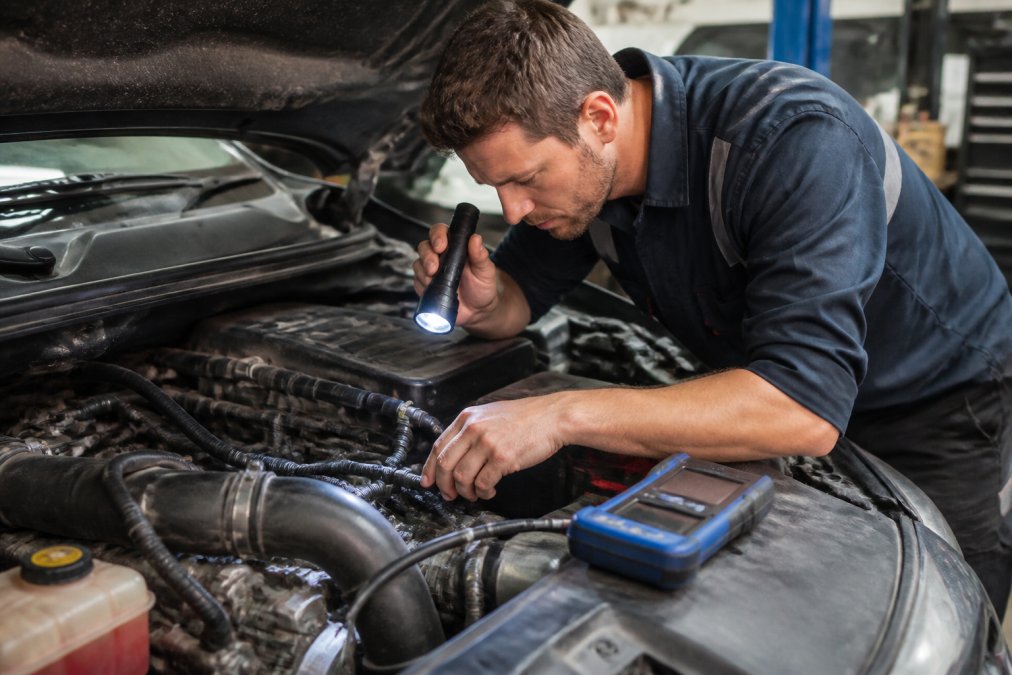
A visual inspection finds what a scanner cannot: cracked wiring, worn belts, oil leaks, and loose connections. Work through the engine bay methodically with a torch, checking the wiring harness, vacuum hoses, and connectors as you go.
Common Causes of Intermittent Electrical Faults in Older Vehicles
Intermittent electrical faults usually come from age-related wear. Heat, vibration, and time break down insulation, loosen grounds, and corrode connectors.
The usual suspects:
- Cracked or chafed wiring in the wiring harness, especially where it bends near the exhaust or rubs against a bracket.
- Corroded or loose ground connections, the single most common cause of phantom electrical faults.
- Failing relays and sensors, particularly those mounted close to heat sources.
- Worn ignition components, coils, leads and plugs that break down under load but test fine cold.
- Faulty powertrain control module connectors, where pin tension weakens with heat cycles.
Why Intermittent Faults Resist Simple Scanning
An intermittent fault often clears before you scan. The ECU only stores a code if the fault repeats within its set conditions. If the fault vanishes, so does the evidence.
Heat-Specific Failure Patterns to Check First in Mildura
Before you chase wiring, check the components Mildura heat punishes hardest:
- Coolant temperature sensor. Drift here causes rich running, poor cold starts and false overheating codes. Compare the sensor reading against actual coolant temperature with an infrared thermometer.
- Crank angle and cam sensors. Heat soak after shutdown is a classic cause of no-start-when-hot faults. If the engine cranks but will not fire after a short stop, suspect these first.
- Ignition coils. Thermal breakdown shows as a misfire under load on a hot day, then disappears overnight.
- Battery and charging system. Heat shortens battery life dramatically. A battery that tests fine at 20°C can fail to crank at 45°C under load.
A Practical Test Sequence
Work in this order to avoid chasing your tail:
- Pull and record every stored and pending code before clearing anything.
- Check battery voltage and charging output first, a weak battery mimics a dozen other faults.
- Wiggle-test the harness and connectors while watching live data, focusing on heat-affected areas.
- Road-test with the scanner logging, ideally in the heat of the day when the fault is most likely to appear.
- Freeze the data the moment the fault triggers, so you have a snapshot to work from.
Do not replace a sensor because a code names it. A crank sensor code can be caused by a wiring fault, a poor ground or a failing ignition switch. Test the circuit before you buy the part.
How Much Does a Car Diagnostic Test Cost in Australia?
A car diagnostic test in Australia typically costs less than the repairs that follow a wrong guess. Exact pricing depends on the workshop, the vehicle, and how deep the diagnosis needs to go. Mallee Auto & Agricultural Services publishes its pricing on its website, so you can see the cost before you book.
| Fault Type | Typical Diagnostic Effort | What It Involves |
|---|---|---|
| Stored fault code | Low | Code retrieval and confirmation |
| Live data fault | Medium | Road test with data logging |
| Intermittent electrical fault | High | Wiggle testing, wiring trace |
| Mechanical fault | Medium to high | Component testing, strip-down |
When to See a Mechanic for Engine Issues
Book a mechanic when the fault involves safety systems, when you lack the tools to test it, or when your own diagnosis has stalled. Some jobs are not worth the risk.
Safety Limits for Home Diagnosis
Stop and hand over the job if any of these apply:
- Fuel system work under pressure
- Airbag or brake system faults
- High-voltage hybrid or electric systems
- Faults you cannot reproduce after two attempts
If you are on a pension, ask about pensioner discounts before you book. Mallee Auto & Agricultural Services offers them.
Farm Machinery and Heavy Equipment: A Different Diagnostic Approach
Farm machinery and heavy equipment need a different diagnostic approach to cars. Tractors and trucks often use manufacturer-specific software, not a standard OBD-II scanner. Faults in these machines are frequently mechanical or hydraulic, not electronic.
Frequently Asked Questions
How do you diagnose engine problems at home?
Start by plugging a scan tool into the OBD-II port and reading the stored diagnostic trouble codes. Note the code numbers rather than replacing parts immediately. Then check the simple things: battery voltage, vacuum hoses, wiring harness connections and fluid levels. A visual inspection often reveals cracked hoses or loose plugs that a code alone will not explain. If the fault returns after clearing codes, or the engine misfires under load, stop and book a professional diagnosis.
When should you stop trying to diagnose an engine issue yourself?
Stop when the fault is intermittent and you cannot reproduce it, when live data shows values outside the manufacturer’s range, or when the repair involves fuel, high-voltage ignition or emissions systems. These areas carry safety and legal risk. In Australia, tampering with emissions control equipment is not something a home mechanic should attempt. If you have replaced two or more parts without fixing the fault, further guessing usually costs more than a proper diagnostic test.
How much does a car diagnostic test cost in Australia?
Diagnostic pricing depends on the fault, the vehicle and how long testing takes. A straightforward scan and fault code retrieval costs less than a full system analysis involving live data, road testing and component testing. Complex intermittent faults take longer to trace. Mallee Auto & Agricultural Services publishes its pricing on the website and offers pensioner discounts, so you can see the rates before booking.
What is the most common cause of engine failure in regional Australia?
Cooling system neglect is the most frequent culprit. Long drives in hot conditions, dusty roads and deferred coolant changes lead to overheating, warped heads and head gasket failure. Missed oil changes and worn timing components follow closely. Regular preventative maintenance, including coolant, oil and belt checks, prevents most of these failures and costs far less than an engine rebuild.
Engine faults rarely fix themselves, and guessing gets expensive fast. If you want a diagnosis you can trust, Mallee Auto & Agricultural Services offers skilled mechanics, modern diagnostic tools, fair pricing with no hidden charges, and pensioner discounts for Mildura and Mallee region residents. Book now with Mallee Auto & Agricultural Services and get your vehicle diagnosed accurately the first time.
