
Table of Contents
- Tractor Engine Problems: Your Step-by-Step Diagnostic Process
- Tractor Won’t Start Troubleshooting: Battery, Fuel and Starting System Checks
- Diesel Tractor Engine Troubleshooting: Beyond the Fuel Filter
- Tractor Engine Overheating Causes and Fixes
- Tractor Engine Losing Power Causes: Fuel, Air and Compression
- When to Call a Mechanic and What to Expect in Mildura
- Conclusion
- Frequently Asked Questions
Last Updated: October 14, 2026
Tractor Engine Problems: Your Step-by-Step Diagnostic Process
A tractor that won’t start or keeps losing power can cost you a full day’s work.
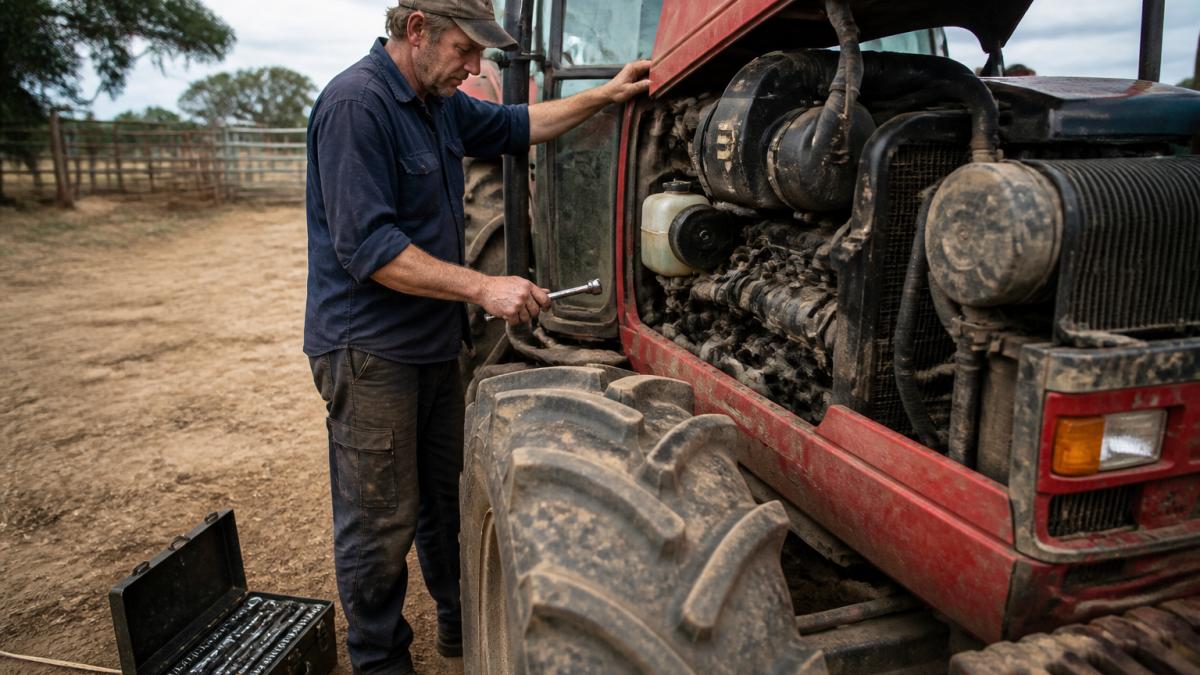
Tractor engine problems are faults that stop an engine from starting, running smoothly, or holding power under load. Most fall into four groups: fuel delivery, air supply, electrical, and mechanical wear.
Safety First: Stop-Work Warnings Before You Begin
Stop the engine and let it cool before you touch anything. A hot exhaust manifold or radiator will burn you, and pressurised coolant can spray when you open a cap too early.
Follow these rules every time:
- Never reach into a running engine or near a spinning fan or belt
- Disconnect the battery negative terminal before working on wiring
- Never open a hot radiator cap; wait until the engine is cold
If you are unsure at any point, stop. A wrong move around fuel or a running engine causes injuries no repair bill is worth.
What You’ll Need: Basic Tools and Prerequisites
Gather your tools before you start so you are not hunting for a spanner mid-job. You will need a socket set, spanners, screwdrivers, pliers, a wire brush, and a multimeter for battery and wiring checks.
You will also want:
- Clean rags and a torch or work light
- A container for draining fuel if needed
- Replacement fuel filters and a spare battery if you have one
Gloves and safety glasses are not optional here: fuel, battery acid and sharp metal all cause real harm.
Tractor Won’t Start Troubleshooting: Battery, Fuel and Starting System Checks
Most no-start faults come down to a weak battery, a blocked fuel supply, a loose connection, or a safety switch that is not made.
Branch 1: No crank (you turn the key and nothing happens)
This is almost always electrical or a safety interlock, not fuel.
- Check the safety switches first. Most tractors will not crank unless the transmission is in neutral, the PTO is disengaged, and the clutch or seat switch is made. A stuck PTO lever or faulty seat switch is a common cause of a “dead” tractor that is otherwise fine.
- Check the battery. Turn on the lights. If they are dim or dead, the battery is flat or the terminals are dirty. Clean the terminals with a wire brush and check the charge with a multimeter. A healthy 12-volt battery should read around 12.6 volts at rest; below about 12.4 volts it is undercharged, and below 12.0 volts it is likely to fail under load.
- Check the starting system. If the battery is fine but you hear a single click, the starter motor or solenoid may be at fault. Check the thick cable from battery to starter for corrosion, and the earth strap from engine block to chassis, a corroded earth strap mimics a flat battery.
- Check the ignition or start relay and fuses. A blown fuse or a failed relay stops the signal reaching the starter. Swap a known-good relay of the same rating to test.
A common mistake is replacing the battery when the real fault is a corroded earth strap or a safety switch. Check the earth connection to the chassis and the PTO/neutral switches before you buy a new battery.
Branch 2: Cranks but will not fire (turns over strongly, no start)
If it cranks strongly, the battery and starter are fine. The fault is fuel, air, or compression.
- Check the fuel level and the fuel valve. A low tank or closed fuel valve is a common cause. Top up and open the valve fully.
- Check fuel flow at the filter. Loosen the fuel line at the filter and turn the engine over briefly. If no fuel comes through, you have a blockage, a blocked filter, or a bad lift pump.
- Check for air in the fuel system. On a diesel, air in the lines after a filter change or a run-dry will stop it firing. Bleed the system according to the workshop manual.
- Check the air filter. A clogged air filter starves the engine of air and makes starting hard. Tap it out or replace it.
- Check the stop solenoid. Many diesel tractors use a fuel shut-off solenoid. If it is not energised, no fuel reaches the pump. Listen for a click when the key is turned on.
Branch 3: Fires then dies (starts, then stalls within seconds)
This usually points to a fuel supply that cannot keep up, or an electrical fault that cuts the stop solenoid once the key returns from start to run.
- Fuel side: a partly blocked filter, a weak lift pump, or air being drawn into the line.
- Electrical side: a faulty ignition switch or a stop-solenoid circuit that loses power in the run position.
- Immobiliser or electronic fault: on modern tractors, a sensor or control-module fault can cut the engine after start. If a warning light is on, read the code before swapping parts.
Stop and call a technician if you smell raw fuel, see fuel leaking onto a hot manifold, or if the engine cranks but the fault is inside the injection pump or electronic control system. Do not keep cranking a diesel with a suspected fuel leak.
Safe Work Australia guidance on machinery safety
Diesel Tractor Engine Troubleshooting: Beyond the Fuel Filter
Diesel engines need clean fuel, no air in the system, good compression and correct timing. A dirty fuel filter is the usual suspect, but not the only one. The table below maps common diesel symptoms to their likely cause and the first check an owner can safely make.
| Symptom | Likely Cause | First Check | Owner or Specialist? |
|---|---|---|---|
| Won’t start, no smoke from exhaust | No fuel reaching injectors | Fuel filter, lines, stop solenoid | Owner |
| Won’t start, white smoke | Air in fuel, glow plugs, low compression | Bleed fuel system, test glow plug circuit | Owner for bleed and glow plugs; specialist for compression |
| Runs rough, white smoke when warm | Water in fuel or bad injector | Drain water trap, inspect fuel | Owner for water trap; specialist for injectors |
| Loses power under load | Blocked filter, air leak, weak lift pump | Fuel flow and air filter | Owner |
| Hard starting when cold | Glow plugs or compression | Glow plug circuit | Owner for glow plugs; specialist for compression |
| Black smoke under load | Over-fuelling or restricted air | Air filter, intake | Owner |
| Blue smoke, oil use | Worn rings or valve guides | Compression test | Specialist |
Air in the fuel system
Air is the most common diesel fault after a filter change or a run-dry: the engine cranks but will not fire, or runs rough and stalls. Bleed the system at the filter and injection pump per the workshop manual. If air keeps returning, check fuel lines and filter housing seals for a small leak drawing air in.
Water contamination
Water in the fuel is a big one in our region. Condensation builds up in tanks overnight and ends up in the injectors. Drain the water trap regularly, weekly during harvest is sensible. If water reaches the injection pump, damage can be expensive, so catch it early.
Glow plugs and cold starting
On a cold Mildura morning, a diesel with failed glow plugs will crank and smoke but not fire. Test the glow plug circuit with a multimeter: each plug should show continuity and draw current. Replace failed plugs as a set.
Injection system faults
If the engine still won’t run after new filters, clean fuel and a proper bleed, the fault may be in the injector pump or injectors. Symptoms include misfiring, knocking and steady power loss. This is a job for a workshop with the right test gear, do not adjust the injection pump yourself.
Compression checks
Low compression from worn rings, a leaking valve or a blown head gasket shows as hard starting, blue smoke and poor power. A compression test needs a diesel gauge and know-how, so leave it to a workshop. If compression is low, the repair is an engine rebuild, not a roadside fix.
Owner-safe diesel checks: fuel level, filter, water trap, bleed, air filter, glow plug circuit. Specialist-only: injector pump, injectors, compression test, electronic control faults. Knowing where to stop saves you from turning a repair into a rebuild.
Kondinin Group machinery research
Tractor Engine Overheating Causes and Fixes
Overheating usually points to a cooling system fault, not the engine itself. Catch it early and you avoid warping the head or cracking a piston.
Check these in order:
- Coolant level: top up only when the engine is cold
- Radiator fins: clean out dust, chaff and seed heads; blocked fins stop airflow
- Fan belt: a loose or worn belt stops the water pump turning
Dusty paddock work clogs radiators fast. Blow them out with compressed air regularly, especially during harvest.
Never remove a radiator cap while the engine is hot. Pressurised coolant can spray and cause serious burns. Wait until the engine is completely cold.
Tractor Engine Losing Power Causes: Fuel, Air and Compression
Power loss under load almost always comes back to one of three things: not enough fuel, not enough air, or worn internal parts.
Fuel side: a partly blocked filter, a weak lift pump, or air getting into the fuel line all cut power.
Here is how to tell them apart:
- Power drops slowly over weeks: likely a filter or air restriction
- Power drops suddenly: likely a fuel line or electrical fault
- Rough running plus blue smoke: likely worn rings or valves
A compression test tells you if the engine internals are worn. It needs a gauge and know-how, so it is often best left to a workshop.
Grains Research and Development Corporation farm machinery advice
When to Call a Mechanic and What to Expect in Mildura
Call a mechanic when the fault is inside the engine, when you lack the tools to test it, or when a simple fix has not worked.
For Mildura and Mallee farmers, downtime during harvest is the real cost.
At Mallee Auto & Agricultural Services, our mechanics work on all vehicle types, including tractors and heavy farm equipment.
If you’re searching for tractor repair near me in Mildura, here is what to expect:
- A clear diagnosis before any work starts
- A ballpark figure so you can decide before committing
- A straight answer on whether the repair is worth it
We stand behind our work. If a repair does not hold up, bring it back and we will sort it.
Safe Work Australia guidance on machinery safety
Conclusion
A tractor that won’t start, overheats or loses power rarely needs a full overhaul. Check the battery, fuel flow, air filter and coolant first, and you will solve most tractor engine problems yourself.
When the fault runs deeper, or when downtime is costing you money, that is the time to bring in a workshop with the right tools. Mallee Auto & Agricultural Services offers accurate diagnostics, fair pricing with no hidden charges, and pensioner discounts for the Mallee community.
Frequently Asked Questions
Why won’t my tractor start?
A tractor that won’t start usually has a flat battery, a clogged fuel filter, or a loose electrical connection. Check the battery charge and terminals first, then confirm the fuel valve is open and fuel is reaching the engine. If the engine turns over but won’t fire, the problem is likely fuel delivery or compression. A mobile mechanic can test the starting system and fuel flow on site.
What should I check first when a tractor engine loses power?
Start with the air filter and fuel filter. A clogged air filter restricts airflow and causes power loss, while a dirty fuel filter limits fuel delivery. Check the fuel level and look for water or debris in the sediment bowl. If filters are clean, inspect fuel lines for cracks or blockages. On common-rail diesel engines, a diagnostic scan can reveal sensor faults that cause derating.
Why is my tractor engine overheating?
Overheating often comes from a blocked radiator core, a faulty thermostat, or low coolant. In dusty conditions, chaff and dirt pack the radiator fins and stop airflow. Check the coolant level, inspect the radiator for debris, and test the thermostat. A slipping fan belt or a failing water pump also reduces cooling. Stop the engine immediately if it overheats to avoid warping the cylinder head.
How can I tell if a tractor engine is seized?
A seized engine will not turn over even with a fully charged battery and good starter. You may hear a single clunk instead of regular cranking. Try turning the crankshaft by hand with a breaker bar; if it won’t budge, the engine is likely seized. Common causes include oil starvation, overheating, or coolant entering the cylinder. A mechanic can confirm with a borescope before you commit to a rebuild.
