
Table of Contents
- Start With What Modern Cars Actually Demand
- Why a 10-Year-Old Workshop Manual No Longer Cuts It
- Check Qualifications, Licences and Industry Credentials
- Match the Workshop to Your Make, Model and Driving Conditions
- Mechanic Diagnostic Equipment: What to Look For on Site
- Questions to Ask a Mechanic Before You Book
- How to Read a Mechanic Repair Quote Line by Line
- Independent Mechanic vs Dealership: Which Fits Your Car?
- Reviews, Referrals and Red Flags That Should Stop You
- Frequently Asked Questions
Last Updated: October 17, 2026
Start With What Modern Cars Actually Demand
Modern cars are computers on wheels, and choosing a mechanic for modern cars means finding someone who can talk to those computers. A 2026 model can run dozens of electronic control units, and fault-finding starts with a scan tool, not a screwdriver.
That shift changes everything about how you pick a workshop. At Mallee Auto & Agricultural Services, a car arrives with a warning light, and the fix depends on reading live data, not guessing. Below, we’ll show you exactly how to shortlist a workshop, question it, and compare quotes without getting burned.
Here’s what most guides get wrong: they treat all mechanics as interchangeable. They’re not.
Why a 10-Year-Old Workshop Manual No Longer Cuts It
A workshop manual from a decade ago won’t help with a car that updates its own software. Electronic systems now control engine timing, braking, steering assist and safety alerts, and each system logs its own fault codes.
The practical difference matters:
- Old approach: listen, guess, replace a part, hope.
- Modern approach: scan, read fault codes, test the circuit, then repair.
A workshop without current software and diagnostic equipment is guessing on your money. That’s the first filter in your shortlist.
Check Qualifications, Licences and Industry Credentials
Ask for credentials before you ask for a price. In Australia, a qualified automotive technician holds a trade qualification, and many hold additional manufacturer or industry certification for specific systems.
What to check:
- Trade qualification and current industry certification
- Membership of a recognised automotive body
- Insurance and a clear complaints process
- Evidence of ongoing training on modern vehicle systems
Credentials tell you the workshop has met a standard. They don’t guarantee great service, but their absence is a red flag worth heeding.
Match the Workshop to Your Make, Model and Driving Conditions
Experience with your make and model matters more than a big sign out the front. A workshop that services mostly one brand family will know its quirks, common faults and parts sources.
Mildura conditions add another layer. Heat, dust and long country runs stress cooling systems, suspension and filters differently from city driving. A good local workshop will factor that into your maintenance schedule.
Ask directly: “How many of this model have you serviced this year?” A vague answer is your answer.
Mechanic Diagnostic Equipment: What to Look For on Site
Walk in and look around. You don’t need to be a technician to spot whether a workshop has real mechanic diagnostic equipment. A modern scan tool, a laptop with current software, and a clean diagnostic bay are the basics.
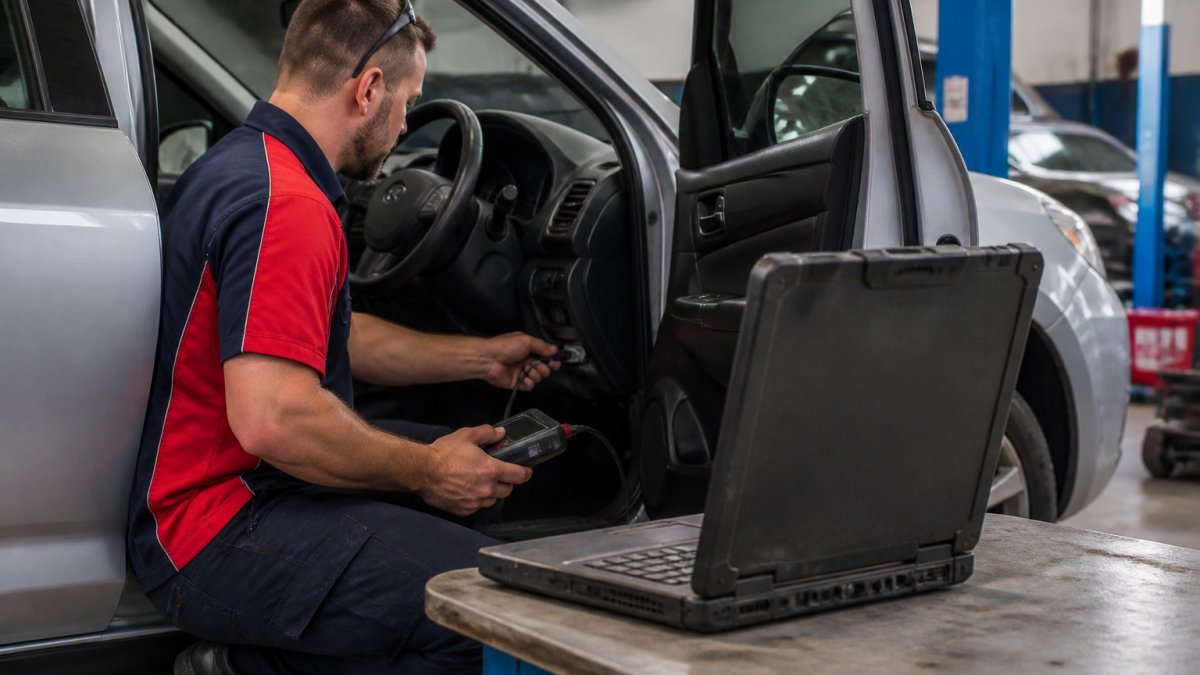
But “has a scan tool” is a low bar. Modern cars need more than a code reader. Use this practical checklist when you visit or call a Mildura workshop.
The scan tool itself
- Multi-system coverage: It should read more than engine codes, transmission, ABS, airbags, body control, climate and infotainment modules all log faults on a modern car.
- Live data and freeze-frame: The tool should display live sensor data and capture the conditions when a fault was set, not just a code number.
- Bi-directional control: Good tools can command actuators (fans, injectors, solenoids) to test a circuit rather than just read it.
- Current software: Ask when the tool’s software was last updated. A scan tool that doesn’t recognise your vehicle’s model year will miss modules and misread codes.
Fault-code interpretation, not just reading
A fault code is a starting point, not a diagnosis. A P0420 code, for example, can point to a catalytic converter, an oxygen sensor, an exhaust leak or a wiring fault. Ask the workshop how they confirm a code before replacing parts. A good answer involves circuit testing, live data comparison and a road test, not “the computer says replace it.”
Software updates and module programming
Many modern vehicles need module software updates or reprogramming after a repair, a new battery may need registration to the charging system, a new sensor may need a learn procedure, and some fixes are software-only. Ask whether the workshop can perform manufacturer software updates and module programming for your make, or whether it sends that work out. If it sends it out, ask how that affects turnaround and cost.
Calibration and ADAS
Advanced driver assistance systems (ADAS), lane-keep assist, adaptive cruise, autonomous emergency braking, blind-spot monitoring, rely on cameras, radar and sensors that need calibration after windscreen replacement, wheel alignment, suspension work or a collision repair. Calibration often needs a controlled space, target boards and manufacturer procedures. Ask whether calibration is done in-house, subcontracted, or included in the quote. A workshop that does this regularly will have examples on hand.
Ask the workshop to show you the calibration certificate or report for ADAS work. A shop that does this regularly will have examples on hand.
Hybrid and EV high-voltage competence
Hybrid and electric vehicles add high-voltage safety requirements. Ask whether technicians hold high-voltage safety training, whether the workshop has the insulated tools and PPE, and whether it can safely isolate and test the high-voltage system. Not every general workshop can, and that’s fine, but you need to know before you book.
The diagnostic process, in writing
Ask the workshop to explain, in plain English, how it will find the fault. A written diagnostic process, scan, test, confirm, quote, repair, verify, is a sign of a professional operation. A verbal “we’ll have a look” is not.
If the workshop can’t explain how it will find the fault, it probably can’t.
Questions to Ask a Mechanic Before You Book
The best questions to ask a mechanic are the ones that reveal process, not personality. Ask how they diagnose, how they quote, and what happens if the repair doesn’t hold.
A short list to take with you:
- How will you diagnose the fault, and is there a diagnostic fee?
- Will I get a written quote before work starts?
- Do you use genuine or quality aftermarket parts, and why?
- Will you call me before doing extra work?
- What warranty do you offer on parts and workmanship?
- Can you explain the repair in plain English?
How they answer tells you more than what they answer.
How to Read a Mechanic Repair Quote Line by Line
A mechanic repair quote should separate labour, parts and any diagnostic charge. If it’s one lump sum with no breakdown, ask for detail before you approve anything.
Check these lines:
- Labour: hours estimated and hourly rate
- Parts: genuine, aftermarket or second-hand, and which
- Diagnostic fee: charged separately or absorbed into the repair
- Extras: consumables, calibration, environmental charges
You have the right to ask for a written quote and to approve work before it proceeds. A workshop that resists that is telling you something.
A Step-by-Step Quote Comparison
Most guides tell you to “compare quotes” without showing you how. Here is a practical method you can use in Mildura this week.
Step 3, Compare on these lines, not on the total.
| What to Compare | What Good Looks Like | Red Flag |
|---|---|---|
| Parts | Named brand, genuine/aftermarket stated | “Parts” with no detail |
| Labour | Hours plus hourly rate | One lump sum only |
| Diagnostic fee | Stated upfront, credited if repair proceeds | Fee appears after the fact |
| GST | Shown separately and correctly | No GST line on a taxable supply |
| Approvals | Written authority before extra work | Bill grows without notice |
| Warranty | Written, parts and labour, stated period | Verbal only |
| Calibration | Listed if ADAS or sensor work involved | Omitted then added later |
Step 4, Ask about the diagnostic fee policy. Some workshops charge a diagnostic fee and credit it against the repair if you proceed; others charge it regardless.
Step 5, Confirm the approval process. Ask: “Will you call me before doing any work beyond the quote?” Get the answer in writing (email or text is fine).
Step 6, Check warranty terms side by side. Compare the period, what’s covered (parts, labour, or both), and whether the warranty is conditional on servicing intervals.
Step 7, Ask each workshop to explain any line you don’t understand. A workshop that can’t explain its own quote in plain English is a risk.
Step 8, Choose on total value, not the lowest number. Factor in diagnostic quality, warranty, parts type, booking availability and transport options.
The cheapest quote often hides the most risk. A quote that skips diagnostic time usually means guesswork, and guesswork gets billed to you twice.
Keep every quote and invoice. If a dispute arises, the ACCC guidance on consumer guarantees and your state consumer affairs office will ask for the paper trail.
Independent Mechanic vs Dealership: Which Fits Your Car?
The independent mechanic vs dealership choice comes down to your car and your priorities. Dealerships carry brand-specific tools and software. Good independents often offer more flexible pricing, faster bookings and a direct relationship with the person doing the work.
For routine servicing and most repairs, a well-equipped independent workshop is a strong choice. For complex warranty work or brand-specific software, the dealership may still be the right call.
Ask any independent whether servicing affects your warranty. Under Australian Consumer Law, you can service outside the dealer network without automatically voiding your warranty, provided the work meets the manufacturer’s specification. Check the ACCC guidance on consumer guarantees if you’re unsure.
Reviews, Referrals and Red Flags That Should Stop You
Reviews and referrals narrow the field, but read them properly. Look for patterns: repeated mentions of surprise charges, poor communication, or repairs that didn’t last.
Red flags worth walking away from:
- No written quote or refusal to itemise
- Pressure to approve work on the spot
- No clear warranty or complaint process
- Vague answers about diagnostic equipment
- No interest in your service history or logbook
Keep your logbook servicing up to date, whether digital or paper. It protects resale value and gives any workshop the history it needs.
The best workshop for your car is the one that can explain its diagnosis, quote in writing, and stand behind the repair. Everything else is noise.
Modern cars punish guesswork, and the wrong workshop costs you twice: once for the failed repair, once for the right one. If you’re in Mildura or the wider region and want a straight answer on what’s wrong with your vehicle, our team at Mallee Auto & Agricultural Services uses modern diagnostic tools to find the fault, quotes the work in writing before we start, and offers pensioner discounts for local residents. We service cars, trucks, farm machinery and motorbikes. Book now and get a clear diagnosis and a fair, itemised quote before any work begins.
Frequently Asked Questions
What should I look for in a mechanic for a modern car?
Look for three things: current diagnostic equipment that can read fault codes and run software updates, experience with your specific make and model, and a willingness to put a written quote in front of you before work starts. Ask whether they handle ADAS calibration and hybrid or EV systems if your car has them. A workshop that explains what it can and cannot do is more trustworthy than one that claims to cover everything.
How can I tell whether a mechanic has the right diagnostic equipment?
Ask directly what scan tool and software they use, and whether it covers your vehicle’s modules, not just engine codes. Modern cars run dozens of electronic control units for ABS, transmission, climate and safety systems, so a basic code reader is not enough. A good sign is a technician who can show you a diagnostic report and explain the fault codes in plain language before quoting any repairs.
Should I choose a dealership or an independent mechanic?
A dealership carries manufacturer-specific tools and software, which suits new cars under warranty or complex recalls. An independent mechanic often costs less on labour and can still log book service your car without voiding the warranty, as long as they follow the manufacturer’s schedule and use suitable parts. Match the choice to your car’s age, warranty status and how specialised the fault is.
How do I compare repair quotes from different mechanics?
Ask each workshop for a written quote that separates labour hours, parts (genuine, aftermarket or second-hand) and any diagnostic fee. Compare the total, not just the headline number, and check whether the quote includes a warranty on workmanship. A cheap quote that uses second-hand parts or skips the diagnostic step can cost more later. Get at least two quotes for anything beyond routine servicing.
