
Table of Contents
- What You’ll Need Before You Start Diagnosing Suspension Noises
- Step 1: Match the Sound to the Suspension Component
- Step 2: How to Check Car Suspension at Home
- Step 3: Spot the Signs of Worn Shock Absorbers
- Step 4: Inspect Sway Bar Links, Ball Joints and Bushings
- When to Stop and Book Suspension Repair in Mildura
- Local Road Conditions and the Cost of Waiting
- Frequently Asked Questions
Last Updated: September 14, 2026
What You’ll Need Before You Start Diagnosing Suspension Noises
Suspension noises are the sounds a vehicle makes when worn or damaged components, shock absorbers, struts, sway bar links, ball joints, bushings, allow metal-on-metal contact or excess movement over bumps and around corners. Catching them early is the difference between a cheap fix and a major repair bill.
This guide walks you through diagnosing strange noises from car suspension, step by step, so you know what you’re dealing with before you book anything in.
Before you start, gather a few basics:
- A torch or headlamp for inspecting the undercarriage
- A tyre pressure gauge and a jack with stands, if you plan to lift the vehicle
- Gloves and a rag
- A helper to bounce the car while you listen
- Your phone, to record the noise and note when it happens
Most home checks take 20 to 30 minutes. Nothing here replaces a proper workshop diagnosis, but it tells you whether you’re looking at a minor annoyance or something needing attention now.
Step 1: Match the Sound to the Suspension Component
Matching the noise to the right component is the fastest way to narrow down the fault. Use the diagnostic table below as a decision tree: start with the sound, add the condition that triggers it, and you land on the most likely culprit.
A guide to vehicle noise diagnosis from the Australian Automobile Association makes the same point: the conditions that trigger a noise matter as much as the noise itself.
Suspension Noise Diagnostic Table
| Sound | When It Happens | Most Likely Component | Why It Makes That Noise | Urgency |
|---|---|---|---|---|
| Clunk or thump | Over bumps, low speed | Sway bar links, bushings, strut mounts | Loose component takes up slack as suspension compresses and rebounds | Moderate |
| Clunk | Over bumps, any speed, feels loose | Worn control arm bushings | Control arm moves laterally in its mount under load | Moderate to high |
| Metallic clang | Sharp bumps, potholes | Broken coil spring, failed strut mount bearing | Metal-on-metal contact as spring or bearing shifts | High |
| Squeak or creak | Cold start, first few bumps, then settles | Dry or perished rubber bushings | Rubber loses grip and rubs against metal | Low to moderate |
| Squeak | Constant, speed-related | Worn wheel bearing (early stage) | Bearing race surface degradation | Moderate |
| Knock or pop | Cornering, especially at full lock | Worn CV joint, failing ball joint | Joint articulation exceeds worn tolerance | High |
| Knock | Cornering, feels vague | Worn ball joint or control arm | Load shifts to worn joint under lateral force | High |
| Rattle | Rough road, light bumps | Worn sway bar link, loose exhaust mount | Small component vibrates freely | Low to moderate |
| Grinding or growl | Constant, changes with speed | Wheel bearing (late stage), brake backing plate contact | Metal-on-metal contact or bearing collapse | High |
| Thud or bang | Large bumps, feels harsh | Bottomed-out shock absorber, collapsed spring | Suspension reaches end of travel | High |
Clunking Over Bumps
A clunk or thump over a bump usually points to worn sway bar links, tired bushings, or a failing strut mount, a loose component taking up slack as the suspension compresses and rebounds. A loud, metallic clunk means the wear is further along.
If the clunk happens on both sides over the same bump, suspect sway bar links or bushings; one side only points to a strut mount or control arm bushing on that corner. Steering wander alongside the clunk makes control arm bushings the prime suspect.
Squeaking and Creaking
Squeaks and creaks are rubber bushings drying out, cracking, or losing grip. They often show up in cold weather or the first few bumps of a trip, then settle. Left alone, dry bushings wear faster and can lead to knocking as play increases.
A common pattern in Mildura is squeaking that appears after a run on dusty or unsealed roads. Fine dust works into the bushing surfaces and accelerates wear. If the squeak is constant and speed-related rather than bump-related, check the wheel bearings before assuming bushings.
Knocking During Cornering
Knocking or popping while turning usually means a worn CV joint, failing ball joint, or control arm issue. This deserves attention quickly, because these parts affect steering response and stability.
If the knock happens only at full lock and is rhythmic, a CV joint is the likely cause. If it happens on moderate cornering and feels like a single pop, suspect a ball joint or control arm bushing. Any knock that comes with steering vagueness or a change in ride height should be treated as a safety issue and inspected professionally before further driving.
Rattle and Grinding Sounds
Rattles over rough road are the least urgent but most annoying: a worn sway bar link or loose exhaust mount can rattle for months while the underlying wear progresses. Grinding or growling that changes with speed is different, usually a wheel bearing on the way out, which can fail suddenly. Do not delay a professional inspection for grinding noises.
Record the noise on your phone before you start. Note the speed, the road surface, and whether it happens turning left, right, or straight. That single clip can cut diagnostic time significantly.
Step 2: How to Check Car Suspension at Home
A bounce test is the simplest way to check car suspension at home, taking about two minutes. Press down firmly on each corner, release, and watch how the body settles: it should rebound once and stop. If it keeps bouncing, the shock absorbers or struts are worn.
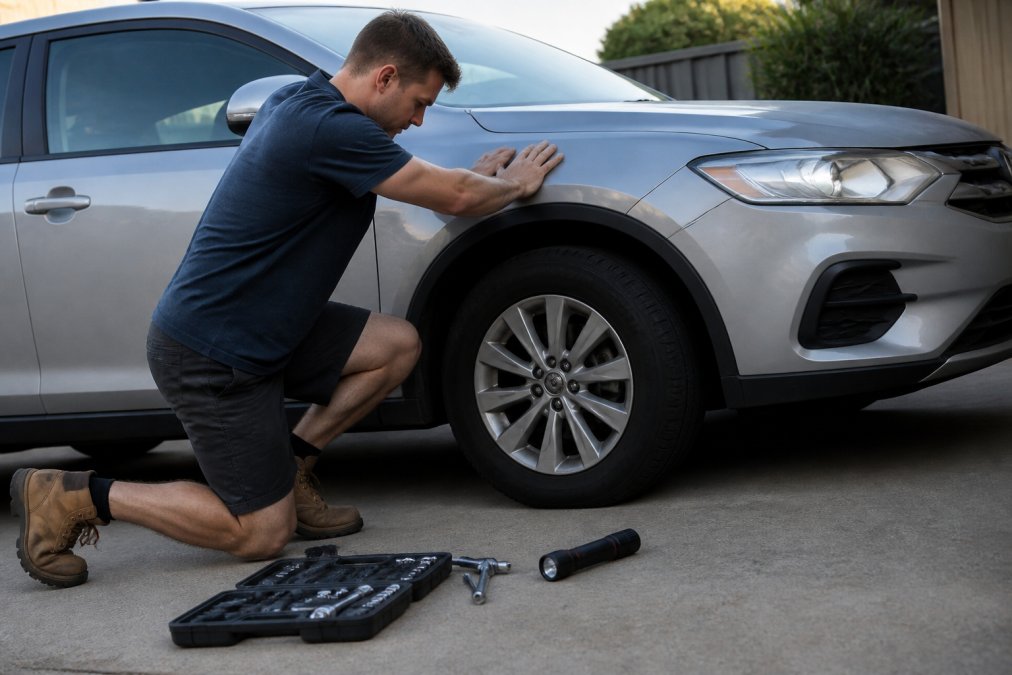
Next, park on level ground and look at the vehicle from the front and side. A car sitting lower on one corner, or with a visible lean, often has a sagging coil spring or collapsed mount. Push and pull each wheel top and bottom; movement beyond a millimetre or two suggests a worn wheel bearing or ball joint.
Finally, check tyre wear. Cupping or uneven patches across the tread are a classic sign that the suspension is no longer holding the tyre flat against the road. A wheel alignment won’t fix this on its own; the worn part has to be replaced first.
Step 3: Spot the Signs of Worn Shock Absorbers
The clearest signs of worn shock absorbers are a bouncy ride, nose-diving under braking, and fluid leakage around the shock body. Shocks control the spring’s movement, so when they fail, the whole vehicle feels unsettled.
Get under the car with a torch and look at each shock and strut. A thin film of oil around the shaft or body is normal on an older vehicle, but a wet, dripping shock is finished. Also check the mounts at the top and bottom for cracked rubber or missing bolts.
On a test drive, find a quiet stretch of road and note how the car behaves over bumps. Good dampening settles quickly; worn shocks float, wallow, or feel vague through the steering. If unsure what “normal” feels like, compare it to how the car drove a year ago.
Step 4: Inspect Sway Bar Links, Ball Joints and Bushings
Sway bar links, ball joints and bushings are the three components most likely to cause a clunk or knock, and all are easy to check with the car safely raised on stands. Grab each sway bar link and try to move it by hand; any rattle or visible play means it’s worn.
For ball joints, look for a torn rubber boot with grease escaping, or rust streaks around the joint. A ball joint with play is a safety issue, not a comfort issue, because a complete failure can separate the wheel from the suspension (nhtsa.gov).
Bushings should look firm and intact. Cracked, perished, or squashed bushings let the control arm and chassis move more than they should, the clunk you hear over bumps. Fresh rust or impact damage underneath is worth flagging to your mechanic too.
Never put your hands or body under a vehicle supported only by a jack. Use axle stands on firm, level ground, and if you’re unsure, leave the inspection to a workshop.
When to Stop and Book Suspension Repair in Mildura
Stop your DIY diagnosis and book suspension repair in Mildura immediately if you find visible play in a ball joint, a leaking shock or strut, a cracked coil spring, or steering that feels loose or wanders. These aren’t jobs to put off or attempt in a home driveway without the right equipment.
A professional inspection uses a hoist and modern diagnostic tools to load each component and reproduce the noise under controlled conditions, a noise you can only hear at 60 km/h on a rough road is almost impossible to trace by hand.
If you’ve been burned before by a mechanic who padded the bill, ask for a written diagnosis naming the specific worn part and why it needs replacing. A trustworthy workshop walks you through what it found and what it didn’t. Mallee Auto & Agricultural Services offers fair pricing with no hidden charges and is committed to your complete satisfaction.
Record the noise on your phone before you book in. Note the speed, the road surface, and whether it happens turning left, right, or straight. That single clip can cut diagnostic time significantly.
Local Road Conditions and the Cost of Waiting
Local road conditions around Mildura and the wider Mallee region put extra strain on suspension components. Long highway stretches, unsealed farm access roads, and the heat that builds up under a vehicle in a Mallee summer all accelerate wear on bushings, mounts, and shock absorbers.
That’s the part most generic guides miss. A suspension that would last years in a city can wear noticeably faster here, especially on vehicles that regularly tow trailers, carry loads, or travel gravel roads to reach properties.
What Makes Mildura Roads Different
The Mallee’s road network has a few characteristics that matter for suspension life:
- Unsealed access roads. Properties off the Sturt Highway and around areas like Merbein, Red Cliffs, and Irymple are often reached by gravel or dirt tracks. Corrugations and potholes on these surfaces work bushings and shock absorbers far harder than sealed roads.
- Long highway runs. The Sturt Highway and Calder Highway carry a lot of traffic at sustained speed. Heat build-up in shock absorbers over long distances shortens their service life, especially in summer.
- Thermal cycling. Mallee summers regularly push past 40°C, and winter nights can drop close to freezing (bom.gov.au). That daily expansion and contraction cycle hardens rubber bushings and can cause seals to weep.
- Dust ingress. Fine Mallee dust works into bushings, ball joint boots, and CV joint gaiters. Once inside, it acts like an abrasive paste and accelerates wear.
- Towing and load carrying. Many Mildura vehicles tow trailers, caravans, or farm equipment. That extra load transfers directly through the suspension and shortens component life.
The Cost of Waiting
Waiting makes the cost worse, not better. A worn sway bar link is a small job; let it go and the extra movement works on the control arm bushings, strut mounts, and eventually the tyres. What began as one part becomes four.
A common Mallee pattern: a vehicle develops a light clunk after a season of gravel-road use, the owner waits until the next service, and by then the clunk has become a knock and the control arm bushings are also worn. The repair bill is often several times what it would have been if the link had been replaced when the noise first appeared.
Pensioner Discounts and Farm Vehicle Considerations
If you’re on a pension, ask about pensioner discounts before you book; they can make a real difference to the final bill. Mallee Auto & Agricultural Services offers pensioner discounts. If your tractor or farm truck is making the noise, tell the workshop up front so it can allocate the right equipment and get you back to work faster, agricultural vehicles have different suspension designs and load characteristics, and a workshop that understands both passenger cars and farm machinery diagnoses more efficiently.
Suspension noises rarely fix themselves. The earlier you identify the worn component, the smaller the repair, and the sooner your vehicle is safe on the road again.
Frequently Asked Questions
What are the three common suspension noises?
Most suspension noises fall into three groups. Clunking or thumping usually points to worn sway bar links, control arm bushings or struts. Squeaking and creaking often comes from dry or perished rubber bushings and ball joints. Knocking during cornering typically signals a failing CV joint or worn ball joint. Matching the sound to the component narrows down the fault before you even jack up the car.
Are suspension noises dangerous to ignore while driving in regional Victoria?
Yes. A worn ball joint can separate completely, causing loss of steering control. Worn shock absorbers also increase braking distance and reduce grip on uneven surfaces. On regional roads with potholes and gravel shoulders, the risk is higher. If you hear clunking, knocking or metal-on-metal grinding, get the vehicle inspected promptly rather than waiting for the next service.
What does a failing shock absorber sound like?
A failing shock absorber often produces a clunking or thudding sound when you drive over speed humps or rough patches. You may also hear a knocking noise over small bumps. Other signs of worn shock absorbers include fluid leakage on the shock body, excessive bouncing after you push down on the corner, and uneven tyre wear. A bounce test is a quick way to check at home.
How do I know if my car needs suspension repair in Mildura?
Book a professional inspection if you notice any of these: persistent clunking, knocking or squeaking, steering that feels vague, the car pulling to one side, uneven or cupped tyre wear, or visible fluid on the shocks. A mechanic can put the vehicle on a hoist and check ball joints, bushings, sway bar links and struts under load, which is far more accurate than a driveway check.
