
Table of Contents
- Why Diesel Fuel Efficiency Matters for Australian Truck Owners
- The Impact of Tyre Pressure on Fuel Economy
- Driving Habits That Waste Diesel Fuel
- Load Management and Aerodynamic Drag
- Best Diesel Fuel Additive Australia: Do They Work?
- Diesel Truck Maintenance Schedule Victoria Owners Should Follow
- Common Mistakes to Avoid When Trying to Save Fuel
- Conclusion
- Frequently Asked Questions
Last Updated: September 4, 2026
Why Diesel Fuel Efficiency Matters for Australian Truck Owners
Fuel is typically the largest single operating cost for any heavy vehicle, so improving diesel truck fuel efficiency in Australia directly impacts your bottom line. For operators in the Mallee region, where runs between Mildura, Broken Hill, and the Riverland stretch for hundreds of kilometres, small percentage gains translate into meaningful dollars saved each week.
At Mallee Auto & Agricultural Services, we service trucks and farm equipment across Mildura and surrounding districts. Our mechanics repeatedly see vehicles losing efficiency not through major mechanical failure, but through neglected basics that compound over time. A truck running 5% less efficiently than it should costs its owner thousands per year in wasted fuel.
The good news is that most efficiency losses are preventable. Below, we’ll show you exactly how to improve diesel truck fuel efficiency in Australia through driving technique, maintenance discipline, and understanding what works in our climate.
The Impact of Tyre Pressure on Fuel Economy
Tyre pressure is the single fastest way to improve diesel truck fuel efficiency in Australia, yet it is the most commonly overlooked factor. Under-inflated tyres increase rolling resistance, forcing the engine to work harder and burn more fuel to maintain speed.
The impact of tyre pressure on fuel economy is straightforward physics: a soft tyre flattens at the contact patch, creating more friction with the road surface. This effect magnifies under heavy loads across hot Outback roads, where heat raises internal tyre temperatures and accelerates pressure loss.
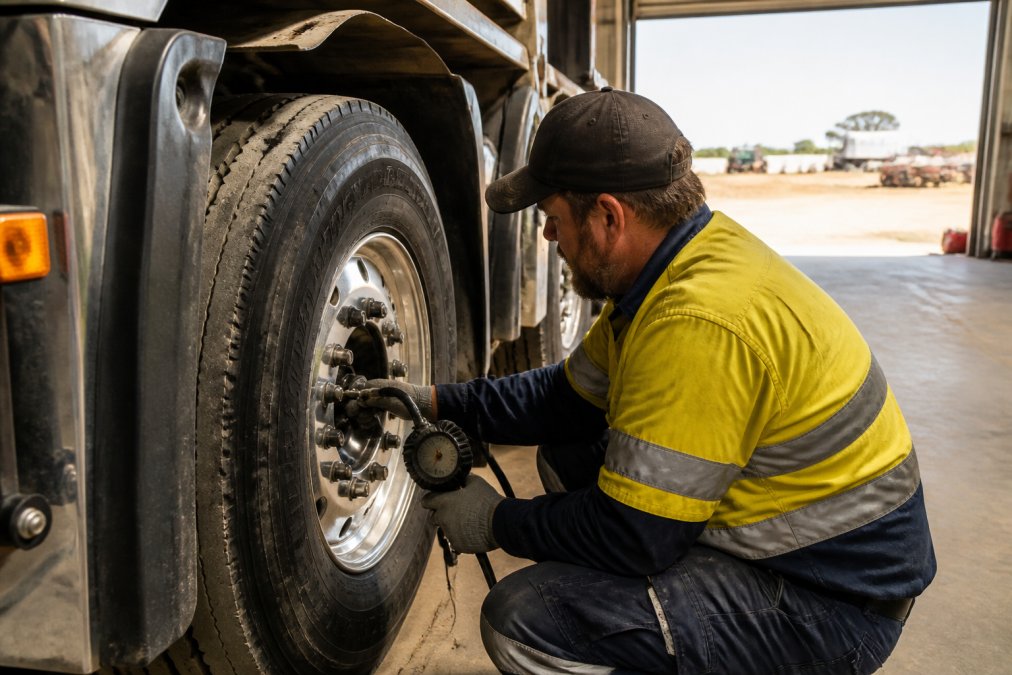
Check pressures weekly, always when tyres are cold, and adjust for load. Most fleets run a dual-pressure system: higher pressures for laden highway work, lower for empty running. According to guidance from the Australian Trucking Association on tyre management, correct tyre inflation also extends casing life, which matters when replacement tyres cost over a thousand dollars each. If you are searching for diesel truck maintenance near me, ask your mechanic to verify pressures during routine services.
Running a truck on under-inflated tyres at highway speed generates excessive heat that can cause a blowout, especially in summer conditions around Mildura where ambient temperatures regularly exceed 40 degrees. A blowout at 100 km/h with a loaded trailer is not a fuel problem; it is a safety emergency.
Driving Habits That Waste Diesel Fuel
Driving technique influences fuel consumption more than any single mechanical factor. Aggressive acceleration, late braking, and excessive speed all burn diesel that careful driving would preserve. For operators running the long, hot stretches between Mildura, Broken Hill, and the Riverland, mastering these habits is about saving money and managing heat and safety.
Mastering Cruise Control and Gear Selection
Cruise control earns its keep on long, flat stretches of the Sturt Highway, maintaining a steady throttle position and avoiding the micro-adjustments that creep fuel use upward. However, it struggles on undulating terrain, where it tends to hold gears longer and rev higher than a skilled driver would. In the rolling country south of Mildura, a driver who anticipates a climb and manually selects the right gear before the engine lugs will burn less fuel than a system reacting after the fact.
Manual gear selection often beats automation in hilly country. The goal is to keep the engine in its most efficient RPM range, typically the lower half of the torque band, by changing up early while maintaining enough revs to hold speed on inclines. A good rule of thumb is to shift when the engine reaches peak torque, not peak power.
Reducing Idling and Anticipatory Driving
Idling is pure waste. A heavy-duty diesel burns fuel every minute it sits with the engine running, delivering no distance in return. In the Mildura heat, idling also places extra load on the cooling system and can accelerate DPF clogging due to low exhaust temperatures.
Anticipatory driving means reading the road ahead. Easing off the throttle early for a red light, a queue, or a slowing vehicle ahead lets engine braking do the work instead of the service brakes. Every time you brake, you convert the kinetic energy that fuel purchased into heat. Transport for NSW driver training materials consistently emphasise that smooth, planned driving reduces both fuel use and brake wear.
A driver logging 2,000 kilometres per week can save roughly a tank of fuel per quarter simply by reducing idling time by 30 minutes per day and maintaining a steady speed on the highway. That is not a small number over a year of operation.
The High-Heat Driving Technique for Outback Conditions
Most generic advice ignores the challenge of driving in sustained 40-degree heat, when a truck’s cooling system is working at its limit. A technique we recommend to local operators is to manage engine load proactively: on a long climb, back off the throttle slightly before the coolant temperature spikes, rather than waiting for the fan to roar and the gauge to climb. This prevents a high-load, high-fuel condition and reduces stress on the cooling system.
Another local factor is wind. The Mallee is flat and open, and strong crosswinds are common. A driver fighting a crosswind with constant steering corrections burns extra fuel. Slowing down by 5 km/h in high wind often results in better fuel economy and less driver fatigue than maintaining speed with constant corrections.
Load Management and Aerodynamic Drag
Every extra kilogram you carry costs fuel. Load management starts at the loading dock: distribute weight evenly, secure it properly, and remove anything you do not need for the trip. Carrying unnecessary tools, spare parts, or empty pallets adds rolling mass that the engine must move.
Aerodynamic drag becomes the dominant resistance factor above 80 km/h. Roof deflectors, side skirts, and gap reducers between cab and trailer all cut drag. Retrofitting them often pays for itself within a year of highway running.
Speed adaptation is the cheapest aerodynamic modification available. Reducing cruising speed from 100 km/h to 90 km/h produces meaningful fuel savings because drag increases with the square of speed. On a 500-kilometre run, that 10 km/h reduction adds roughly 30 minutes to the trip but can cut fuel use substantially.
Best Diesel Fuel Additive Australia: Do They Work?
The market for the best diesel fuel additive Australia offers is crowded, with claims ranging from cetane boosting to injector cleaning. The honest answer is that additives deliver real but modest benefits, and only in specific circumstances.
Quality fuel additives can help in three situations: cleaning carbon deposits from injectors and combustion chambers, preventing fuel gelling in winter, and lubricating the fuel system in older engines running on low-sulphur diesel. A diesel decarbonizer used periodically can restore lost combustion efficiency in engines that have accumulated deposits from extended idling or light-load running.
What additives cannot do is fix mechanical problems. A clogged fuel filter, worn injectors, or a failing turbocharger will not respond to a bottle of additive. Diagnose the mechanical issue first before spending money on treatments.
The Australian Government’s fuel quality standards information sets out what is legally permitted in diesel sold in Australia. Stick to additives from established brands and follow dosing instructions carefully; over-treating can harm injector performance rather than help it.
Diesel Truck Maintenance Schedule Victoria Owners Should Follow
A structured maintenance schedule is the backbone of fuel efficiency. Diesel truck maintenance schedule Victoria operators should follow mirrors the manufacturer’s service intervals but accounts for local conditions: high ambient temperatures, dusty roads, and heavy loads. A schedule tuned for the Mallee keeps your fuel economy from degrading between services.
A Practical Maintenance Schedule for Mallee Operators
Here is a practical schedule we recommend to operators running in the Mildura region. It supplements, rather than replaces, the manufacturer’s schedule:
- Daily (Driver Check): Check tyre pressures when cold, inspect for cuts or damage, check for fluid leaks, and verify no warning lights are on.
- Weekly: Check engine oil level, coolant level, and air filter restriction indicator if fitted. In dusty conditions, inspect the air filter housing for dust ingress.
- Monthly: Inspect and clean the air filter if it is a reusable type, or replace it if it is a paper element and the restriction indicator shows high. Check belt tension and condition. Inspect the fuel filter water separator and drain any water.
- Every 10,000 km or 3 months (whichever comes first): Replace the fuel filter. This is critical in our region, where fuel contamination from dust and condensation is common. Replace the oil and oil filter if your operating conditions are severe (high dust, heavy loads).
- Every 20,000 km or 6 months: Replace the oil and oil filter. Inspect the cooling system, including the radiator fins for blockages from insects and debris. Check all hoses for cracks.
- Every 50,000 km or annually: Inspect and clean the EGR valve and the DPF if your truck is so equipped. Have a professional check injector performance and turbocharger boost pressure.
Air Filters, Fuel Filters, and Injectors
The air filter is your engine’s first line of defence. A clogged air filter restricts airflow, upsetting the air-fuel ratio and forcing the engine to work harder. In dusty conditions around Mildura, filters load up faster than the standard service interval suggests, so inspect them monthly during harvest season. A common mistake is using a cheaper, non-genuine filter that does not seal properly, allowing dust to bypass the filter and score the turbocharger and cylinder walls, a catastrophic failure no fuel additive can fix.
Fuel filters protect injectors from contamination. Water and particulates in diesel cause injector wear, poor atomisation, and incomplete combustion. The fuel filter is cheap; injectors are not. Replace it on schedule with quality parts. In the Mallee, where fuel may sit in tanks for extended periods, condensation can introduce water into the fuel system. Draining the water separator monthly is a simple, high-value habit.
Fuel injectors deliver the precise spray pattern that modern diesel combustion depends on. Worn or fouled injectors produce incomplete combustion, visible as black smoke under acceleration and rising fuel consumption. Professional cleaning or replacement restores combustion efficiency. A simple diagnostic check is to monitor fuel trims with a professional scan tool; a significant deviation from factory spec signals that injectors need attention.
Modern DPF and AdBlue System Health
Modern diesel trucks carry emissions systems that directly affect fuel economy. The diesel particulate filter traps soot and periodically burns it off through regeneration, which injects extra fuel to raise exhaust temperature. A DPF that cannot regenerate properly forces more frequent and longer regeneration cycles, hurting fuel economy.
A key issue in our region is the short, low-load running that service trucks and farm vehicles do, which prevents the DPF from reaching its regeneration temperature. If your truck is used for short runs, schedule a regular highway run at operating temperature to allow passive regeneration. Ignoring this leads to a clogged DPF, requiring expensive forced regeneration or replacement.
AdBlue systems reduce nitrogen oxide emissions but add their own failure modes. A faulty AdBlue injector or sensor can trigger derate modes that limit engine power and increase fuel consumption. A common problem is crystallisation of AdBlue around the injector nozzle, which can be prevented by ensuring the system is used regularly and not allowed to run dry. If your truck shows emissions system warnings, address them promptly rather than ignoring them. information from the Australian Government on diesel vehicle emissions standards explains how these systems work and why maintaining them matters for both compliance and efficiency.
A DPF that is repeatedly failing to regenerate will eventually clog to the point where the truck enters a derate mode, limiting speed to as low as 20 km/h. This is not a minor inconvenience; it is a breakdown that will cost you a day of downtime and a significant repair bill. If your truck is doing frequent short runs, a weekly highway drive is not optional, it is a maintenance requirement.
Using Telematics and Diagnostic Tools for Maintenance
Modern trucks are equipped with sensors that can tell you a lot about fuel efficiency. A simple OBD-II scanner can read real-time fuel consumption, coolant temperature, and DPF status. Using this data to inform your maintenance schedule is a powerful way to catch problems early. For example, a gradual increase in fuel consumption over a month, even with the same driving patterns, is a clear signal that something is degrading, be it a filter, an injector, or a sensor. Tracking this data is the most direct way to measure the impact of your maintenance and driving habits.
Common Mistakes to Avoid When Trying to Save Fuel
The most common mistake we see is chasing fuel savings through products rather than process. Owners buy additives, fit magnetic fuel savers, or install questionable electronic devices, hoping for a miracle. Meanwhile, their tyre pressures sit low, their air filters clog, and their drivers accelerate hard away from every intersection.
Another frequent error is skipping maintenance to save money. Delaying an oil change, running a clogged filter, or ignoring a warning light rarely saves anything once the repair bill arrives. Preventative maintenance is always cheaper than breakdown repairs, particularly for trucks that work through harvest when downtime costs far more than parts.
A third mistake is treating every truck the same. A B-double hauling grain to the silos needs different tyre pressures and driving techniques than a service truck running local calls. Understand your specific operation and tune your approach accordingly.
Conclusion
Improving diesel truck fuel efficiency in Australia comes down to disciplined basics: correct tyre pressures, smooth driving, proper load management, and a maintenance schedule that matches your operating conditions. None are glamorous, but together they deliver savings that compound weekly.
The team at Mallee Auto & Agricultural Services in Mildura understands local operating conditions because we live and work in them. Our mechanics use modern diagnostic tools to identify issues affecting your fuel economy, and we stand behind our work with fair, transparent pricing. Pensioner discounts are available, and we service trucks, farm equipment, and all vehicle types across the Mallee region.
Get started with Mallee Auto & Agricultural Services and book your truck in for a fuel efficiency check. We will inspect your tyres, filters, and emissions systems to make sure nothing is silently burning your profits.
Frequently Asked Questions
How to make a diesel truck more fuel-efficient?
The most effective way to improve diesel fuel efficiency is a combination of consistent tyre pressure checks and a proactive diesel truck maintenance schedule. In Victoria, that means servicing air and fuel filters on time and keeping injectors clean. Driving style also plays a major role. Smooth acceleration, using cruise control on highways, and avoiding unnecessary idling can cut fuel consumption.
What is the best diesel fuel additive in Australia?
The best diesel fuel additive in Australia depends on your truck’s needs. Look for a product that cleans fuel injectors and prevents deposit buildup, as this directly affects combustion efficiency. Quality additives can also improve the lubricity of low-sulphur diesel, which is common here. Fuel system maintenance with a good additive is a practical approach, but it will not fix underlying mechanical issues.
Does regular maintenance impact diesel truck fuel consumption?
Yes, regular maintenance has a direct impact on diesel fuel consumption. A clogged air filter restricts air intake and forces the engine to work harder, which burns more fuel. Similarly, a dirty fuel filter can starve the injectors and reduce engine performance. Following a recommended diesel truck maintenance schedule keeps these components working efficiently and protects your fuel economy.
What driving habits most affect diesel fuel efficiency?
Speed adaptation and gear selection are the two habits that affect diesel fuel efficiency the most. Driving at 100 km/h instead of 110 km/h on the highway can reduce fuel consumption noticeably because aerodynamic drag increases with speed. Also, shifting up early to keep the engine in its most efficient RPM range, usually between 1,200 and 1,500 RPM for highway cruising, reduces engine load and saves fuel.
This article was written using GrandRanker
