
Table of Contents
- Signs Your Mechanic Is Overcharging You
- Lack of Itemised Invoices and Hidden Costs
- How to Read a Mechanic Invoice
- Unnecessary Repairs and High-Pressure Sales Tactics
- What to Ask Your Mechanic Before Service
- Understanding Labour Rates and Parts Markup
- Consumer Rights for Car Repairs in Victoria
- How to Compare Quotes and Get a Second Opinion
- Frequently Asked Questions
Last Updated: September 22, 2026
Signs Your Mechanic Is Overcharging You
Getting overcharged at a repair shop is frustrating. The good news is that signs your mechanic is overcharging you aren’t difficult to spot once you know what to look for. Most dodgy mechanics use the same tactics repeatedly, counting on customers not understanding invoices or feeling too awkward to ask questions. At Mallee Auto & Agricultural Services, we believe in transparent pricing and honest communication, ensuring all vehicle types run smoothly, safely, and efficiently for the community. Below, we’ll walk through the most common warning signs that your mechanic is overcharging you, how to read invoices properly, and what consumer rights protect you.
Lack of Itemised Invoices and Hidden Costs
A proper invoice breaks down exactly what you paid for. An itemised invoice should show each part replaced with its cost, labour time and hourly rate, diagnostic fees clearly separated, and any additional charges explained. If your invoice just says “Engine repair: $800” with no breakdown, you have no way to verify if that’s fair.
Hidden costs are another common tactic. You agree to a service for $200, then the mechanic calls mid-job claiming they found extra problems and the bill jumps to $600. A trustworthy shop will call and explain the problem before starting extra work.
If a mechanic refuses to provide a written, itemised invoice before work starts, walk away. This is a sign they’re not confident in their pricing and may be padding the bill.
Request a detailed estimate in writing before any work begins. This protects both you and the shop by setting clear expectations upfront.
How to Read a Mechanic Invoice
Understanding your invoice is the best defence against overcharging.
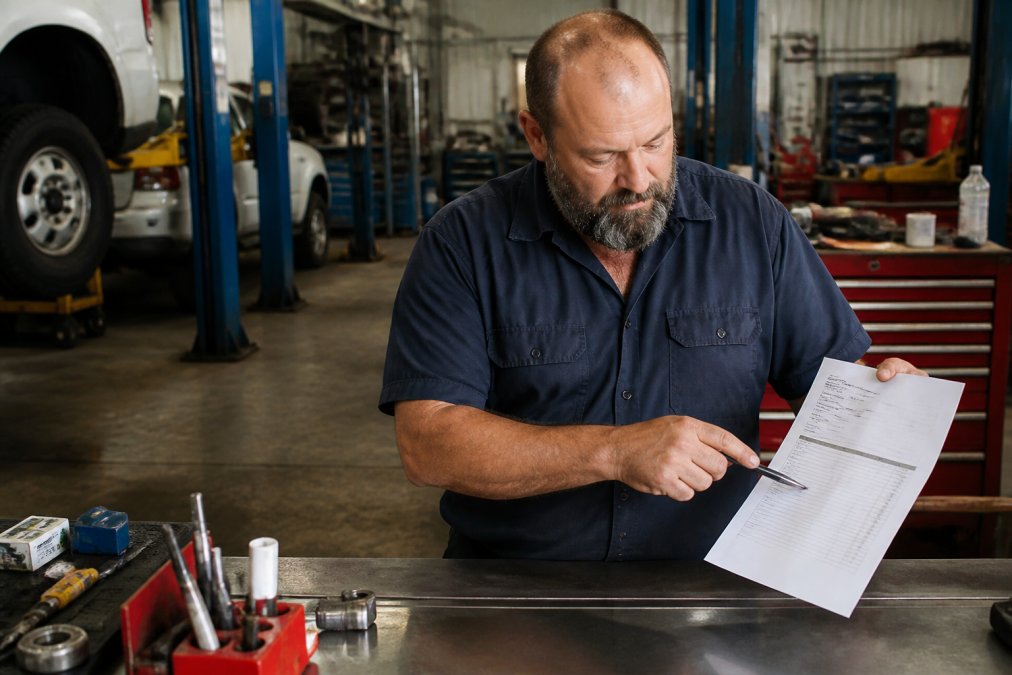
Check the parts section first. Each part should be listed by name, part number, and cost.
Look at labour charges next. The invoice should show the hourly rate, hours spent on each task, and what work was done. A standard oil change takes 30 minutes; if your invoice shows 2 hours, something’s wrong. Compare quoted time to industry standards.
Check diagnostic fees.
Verify the warranty or guarantee. Reputable shops stand behind their work with a written warranty.
Keep all invoices in a folder. Over time, you’ll spot patterns. If one mechanic consistently charges double what others charge for the same work, you’ve found your answer.
Unnecessary Repairs and High-Pressure Sales Tactics
Unnecessary repairs often target customers who don’t understand their vehicles. A mechanic might spot a minor issue and describe it in alarming terms, “Your brake pads are at 4mm. They’re almost gone. Safety risk.”, when in reality, most brake pads are safe until they reach 2-3mm.
High-pressure sales tactics make it worse, with artificial deadlines like “I can only fit you in today” forcing you to decide without thinking.
Preventative maintenance is important, but not every suggested service is urgent. Some shops recommend expensive flushes and treatments that your vehicle manual doesn’t mention.
If a mechanic recommends a repair that wasn’t in your original quote or service logbook, ask for a written explanation of the problem and why it needs fixing now. Get a second opinion before approving work that costs more than $500.
Common unnecessary repairs include fuel system flushes, transmission flushes, premium oil upgrades when standard oil is specified, cabin air filters, and engine flushes.
What to Ask Your Mechanic Before Service
Asking the right questions protects you before work begins. A good mechanic welcomes questions. A dodgy one gets defensive or dismissive.
Before dropping your vehicle off, ask these questions:
-
“What exactly needs fixing, and why?” Demand a clear explanation, not technical jargon. Ask them to show you the problem.
-
“Is this repair urgent, or can it wait?” Understand whether you’re facing a safety issue or routine maintenance.
-
“What’s the hourly labour rate?”
-
“How long will this take?” Get a time estimate in writing and compare it to industry standards. A standard oil change should take 30-45 minutes.
-
“Will you call me if you find additional problems?” A reputable shop will never start extra work without your explicit approval. Get this commitment in writing on your work order.
-
“Do you use genuine or aftermarket parts?” Ask for the price difference.
-
“What’s your warranty on this work?” Get the warranty terms in writing.
-
“Can I see the old parts after you replace them?” This proves the work was actually done. Request this in advance so the mechanic sets the parts aside. Reputable shops do this routinely; dodgy mechanics often refuse or claim they’ve already disposed of the parts.
The Digital Proof Question: Photos and Video Evidence
One question separates trustworthy mechanics from those cutting corners: “Can you show me photos or video of the problem before you start work?” A mechanic should be able to show you photos of the fault, video of the malfunction (for electrical or performance issues), and before-and-after photos after completing the repair.
A mechanic who refuses to provide photographic or video evidence is either hiding the fact that the problem is minor, rushing through diagnostics, or relying on customer confusion to justify unnecessary work. Reputable shops use digital documentation as standard practice.
When you pick up your vehicle, ask for digital copies of all photos and videos taken during the repair. Store these with your invoice. If a problem recurs, you have evidence of what was supposedly fixed.
Getting Commitments in Writing
Don’t rely on verbal promises. Before work begins:
- Ask the mechanic to write the labour rate, estimated hours, and parts cost on your work order
- Request a note stating they will call before starting any work not listed in the original quote
- Ask them to confirm they will provide photos of the fault and before-and-after images
- Get the warranty terms written on the invoice
A mechanic who refuses to put these commitments in writing is signalling that they may not honour them. Walk away.
At Mallee Auto & Agricultural Services in Mildura, we provide detailed written quotes before any work begins and welcome all questions about pricing and process. We’re happy to discuss your options and answer questions about pricing. If you’ve received a quote elsewhere that seems high, bring it in and we’ll review it honestly.
Understanding Labour Rates and Parts Markup
A fair labour rate depends on location, specialisation, reputation, and vehicle complexity.
Ask the mechanic the part cost and markup percentage, then search online to compare.
Fair pricing means transparent labour rates and reasonable parts markups. Dodgy mechanics hide both and rely on customer confusion to inflate bills.
Consumer Rights for Car Repairs in Victoria
Victoria’s consumer protection laws give you strong rights when dealing with repair shops. Understanding these protections and knowing how to enforce them is essential if you suspect overcharging.
The Australian Consumer Law applies to all repair services in Victoria.
What to Do If You’ve Already Been Overcharged
Step 1: Document everything. Gather your original quote, final invoice, photos of your vehicle before and after repair, and any written communication with the mechanic.
Keep all documentation in one folder: original quote, invoice, photos, emails, and any written responses from the mechanic. This evidence is essential if you need to lodge a formal complaint or pursue a claim.
What Mechanics Must Disclose
Under Victorian consumer law, mechanics must disclose:
- Hourly labour rates before work begins (must be displayed visibly in the workshop)
- Parts costs and markups if you ask
- Warranty terms in writing
- Any diagnostic fees upfront
- Changes to the original quote if the final bill will exceed the estimate by more than 10%
If a mechanic refuses to disclose these details, that’s a red flag and grounds for complaint to Consumer Affairs Victoria.
If a mechanic pressures you to pay before you’ve reviewed the invoice, or refuses to provide an itemised breakdown, do not pay. This behaviour violates consumer law and suggests the charges may not withstand scrutiny.
How to Compare Quotes and Get a Second Opinion
Never accept the first quote. Getting multiple quotes is the simplest way to spot overcharging.
| Shop | Labour Rate | Estimated Hours | Parts Cost | Total Quote |
|---|---|---|---|---|
| Shop A | $100/hr | 3 hours | $250 | $550 |
| Shop B | $110/hr | 2.5 hours | $280 | $555 |
| Shop C | $95/hr | 8 hours | $150 | $910 |
Frequently Asked Questions
How can I tell if a mechanic in Mildura is overcharging me?
Compare your invoice against quotes from other repair shops for the same work. Check that labour rates align with industry standards and that parts are itemised separately from labour. Request a written estimate before work begins, and ask the mechanic to explain any diagnostic fees. Overcharging often shows up as vague line items, inflated labour hours, or parts costs significantly higher than retail prices. If you’re unsure, request the old parts back and have them inspected independently.
What consumer rights do I have for car repairs in Victoria?
Under the Australian Consumer Law, you have the right to expect repairs to be carried out with due care and skill, and to receive goods and services at a fair price. Repair shops must provide a written estimate before work begins unless you’ve agreed otherwise. If a mechanic recommends repairs beyond your authorisation, they cannot charge you for that work. You can request a refund or credit if work is faulty or unnecessary. If you believe you’ve been overcharged, contact the Victorian Civil and Administrative Tribunal (VCAT) for guidance.
What should I ask my mechanic before service?
Always ask for a written estimate before work starts, including labour hours and parts costs separately. Request an explanation of what’s wrong with your vehicle and why repairs are necessary. Ask whether the work is urgent or can wait, and whether any parts carry a warranty. Clarify the hourly labour rate and whether diagnostic fees are included in the final bill or charged separately. Ask if you can have old parts returned so you can inspect them. Finally, confirm how long the repair will take and when your vehicle will be ready.
Are there standard labour rates for car repairs in Victoria?
Labour rates vary by repair shop, vehicle type, and repair complexity. Ask your mechanic for their hourly rate upfront and request an estimate of how many hours the job will take. Always request a written estimate so you can compare labour costs across different shops before committing to repairs.
