
Table of Contents
- Signs Your Car Needs Brake Replacement
- How to Inspect Brake Pads Without Removing Wheels
- Average Brake Pad Lifespan and Replacement Intervals
- Signs of Worn Brake Rotors
- DIY Inspection vs. Professional Brake Assessment
- Brake Pad Materials and Why They Matter
- Conclusion
Last Updated: August 15, 2026
Signs Your Car Needs Brake Replacement
Your brakes are the most critical safety system on your vehicle. Recognising when your car needs brake replacement can mean the difference between routine maintenance and dangerous failure on the road. Brake problems often develop gradually, and by the time many drivers notice something’s wrong, their braking system is already compromised.
At Mallee Auto & Agricultural Services in Mildura, we’ve seen countless vehicles with brake issues that could have been caught earlier with simple awareness. Your car sends clear signals when brake replacement is approaching. Learning to recognise these warning signs means you can address problems before they become safety hazards.
High-pitched squealing or screeching noises
A high-pitched squeal when you apply the brakes is an early warning sign that brake replacement may be necessary. This noise typically comes from a wear indicator built into your brake pads, a small metal tab designed to make contact with the rotor when pad material has worn down significantly.
The squealing sound is intentional. Manufacturers include these indicators so you’ll hear them before your brakes fail completely. If you’re hearing this noise regularly, it’s time to have your brakes inspected. Ignoring squealing for weeks or months means the friction material on your pads is often nearly gone, and your rotors may already be damaged.
Screeching, a higher, more intense noise than squealing, indicates that metal is already making direct contact with metal. This is a more urgent signal that brake replacement is overdue. Continuing to drive risks damaging your rotors beyond simple resurfacing, which increases repair costs significantly.
Grinding sounds when braking
Grinding is a distinctly different sound from squealing, a rough, metallic noise that occurs when you press the brake pedal. This means the brake pad friction material has worn away completely, and the metal backing of the pad is now grinding directly against the brake rotor.
Grinding indicates that brake replacement is urgent. Driving with grinding brakes damages the rotors with every stop, turning what might have been a simple pad replacement into a job requiring rotor replacement as well. The longer you drive with grinding brakes, the more expensive your repair bill becomes.
If you hear grinding, book a professional brake assessment immediately. Modern diagnostic tools can quickly confirm whether you’re experiencing pad-to-rotor contact, and a qualified mechanic can assess the full extent of damage to your braking system.
Vibrating or pulsating brake pedal
When you press the brake pedal and feel it vibrating or pulsating beneath your foot, this typically indicates that your brake rotors have developed uneven surfaces or excessive wear. As the brake pads contact these uneven surfaces, they create a rhythmic vibration that transfers through the pedal to your foot.
Pulsation in the brake pedal indicates that brake replacement or rotor resurfacing is needed soon. The uneven rotor surface reduces braking efficiency and can increase stopping distance. Over time, this wear pattern worsens, making the vibration more pronounced.
Some drivers mistake this pulsation for ABS (anti-lock braking system) activation, which does create a similar feel during emergency braking. The difference is that ABS pulsation occurs only during hard braking in low-traction conditions, whereas brake wear pulsation happens during normal braking.
Reduced brake responsiveness or spongy pedal
A spongy brake pedal feels soft or mushy when you press it, often requiring you to press further than normal to achieve full braking. This can indicate low brake fluid, air in the brake lines, or worn brake pads that have reduced your system’s mechanical advantage.
Reduced responsiveness is a serious safety concern. If your brakes feel less responsive than they should, your stopping distance increases, and in an emergency, you may not be able to stop in time. This requires professional assessment.
The spongy pedal sensation can also indicate brake fluid contamination or a failing master cylinder. Don’t attempt to drive long distances with a spongy brake pedal. Have your braking system checked by a qualified mechanic before your next major journey.
Dashboard brake warning lights
Modern vehicles have brake warning lights on the dashboard that illuminate when your brake system detects a problem. A steady brake warning light typically indicates low brake fluid or a problem detected by your brake system’s sensors.
Don’t ignore dashboard warning lights in the hope they’ll go away. These lights are connected to your vehicle’s diagnostic system and indicate that something requires attention. Continuing to drive with warning lights active can result in brake failure.
How to Inspect Brake Pads Without Removing Wheels
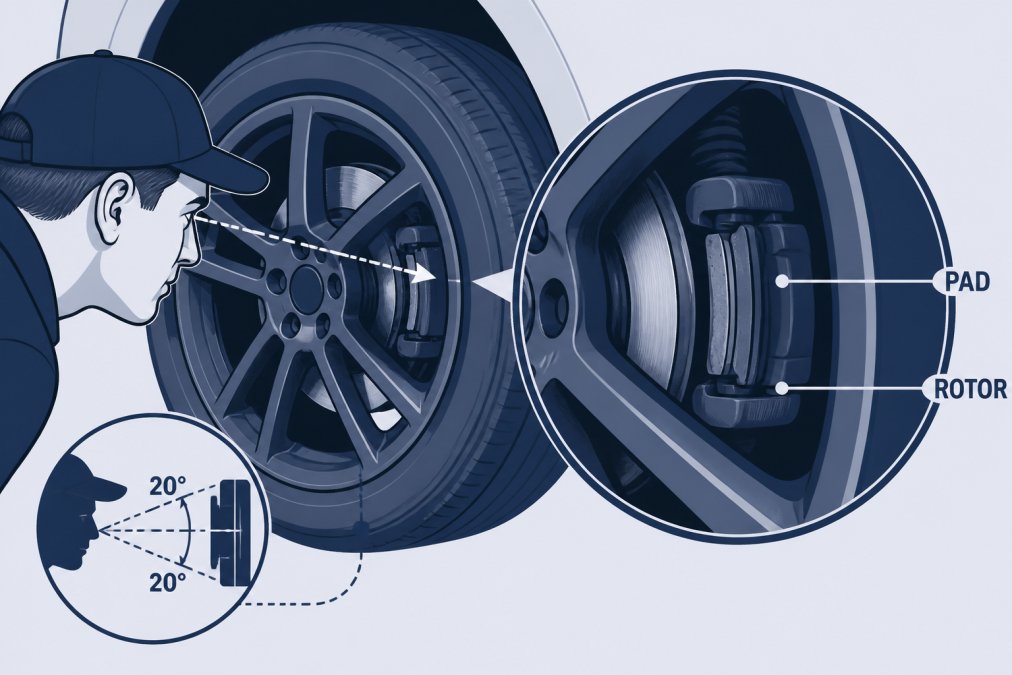
You don’t need to remove your wheels to get a visual assessment of your brake pad thickness. A basic visual inspection through the wheel gap can give you useful information about whether brake replacement is approaching.
Visual inspection through wheel gaps
Start by parking on a level surface and engaging the handbrake. Look through the gap between your wheel and wheel arch toward the brake assembly. You’ll see the brake caliper and, if you position yourself correctly, you can see the thickness of the brake pad material.
If the pad appears thick and substantial, you likely have adequate brake pad life remaining. If the pad looks thin, approaching the thickness of a few millimetres, brake replacement will be needed soon. Use a torch or position your vehicle in bright daylight for best visibility.
Checking pad thickness and wear indicators
Brake pads typically have a friction material thickness of 10-12 millimetres when new. Most brake pads have a wear indicator, a small metal tab or groove, that shows when pad thickness has reduced to approximately 3 millimetres.
If you can see the wear indicator making contact with the rotor, or if the friction material appears to be only 3 millimetres thick or less, brake replacement is due. Some vehicles have electronic wear sensors that trigger a dashboard warning light when pads reach a certain wear level. If your car has this feature and the light is illuminated, brake replacement is needed.
The visual inspection method is useful for getting a general sense of your brake condition, but it has limitations. For a complete brake assessment, professional inspection is always the better choice.
Average Brake Pad Lifespan and Replacement Intervals
Understanding how long brake pads typically last helps you anticipate when brake replacement will be necessary. Most drivers find their pads need replacement somewhere between 40,000 and 70,000 kilometres of driving.
This wide range exists because brake pad wear is heavily influenced by driving habits, road conditions, and the type of brake pad material installed on your vehicle.
How driving habits affect brake pad wear
Aggressive braking wears brake pads faster than gentle, gradual braking. Hard braking removes more material per stop than light braking, so drivers who brake aggressively will need brake replacement more frequently.
City driving produces more brake wear than highway driving because you brake more often in urban environments. Towing or carrying heavy loads increases brake wear significantly. The heavier your vehicle, the more braking force is required to stop it. If you regularly tow or carry heavy loads, expect to need brake replacement more frequently than average.
Riding the brakes, resting your foot on the brake pedal while driving, causes continuous friction and accelerates pad wear. This habit is common on long downhill sections where drivers use brakes to control speed rather than shifting to a lower gear.
Environmental and road condition impacts
Road salt in coastal areas and regions where roads are salted in winter accelerates corrosion of brake components. Dusty or sandy environments can introduce abrasive particles into the braking system, accelerating wear on brake pads and rotors.
Temperature extremes affect brake pad wear as well. Repeated hard braking that generates extreme heat can degrade brake pad material faster than normal braking. In humid environments or regions with frequent rain, brake components are exposed to more moisture, which can accelerate corrosion and affect braking efficiency.
Signs of Worn Brake Rotors
Brake rotors are the metal discs that your brake pads clamp against to create the friction that stops your vehicle. Like brake pads, rotors wear over time and eventually require replacement. Recognising the signs of worn rotors helps you address brake problems before they compromise safety.
Deep grooves and cracks in rotor surfaces
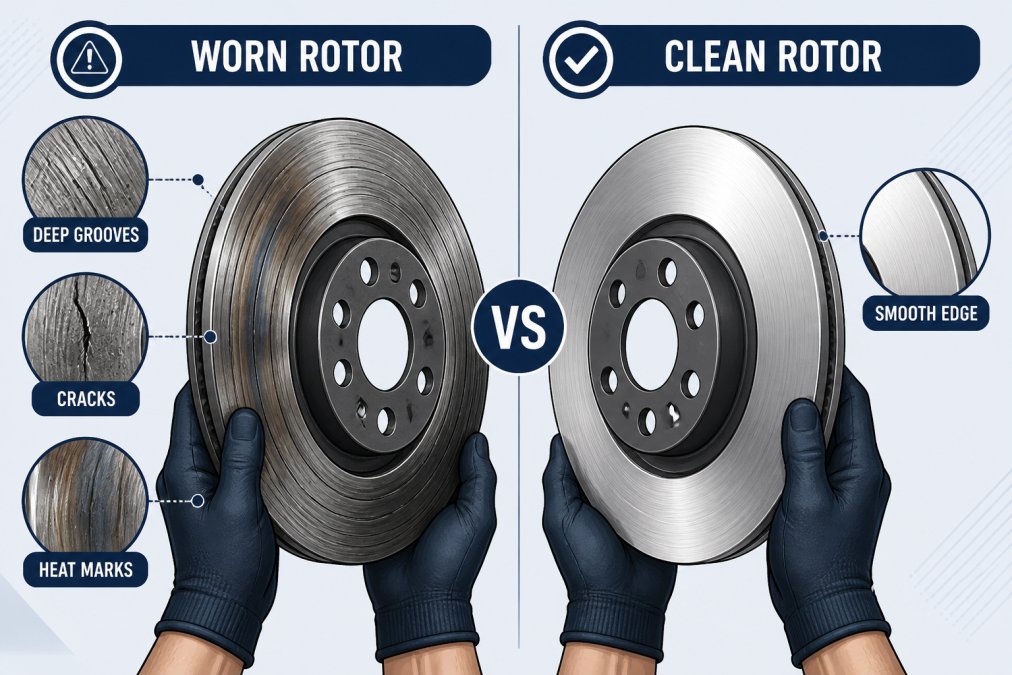
Worn rotors develop visible grooves or scoring on their surface. These grooves are created by the brake pads grinding against the rotor, particularly if pads have worn through to the metal backing. Light scoring is normal wear, but deep grooves indicate significant rotor damage.
If grooves are deep enough that you can feel them with your fingernail when running it across the rotor surface, brake replacement of the rotors is likely needed. Deep grooves reduce the contact area between pads and rotor, decreasing braking efficiency and increasing stopping distance.
Cracks in rotors are a more serious concern. A cracked rotor can fail suddenly, potentially resulting in complete brake failure. If you notice cracks in your rotors during inspection, stop driving the vehicle and have the brakes assessed by a professional immediately.
Uneven wear patterns and heat marks
Uneven wear on rotors, where one area is worn more than another, indicates that your brake calipers may not be applying pressure evenly. This can result from caliper problems, brake pad issues, or suspension alignment problems.
Heat marks on rotors appear as discoloured areas, typically blue or brown patches on the rotor surface. These marks indicate areas where the rotor has been subjected to extreme temperatures during braking. Both uneven wear and heat marks indicate that your braking system needs professional assessment.
DIY Inspection vs. Professional Brake Assessment
Understanding what you can safely check yourself and when to seek professional help is crucial for maintaining your braking system. While basic visual inspection can provide useful information, a complete brake assessment requires professional equipment and expertise.
What you can safely check yourself
Visual inspection of brake pad thickness through wheel gaps is safe and straightforward. You can also listen for squealing or grinding noises and feel for brake pedal pulsation. You can check your brake fluid level by looking at the brake fluid reservoir under the bonnet. The reservoir should have fluid between the minimum and maximum marks.
Checking for brake warning lights on your dashboard is another safe self-check. If warning lights are illuminated, professional assessment is needed.
What you should not attempt yourself is removing wheels to inspect rotors closely, checking caliper function, or diagnosing brake system faults. These tasks require professional tools and expertise. Improper brake work can result in brake failure, which is a serious safety hazard.
When to book professional diagnostics
Book professional brake diagnostics if you notice any of the warning signs mentioned in this guide: squealing, grinding, pedal pulsation, spongy pedal feel, or dashboard warning lights. Professional mechanics have the tools and expertise to assess your complete braking system.
A professional brake assessment typically includes inspection of brake pads, rotors, calipers, brake fluid condition, and brake lines. Modern diagnostic tools can identify problems that aren’t visible during basic inspection. At Mallee Auto & Agricultural Services in Mildura, we use modern diagnostic equipment to provide accurate brake assessments and identify exactly what brake replacement or service your vehicle needs.
Brake Pad Materials and Why They Matter
Not all brake pads are created equal. Different brake pad materials have different characteristics that affect braking performance, wear rate, noise level, and durability.
Organic brake pads are made from a composite of materials including rubber, glass, and resin. They’re quieter than other pad types and provide good initial braking power. However, they wear faster than other materials and can fade under extreme heat.
Metallic brake pads contain metal particles, usually copper or iron, mixed with the friction material. These pads offer better heat dissipation than organic pads and maintain consistent braking performance at higher temperatures. They’re more durable but tend to be noisier and can be harder on rotors.
Ceramic brake pads are made from ceramic material combined with other compounds. They offer excellent heat resistance, low noise, and minimal rotor wear. Ceramic pads last longer than organic or metallic pads but are typically more expensive.
Your vehicle’s manufacturer specifies which brake pad type is appropriate for your car. When you need brake replacement, using the correct pad type ensures optimal braking performance and system compatibility. A professional mechanic can advise you on the best brake pad option for your vehicle and driving conditions.
Conclusion
Recognising when your car needs brake replacement is one of the most important skills for vehicle safety. Whether you’re hearing squealing, feeling pedal pulsation, or noticing dashboard warning lights, your vehicle is sending clear signals that brake service is needed.
At Mallee Auto & Agricultural Services in Mildura, we specialise in complete brake system assessment and replacement for all vehicle types. Our skilled mechanics use modern diagnostic tools to identify exactly what your braking system needs, and we provide transparent pricing with no hidden charges. We’re committed to keeping your vehicle safe and reliable on the road. Book Now to have your brakes professionally assessed, and drive with confidence knowing your braking system is in expert hands.
Frequently Asked Questions
How can I tell if my car brakes need replacing?
Listen for squealing, screeching, or grinding sounds when braking. Feel for a spongy or pulsating brake pedal, reduced responsiveness, or vibration. Check your dashboard for brake warning lights. Visually inspect brake pad thickness through the wheel gaps, pads thinner than 3mm need replacement. If you notice uneven wear on pads or deep grooves in rotors, professional inspection is essential.
What is the average brake pad lifespan?
Brake pad lifespan typically ranges from 25,000 to 70,000 kilometres, depending on driving habits, road conditions, and brake pad material. Frequent city driving with heavy braking wears pads faster than highway driving. Dusty or hilly terrain accelerates wear. Check your manufacturer's recommendations and monitor pad thickness regularly to avoid reaching critical wear limits.
What are the signs of worn brake rotors?
Worn brake rotors show deep grooves, cracks, or scoring on the surface. You may notice heat marks or discolouration indicating excessive friction. Uneven wear patterns suggest caliper issues. If your brake pedal feels spongy or pulsates, or if you hear grinding when braking, your rotors likely need attention. Professional inspection with modern diagnostic tools confirms rotor condition and determines if replacement is necessary.
Can I drive with worn brakes?
Driving with worn brakes increases stopping distance and reduces safety for you and others on the road. If pads are below 3mm or you hear grinding, avoid driving except to reach a mechanic. Worn rotors can fail suddenly, creating serious safety risks. Professional repair should happen immediately, delayed brake service puts lives at risk and may result in more costly damage to your brake system.
This article was written using GrandRanker
