
Last Updated: November 2, 2026
Quick Summary
To calculate diesel fuel consumption per kilometre, divide the litres of diesel used by the kilometres travelled. For example, 62 litres over 780 km equals 0.0795 L/km, which is the same as 7.9 L/100km. Multiply that per-kilometre figure by the price per litre to get your cost per kilometre.
- Use the full-tank method and average at least three tanks, because one tank is only a snapshot.
- Convert L/100km to km/L by dividing 100 by your L/100km figure.
- At $2.00 per litre, a ute using 0.0795 L/km costs about 16 cents per kilometre.
- Fuel cost per kilometre is your L/100km figure multiplied by price per litre, then divided by 100.
- Flag any tank that jumps more than 10% above your average as a possible problem.
Table of Contents
- Why Knowing Your Diesel Fuel Consumption per Kilometre Pays Off
- The Fuel Consumption Formula L/100 km Explained
- How to Measure Diesel Use Accurately Over a Trip
- Using a Diesel Fuel Consumption Calculator
- How to Calculate Fuel Cost per Kilometre
- Diesel Fuel Consumption Tracking That Actually Works
- What Changes Diesel Consumption on Mallee Roads and Farms
- Book a Diesel Health Check at Mallee Auto & Agricultural Services
- Frequently Asked Questions
Why Knowing Your Diesel Fuel Consumption per Kilometre Pays Off
Diesel fuel consumption is the amount of fuel a vehicle uses to travel a set distance, and knowing yours turns guesswork into a budget line. For practical ways to cut diesel use, see how to improve diesel truck fuel efficiency in Australia. Owners who track fuel tend to catch problems early. A ute that suddenly drinks more diesel is telling you something.
Here in Mildura, Victoria, that matters. Long runs to farms, heavy loads, and hot summers all push diesel use up. A small change in consumption adds up over a season.
Below, we’ll show you exactly how to calculate diesel fuel consumption per kilometre, step by step, with real examples for a ute, a truck and a tractor. You’ll also learn how to spot a vehicle that’s wasting fuel before it becomes a repair bill.
The Fuel Consumption Formula L/100 km Explained
The fuel consumption formula L/100 km is simple: litres used divided by kilometres travelled, then multiplied by 100. That gives you litres per 100 kilometres, the standard unit in Australia.
Here it is in plain terms:
L/100km = (litres used ÷ kilometres driven) × 100
For example, if you use 40 litres over 500 km: 40 ÷ 500 = 0.08, then × 100 = 8 L/100km.
A lower number means better fuel efficiency. A higher number means the vehicle is using more diesel to cover the same ground.
Converting L/100km to km/L and MPG
Converting between units is where people get stuck, so here’s the short version:
- km/L: divide 100 by your L/100km figure. An 8 L/100km vehicle gets 12.5 km/L.
- MPG: multiply km/L by 2.352 for US gallons, or 2.825 for imperial gallons.
| Unit | Formula | Example (8 L/100km) |
|---|---|---|
| L/100km | (litres ÷ km) × 100 | 8.0 |
| km/L | 100 ÷ L/100km | 12.5 |
| MPG (imperial) | km/L × 2.825 | 35.3 |
| MPG (US) | km/L × 2.352 | 29.4 |
Use whichever unit your records already use. The important thing is to stay consistent so you can compare trips.
How to Measure Diesel Use Accurately Over a Trip
Accurate measurement starts at the bowser, not the dashboard. Trip computers estimate; they don’t measure. To get a diesel figure you can trust, use a repeatable full-tank method and record every fill the same way.
The full-tank method, step by step:
- Fill the tank at the same service station until the pump clicks off. Do not top off after the click. Note the odometer reading and the litres added.
- Drive your normal routes and loads. Don’t change habits to flatter the numbers.
- Refill at the same pump until it clicks off again. Note the litres added and the new odometer reading.
- Subtract the starting odometer from the ending one to get distance travelled.
- Divide litres used by kilometres driven, then multiply by 100 for L/100km.
Do this over at least three tanks and average the results. One tank is a snapshot; three is a pattern.
Why one tank can mislead:
- Partial fills: if you add $50 of diesel instead of filling, you cannot divide litres by distance cleanly. Either fill fully or record the partial litres and carry them forward to the next full fill.
- Pump shut-off variation: different pumps and different flow rates trip the nozzle at slightly different levels. Filling at the same pump, same direction, reduces this.
- Short trips: a 20 km run to the shops and back tells you almost nothing. Diesel consumption settles over longer runs once the engine is at operating temperature.
- Inconsistent routes: a week of highway running followed by a week of paddock work will produce two very different figures. Note the route and load with each fill so you compare like with like.
- Towing and heavy loads: a tank that includes a loaded trailer will read higher. Flag those tanks rather than letting them drag your baseline up.
Recording litres and distance across multiple fills: keep a simple log with columns for date, odometer, litres, price per litre, route type and load. At each full fill, calculate the distance since the last full fill and the litres added since then. If you had partial fills in between, add those litres to the total for that interval. This is the same logic a fleet manager uses, and it is why fleet records are more reliable than a single tank reading.
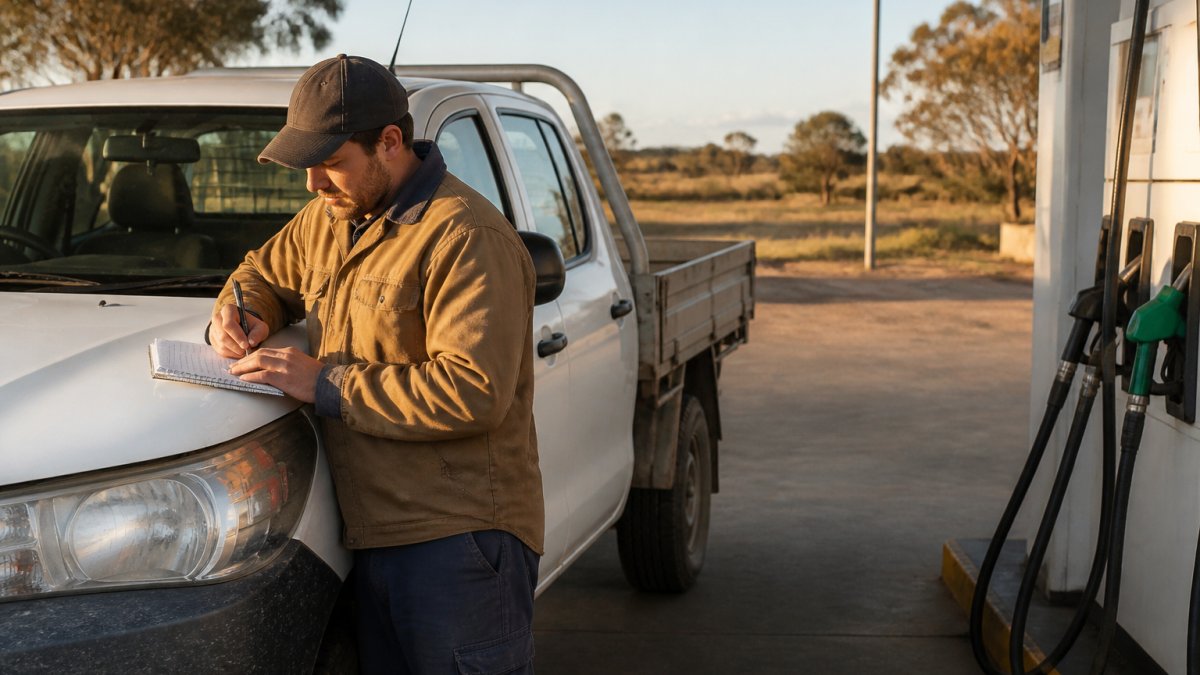
Watch out: filling at different pumps, or stopping at the first click on one fill and topping off on another, skews your litres figure. Consistency is everything here.
Worked Diesel Examples for a Ute, a Truck and a Tractor
Numbers make more sense with examples, so here are three worked cases, plus the per-kilometre figure that many guides skip.
Ute: 62 litres used over 780 km. 62 ÷ 780 = 0.0795, × 100 = 7.9 L/100km. Per kilometre: 62 ÷ 780 = 0.0795 L/km, or about 0.08 L/km.
Truck: 210 litres over 1,400 km. 210 ÷ 1,400 = 0.15, × 100 = 15 L/100km. Per kilometre: 210 ÷ 1,400 = 0.15 L/km.
Tractor: 48 litres over 160 km of paddock work. 48 ÷ 160 = 0.3, × 100 = 30 L/100km. Per kilometre: 48 ÷ 160 = 0.3 L/km.
Tractors often look thirsty on paper because field work is stop-start and load-heavy.
To turn litres per kilometre into dollars per kilometre, multiply by the price per litre. At a Mildura diesel price of, say, $2.00 per litre, the ute above costs 0.0795 × 2.00 = about 16 cents per kilometre. The truck costs 0.15 × 2.00 = 30 cents per kilometre. The tractor costs 0.3 × 2.00 = 60 cents per kilometre. Use the price on the day you filled, not a remembered figure, because diesel prices move with freight and seasonal demand.
Using a Diesel Fuel Consumption Calculator
A diesel fuel consumption calculator does the maths for you: enter litres used and kilometres driven, and it returns L/100km, km/L and cost. Most are free online tools. The formula behind them is the same one above, so a calculator is only as good as the numbers you feed it.
What a good diesel calculator should return:
- Litres per 100 kilometres (L/100km): the standard Australian unit for comparing vehicles and trips.
- Litres per kilometre (L/km): the direct per-kilometre figure, which is what you multiply by price to get cost per kilometre.
- Kilometres per litre (km/L): useful if your records or a vehicle spec sheet use it.
- Cost per kilometre and cost for the trip: litres per kilometre multiplied by the price per litre you paid.
Many calculators foreground L/100km and leave you to work out the per-kilometre figure yourself. If yours does, divide litres by kilometres directly. If you’re weighing fuel-saving options, read about diesel engine tuning vs performance chips for farm equipment.
Worked calculator example using a Mildura diesel price: suppose you filled 55 litres over 620 km and paid $1.98 per litre at a Mildura bowser. The calculator returns 55 ÷ 620 × 100 = 8.87 L/100km, or 55 ÷ 620 = 0.0887 L/km.
Should you use a calculator? For a single trip, yes. For ongoing records, a simple spreadsheet beats most calculators because it keeps history and lets you average across fills. We recommend tracking litres, kilometres and price per litre in three columns, then adding a fourth column for L/100km and a fifth for cost per kilometre.
How to Calculate Fuel Cost per Kilometre
Fuel cost per kilometre is your L/100km figure multiplied by the price per litre, then divided by 100. This is the number that actually hits your wallet.
Cost per km = (L/100km × price per litre) ÷ 100
Take a ute at 8 L/100km with diesel at $2.00 per litre: 8 × 2.00 = 16, ÷ 100 = 16 cents per kilometre. A 500 km run costs about $80 in fuel.
Do this for each vehicle you run. It makes trip costing and quoting far more accurate than a rough guess.
Diesel Fuel Consumption Tracking That Actually Works
Diesel fuel consumption tracking only works if it’s easy enough to keep doing. Most people start a logbook and quit within a month. Here’s a method that survives:
- Record odometer and litres at every fill, every time
- Keep a notebook in the glovebox or a note on your phone
- Review monthly, not daily
- Flag any tank that jumps more than 10% above your average
- Note heavy-load trips so they don’t skew the baseline
A jump you can’t explain is a signal. It might be a clogged filter, low tyre pressure or an injector issue. Catching it early is cheaper than catching it at breakdown.
What Changes Diesel Consumption on Mallee Roads and Farms
Several factors move your diesel numbers, and not all of them are mechanical:
- Load and towing: every extra tonne costs fuel
- Terrain: sandy tracks and soft paddocks burn more than bitumen
- Heat: air conditioning and hot air both raise consumption
- Tyre pressure: under-inflated tyres drag
- Idling: long warm-ups and stationary work add up fast
- Service condition: dirty filters and worn injectors waste fuel
Downtime and poor fuel economy often share the same root cause.
Book a Diesel Health Check at Mallee Auto & Agricultural Services
If your figures look wrong and you can’t find the cause, book a diesel health check with us in Mildura. You can also look at top diesel mechanics in Mildura for trucks to carry out the check. Our mechanics use modern diagnostic tools to find the real issue. We service cars, utes, trucks and farm machinery, with fair pricing and pensioner discounts.
Frequently Asked Questions
How do you calculate diesel fuel consumption per kilometre?
Fill the tank to the same point twice, note the odometer at each fill, and divide the litres used by the kilometres driven. For example, 68 litres over 620 km is 0.11 L/km. Multiply by 100 to express it as L/100km, which gives 11 L/100km. Doing this over three or more tanks smooths out fill variation and gives a reliable average diesel fuel consumption figure.
How do you convert litres per 100 km to kilometres per litre?
Divide 100 by the L/100km figure. A vehicle using 12 L/100km returns 100 ÷ 12 = 8.33 km/L. To go the other way, divide 100 by km/L. For miles per gallon, multiply km/L by 2.825 for imperial MPG or 2.352 for US MPG. Keep the unit you quote consistent so comparisons between vehicles stay meaningful.
How do you calculate diesel fuel cost per kilometre in Australia?
Multiply your L/100km figure by the price per litre, then divide by 100. At 12 L/100km and $1.85 per litre, the cost is 12 × 1.85 ÷ 100, or about 22 cents per kilometre. Multiply by trip distance for a full trip cost. Check the bowser price on the day, since diesel prices move and vary between towns.
Why has my diesel vehicle’s fuel consumption increased?
Common causes include low tyre pressures, a clogged air or fuel filter, dragging brakes, a failing injector, heavy loads and short stop-start trips. Seasonal diesel blends and colder mornings also raise use slightly. If tracking shows a jump of 10% or more with no change in load or route, have the fuel system and diagnostics checked before the problem grows.
A vehicle using more diesel than it should is often telling you something is wearing out. At Mallee Auto & Agricultural Services, our skilled mechanics diagnose the cause with modern tools, quote clearly before work starts, and stand behind every job. We also offer pensioner discounts for local residents. Get started with Mallee Auto & Agricultural Services and get your fuel figures back where they belong.

