
Last Updated: October 30, 2026
Quick Summary
To reduce diesel consumption in heavy vehicles, set a fuel baseline by logging odometer readings, litres added, load and engine hours over at least three fills, then calculate litres per 100 kilometres. Act on that data with smooth driving, correct tyre pressures, scheduled maintenance and reduced idling.
- Record five fields at every fill and calculate litres divided by kilometres, times 100.
- Run comparisons over at least three fills so one bad tank does not skew results.
- Check tyre pressures cold at least weekly and match them to the load.
- Service on the manufacturer’s schedule rather than waiting for something to break.
- Use telematics to target idling reduction first, then driver coaching.
Table of Contents
- Start With a Fuel Consumption Baseline and Calculator
- Fuel-Efficient Truck Driving Techniques That Cut Litres per 100 Kilometres
- Truck Tyre Pressure and Fuel Economy: The Rolling Resistance Factor
- Heavy Vehicle Maintenance for Fuel Efficiency
- Managing Payload, Vehicle Weight and Aerodynamics
- Australian Heavy-Vehicle Compliance, Safety and Telematics
- Book a Fuel Efficiency Check at Mallee Auto & Agricultural Services
- Frequently Asked Questions
Start With a Fuel Consumption Baseline and Calculator
You cannot reduce diesel consumption in heavy vehicles until you know what you are burning now. A baseline turns guesswork into a number you can track, compare and improve.
Diesel consumption is the volume of fuel an engine burns over a set distance or working period, usually shown as litres per 100 kilometres (L/100km) for highway work. For trucks doing stop-start farm runs around Mildura, litres per engine hour tells a truer story.
How to Set Up a Simple Fuel Tracking Log
Record these five fields every fill, without exception:
- Odometer reading at fill
- Litres added, from the pump docket
- Date and start/end location
Then run the maths: litres divided by kilometres, times 100. Do it over at least three fills so one bad tank does not skew the result. A truck fuel consumption calculator is just this formula in a spreadsheet, and it beats any app you will forget to open.
Watch out: filling from a farm tank without recording litres is the most common reason baselines fail. Guessing the volume defeats the whole exercise.
Worked Example: From Litres to Dollars
Suppose a rigid truck uses 32 L/100km and covers 500 km in a week. That is 160 L of diesel. Multiply that weekly volume by your own bowser price to see what the week costs. The point is that you can put a dollar value on each change and decide whether it is worth the effort.
Comparing Like-for-Like Trips
A baseline only works if you compare apples with apples. A loaded B-double on the Sturt Highway will always burn more than an empty rigid on a farm access track. To isolate the effect of a change, compare trips with the same:
- Route and distance
- Load weight and configuration
- Time of year (Mallee summer heat and headwinds both raise consumption)
If you change tyres, driving style or a filter, hold everything else steady for at least three fills and compare the L/100km before and after. If the number moves outside normal variation, you have evidence. If it does not, you have saved yourself a costly mistake.
Separating Driving from Mechanical Causes
A rising baseline can come from the driver, the load, the weather or the machine. Before you blame driving habits, rule out the mechanical basics: dragging brakes, a restricted air filter, low tyre pressures, a leaking fuel line or a faulty injector. A simple check is to compare fuel used on a known route against the same route run previously under similar conditions.
Keep a photo of each fuel docket in a folder on your phone. It takes seconds and gives you a paper trail if a supplier or customer queries fuel use later.
Once you have four to six weeks of clean data, you can rank your options: driver training, tyre pressure, idling reduction or workshop attention. The baseline tells you which one is actually costing you money in Mildura conditions.
A clean fuel log rests on five fields recorded at every fill, then a simple litres-per-kilometre calculation.
| Field to record | Detail | Note |
|---|---|---|
| Odometer reading | Taken at fill | Record every fill |
| Litres added | From the pump docket | Farm tank fills often unrecorded |
| Date and location | Start and end | Keeps trips comparable |
| Load or task | Load carried or task performed | Compare like-for-like trips |
| Engine hours | If the truck has a meter | Use for stop-start farm runs |
| Calculation | Litres divided by kilometres, times 100 | Run over at least three fills |
Fuel-Efficient Truck Driving Techniques That Cut Litres per 100 Kilometres
Driver behaviour is the cheapest fuel upgrade available to any fleet. No workshop visit, no parts, just changed habits behind the wheel. The gains show up in fuel consumption within a week of consistent effort.
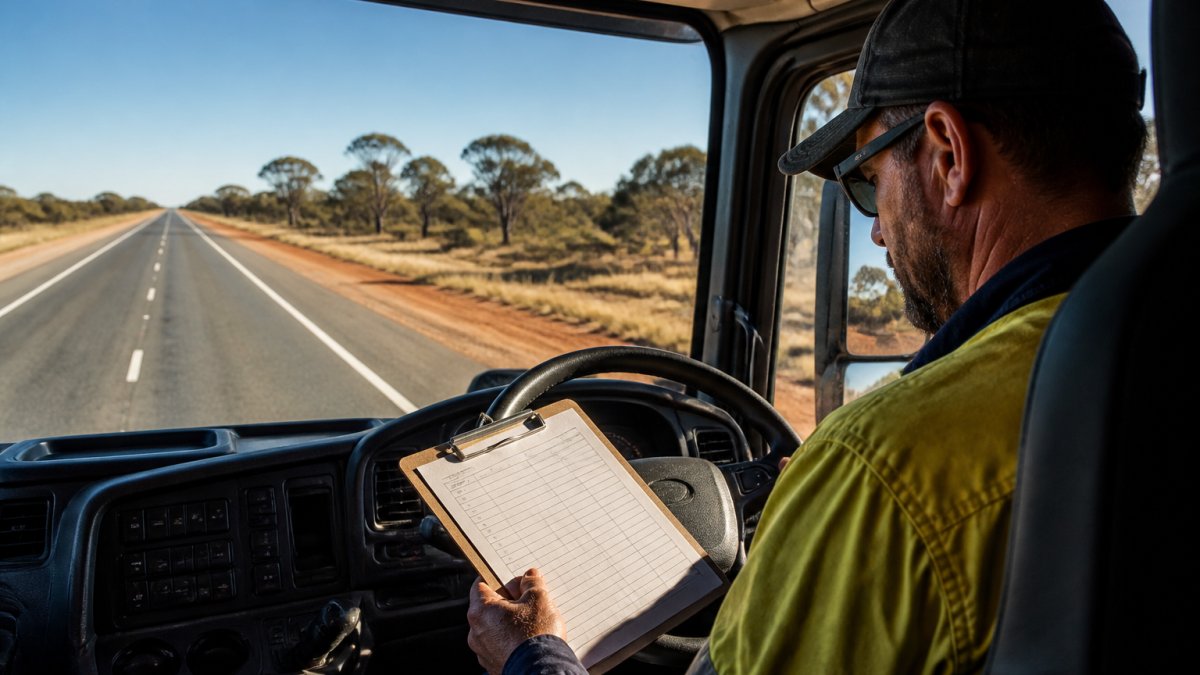
Gentle Acceleration, Smooth Driving and Steady Speed
Hard acceleration dumps fuel into the engine faster than it can burn efficiently. Ease the throttle, let the gearbox do its job, and keep the engine in its sweet spot rather than revving toward the red line.
Fuel-efficient truck driving techniques come down to three habits:
- Roll into the throttle instead of stomping it
- Read the road ahead so you brake less and coast more
- Pick a steady speed and hold it, using cruise control where it is safe
Smooth driving also cuts brake wear and driveline shock. Two savings for one habit.
Cutting Engine Idling and Planning Vehicle Routes
An idling engine burns fuel and moves nothing. In cold Mallee mornings the temptation to warm up for twenty minutes is real, but most modern diesels need far less. Switch off during loading, waiting and long queues.
Route planning matters just as much. Combine farm visits, avoid backtracking, and check load restrictions before you leave the yard. Fewer kilometres with the same payload is free fuel savings.
Truck Tyre Pressure and Fuel Economy: The Rolling Resistance Factor
Under-inflated tyres are a silent fuel thief. Soft tyres flatten against the road, raising rolling resistance and forcing the engine to work harder for every kilometre.
Check pressures cold, at least weekly, and match them to the load.
Watch out: pressure gauges at service stations drift. A cheap gauge that reads high will have you running soft tyres without knowing it.
Heavy Vehicle Maintenance for Fuel Efficiency
A tired engine wastes fuel in ways a driver cannot fix. Heavy vehicle maintenance for fuel efficiency covers the air filter, injectors, fuel pump, transmission and exhaust system.
Book servicing on the manufacturer’s schedule, not when something breaks. A diesel that is running rich or misfiring will quietly add to your fuel costs every single day. See our tips for reducing farm equipment downtime to keep heavy vehicles efficient and on the road.
Fuel Quality and Mechanical Fault Diagnosis
Poor fuel quality and mechanical faults show up in the same place: rising consumption with no change in load or route. Water in the fuel, contaminated tanks or a failing sensor can all drag fuel economy down.
If your numbers jump and the driving has not changed, get it looked at. Fault diagnosis is cheaper than weeks of wasted diesel.
Managing Payload, Vehicle Weight and Aerodynamics
Every kilogram and every square metre of frontal area costs fuel. Payload and vehicle weight are the two biggest controllable factors after driving style. Check that loads are balanced, axles are not overloaded, and nothing is carried that the job does not need.
Aerodynamics matters most at highway speed. Roof racks, tarps flapping loose and open trays all add drag. Fit covers, secure loads and remove accessories you are not using. Load control is a safety issue first, but it pays at the pump too.
Australian Heavy-Vehicle Compliance, Safety and Telematics
Fuel-saving changes must stay inside the law. In Australia, heavy vehicle operations are governed by the National Heavy Vehicle Regulator, which administers the Heavy Vehicle National Law in participating states and sets mass, dimension, load restraint and fatigue rules. Cutting weight or altering a vehicle to save fuel still has to meet those standards, and a modification that improves aerodynamics but changes dimensions may need approval.
Where Fuel Saving Meets Compliance
Several fuel-saving habits sit directly against Australian requirements:
- Mass and payload: Running lighter saves fuel, but you must still comply with gross and axle mass limits and the load restraint guide. Do not shed weight by leaving loads unsecured.
- Tyres: Correct pressure improves fuel economy, but tyre load ratings and minimum tread depths still apply. Never run below the manufacturer’s pressure for the load to chase a number.
- Maintenance: Servicing on schedule supports fuel efficiency and helps you meet your primary duty obligations. A poorly maintained brake or steering component is a safety defect, not just a fuel issue.
If you operate across the Mildura region and into New South Wales or South Australia, check which fatigue and mass rules apply on each leg. The NHVR website and your state regulator are the authoritative sources. Learn what rural contracting satisfaction guaranteed means for the service standards you should expect.
Telematics and Real-Time Fuel Monitoring
Telematics and real-time fuel monitoring give you data no clipboard can match. Fuel tracking systems log idling time, harsh acceleration, speeding and route deviations automatically, and many can flag fuel use per trip against a baseline.
Use telematics to answer specific questions:
- Which trips have the highest litres per 100km for the same load?
- How much fuel is burned while idling at loading docks or in queue?
- Are there sudden consumption jumps that suggest a mechanical fault?
A common pattern is that telematics pays for itself first through idling reduction, then through targeted driver coaching. Start with one metric, such as idling hours per week, and act on it before adding more dashboards.
Telematics data can be used in investigations and audits. Make sure drivers understand what is recorded and that the system is used to improve performance, not just to punish. That keeps the safety and fuel benefits coming.
Safety comes first. Fuel-efficient driving is smooth driving, and smooth driving is safer driving.
Book a Fuel Efficiency Check at Mallee Auto & Agricultural Services
You have the baseline method, the driving habits, the tyre checks and the maintenance schedule. Read about the reliable truck mechanics in Mildura who would perform your fuel efficiency check.
Mallee Auto & Agricultural Services works on all vehicle types, including trucks and farm machinery. Our service pricing is available on our website, where you can also request a quote.
Frequently Asked Questions
Does driving slower save fuel in a heavy vehicle?
Yes, up to a point. Aerodynamic drag rises sharply with speed, so dropping highway cruising speed by a few kilometres per hour usually lowers litres per 100 kilometres. The gain is largest on long open-road runs. Keep to a steady speed within the legal limit and the engine’s efficient rev range rather than braking and accelerating repeatedly, which erases any saving from slower travel.
How do tyre pressure and wheel alignment affect truck fuel consumption?
Under-inflated tyres increase rolling resistance, so the engine works harder for the same distance. Check pressures cold against the manufacturer’s specification for the load, and inspect for uneven wear that points to misalignment. Correct pressure and alignment support truck tyre pressure and fuel economy, and they also reduce tyre costs. Check weekly and before any long haul out of Mildura.
Can regular servicing improve heavy vehicle fuel efficiency?
It can. Clogged air filters, dirty injectors, faulty sensors and overdue oil changes all push fuel burn upward. Heavy vehicle maintenance for fuel efficiency means servicing to the manufacturer’s interval, fixing leaks and diagnosing fault codes early with proper scan tools. A mechanic can also spot drag from brakes or bearings that quietly adds to running costs.
How can I track fuel consumption in a truck?
Record every fill in litres and odometer reading, then divide litres by distance and multiply by 100 for litres per 100 kilometres. A truck fuel consumption calculator or a simple spreadsheet does this for you. Telematics and real-time fuel monitoring add per-trip detail. Compare against a baseline before and after changes so you can see which actions actually reduce diesel consumption.
Fuel is one of the largest running costs on any heavy vehicle, and small faults add up fast. If your litres per 100 kilometres have crept up and the driving has not changed, let us find out why. Get started with Mallee Auto & Agricultural Services and book a fuel efficiency check backed by accurate diagnostics, transparent pricing and pensioner discounts.

