
Table of Contents
- What Modern Car Engine Diagnostic Tools Actually Do
- How OBD-II Systems Work and Why They Matter
- How to Interpret OBD-II Fault Codes
- Common Causes of Check Engine Light
- Benefits of Professional Car Diagnostics
- DIY vs. Professional-Grade Diagnostic Tools
- Choosing the Right Diagnostic Scanner for Your Needs
- Conclusion
- Frequently Asked Questions
Last Updated: September 25, 2026
What Modern Car Engine Diagnostic Tools Actually Do
Modern car engine diagnostic tools explained: they read and interpret data from your vehicle’s onboard computer, connecting to the diagnostic port to identify faults and help mechanics understand warning lights.
A quality diagnostic scanner saves time, eliminates guesswork, and ensures repairs address the actual problem rather than symptoms.
Your vehicle constantly monitors dozens of sensors across engine, emissions, transmission, and safety systems. When something deviates from normal parameters, the onboard computer stores a fault code. A diagnostic tool retrieves that code, translates it into plain language, and provides live data showing what each sensor is reading.
A check engine light could mean anything from a loose fuel cap to a failing catalytic converter. Without proper diagnostics, you risk unnecessary repairs or ignoring problems that cost more to fix later.
The best diagnostic tools don’t just read codes, they show live sensor data. Watching real-time values from oxygen sensors, fuel injectors, and air intake systems tells you whether a problem is intermittent or constant, which dramatically speeds up diagnosis.
How OBD-II Systems Work and Why They Matter
OBD-II (On-Board Diagnostics, generation 2) is the standardised system all vehicles sold in Australia since 1996 must have, meaning every modern car, truck, and agricultural vehicle shares the same basic diagnostic port and communication protocol.
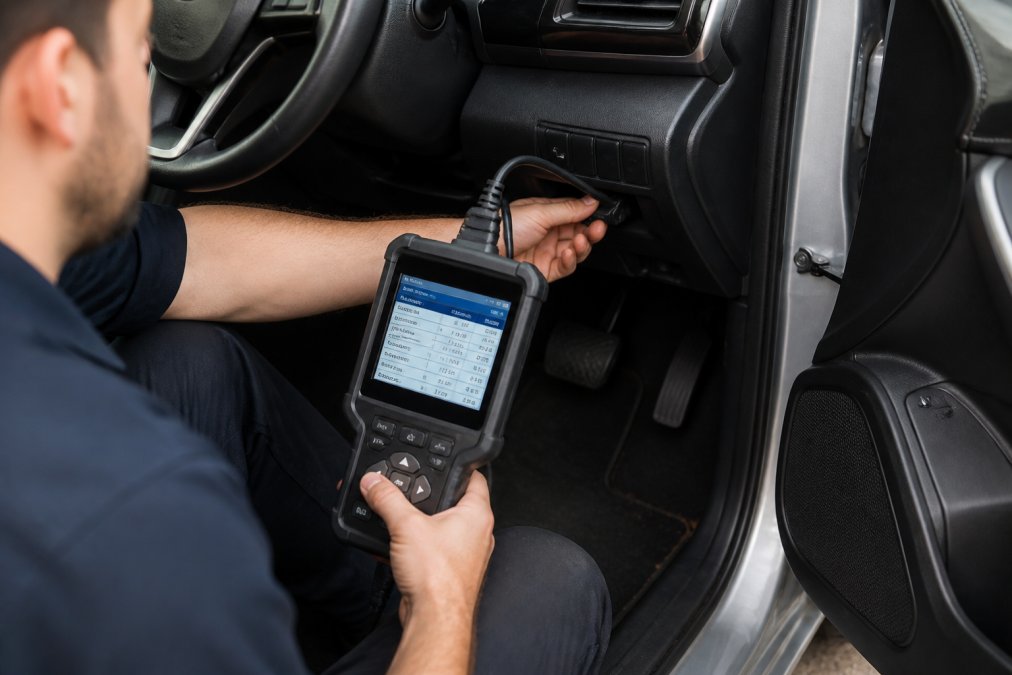
The system works through the CAN Bus (Controller Area Network), linking all electronic control units. Plugging a scanner into the OBD-II port taps into this network to retrieve diagnostic data.
This standardisation is why a $70 entry-level scanner can read fault codes from a Ford, Toyota, or Holden, though the depth of information available varies.
The engine control unit continuously monitors sensor inputs and compares them to expected values. If an oxygen sensor reads outside its normal range or fuel pressure drops below specification, the ECU logs a Diagnostic Trouble Code, illuminating your check engine light. Without clearing the code or fixing the underlying problem, the light remains on.
This is where diagnostic tools become essential. They let you see what the vehicle’s computer knows, not just the warning light on your dash.
How to Interpret OBD-II Fault Codes
Reading Diagnostic Trouble Codes (DTCs)
A Diagnostic Trouble Code is a five-character alphanumeric string identifying a specific fault. The first character indicates the system affected (P for powertrain/engine, B for body, C for chassis, U for network); the second indicates whether it’s manufacturer-specific or standardised.
For example, P0128 means “coolant thermostat malfunction” and P0301 means “cylinder 1 misfire detected.” These standardised codes are consistent across all vehicles.
The real value is understanding what the code means for your vehicle. A P0128 on a 2010 Holden Commodore might be a failing thermostat; on a 2018 Ford Ranger, it could be a coolant temperature sensor reading incorrectly.
A single fault code rarely tells the whole story. Always look at live data, sensor readings, fuel pressure, ignition timing, to confirm whether the code reflects a genuine failure or a sensor that’s reading out of range.
Understanding Freeze Frame and Live Data
Freeze frame data is a snapshot of all sensor readings when a fault code was triggered, capturing engine RPM, fuel pressure, ignition timing, and air intake temperature. This shows the exact conditions when the problem occurred.
Live data is the real-time stream of sensor values as your engine runs.
Common Causes of Check Engine Light
A loose fuel cap is the most common cause of a check engine light. The fuel system is sealed to prevent vapour loss; a loose cap triggers an emissions fault code that clears within a few driving cycles.
Benefits of Professional Car Diagnostics
Professional diagnostics go beyond reading fault codes, combining diagnostic scanners with visual inspection and specialised equipment testing.
Ignoring a check engine light can lead to serious damage. A misfire left unchecked can destroy a catalytic converter (expensive). An oxygen sensor fault can cause your engine to run too rich, wasting fuel and damaging emissions equipment. Address the fault promptly.
DIY vs. Professional-Grade Diagnostic Tools
Entry-level diagnostic scanners are useful for DIY owners. They read and clear fault codes, display freeze frame data, and cost $50-$150, delivering real value for understanding check engine lights without paying a diagnostic fee.
| Tool Category | Best For | Typical Cost | Key Limitation |
|---|---|---|---|
| Entry-Level | Understanding fault codes, basic troubleshooting | $50-$150 | Limited to standardised codes only |
| Mid-Range | DIY diagnosis with smartphone integration | $90-$250 | No bi-directional testing or reprogramming |
| Professional-Grade | Workshop diagnostics, complex repairs | $350-$500+ | Requires training; risk of misconfiguration |
Choosing the Right Diagnostic Scanner for Your Needs
Your choice depends on what you’re trying to accomplish. If you’re a vehicle owner who wants to understand warning lights before visiting a mechanic, an entry-level scanner is sufficient. If you’re a DIY enthusiast who regularly services your own vehicles, a mid-range tool with live data and smartphone integration is worth the investment.
Entry-Level Scanners for Basic Engine Checks
Entry-level scanners like the Forauto YM519 ($50 AUD) and Ruoginss V700 ($70 AUD) read and clear fault codes, display freeze frame data, and show I/M readiness status (whether your vehicle’s emissions systems are ready for inspection). They’re plug-and-play: connect to the OBD-II port, and the scanner displays codes within seconds.
Mid-Range Tools with Advanced Features
Mid-range scanners like the BlueDriver Pro Next Gen ($180 AUD) and MUCAR 892T ($250 AUD) offer wireless smartphone connectivity, live data streaming, and access to vehicle-specific repair information. The BlueDriver app, for example, includes a database of verified fixes for common fault codes, you see not just “P0128 coolant thermostat malfunction” but a list of repairs that have actually solved that problem on your vehicle model.
Professional-Grade Equipment for Complex Diagnostics
Professional-grade scanners like the Bosch OBD 1200 ($500 AUD) and TOPDON ArtiDiag600S ($350 AUD) are what you’ll find in a professional workshop. They access manufacturer-specific fault codes, perform advanced system diagnostics, and can reprogram control modules.
Farmers and agricultural business owners needing quick diagnosis of heavy machinery. Professional-grade tools can access tractor and farm equipment diagnostics that consumer scanners cannot reach.
Conclusion
Modern car engine diagnostic tools have transformed how mechanics identify vehicle faults. What once required hours of manual testing now takes minutes, and the accuracy is far superior. Whether you’re a DIY owner wanting to understand a warning light or a farmer needing urgent diagnosis of farm equipment, the right diagnostic approach saves time and money.
Frequently Asked Questions
What is a good car diagnostic tool that can do everything?
A comprehensive diagnostic tool needs to read and clear fault codes, display live sensor data, and access multiple vehicle systems (engine, transmission, ABS, SRS). Tools like the TOPDON ArtiDiag600S or MUCAR 892T offer broad functionality with multi-system support. However, ‘everything’ depends on your vehicle’s complexity and your needs. Professional-grade tools handle advanced diagnostics, while entry-level scanners excel at basic engine checks. For most vehicle owners, a mid-range OBD-II scanner that reads DTCs and streams live data is sufficient.
How do I read a car diagnostic tool display?
Modern diagnostic tools display Diagnostic Trouble Codes (DTCs) in the format P0XXX, C0XXX, B0XXX, or U0XXX, where the first letter indicates the system affected. The remaining numbers identify the specific fault. Live data shows real-time sensor readings like engine temperature, oxygen sensor voltage, and fuel pressure. Freeze frame captures system conditions at the moment a fault occurred. Most tools provide code descriptions and suggested fixes. Understanding what each value means requires familiarity with your vehicle’s normal operating ranges, which professional mechanics use to diagnose issues accurately.
Why does my car need a professional diagnostic scan?
A professional diagnostic scan identifies the root cause of faults rather than guessing at symptoms. Modern vehicles contain dozens of sensors and electronic control units communicating via the CAN Bus. A fault in one system can trigger codes in another, making diagnosis complex without proper tools and expertise. Professional diagnostics reveal whether a check engine light is caused by a faulty oxygen sensor, a catalytic converter problem, or a misfire condition. This accuracy prevents unnecessary repairs, saves money, and ensures your vehicle runs safely and efficiently. DIY scanners read codes but cannot always interpret what they mean for your specific vehicle.
What are the latest automotive diagnostic tools available?
Current diagnostic tools integrate wireless connectivity, mobile app interfaces, and AI-assisted reporting. The BlueDriver Pro Next Gen connects via Bluetooth to smartphones for real-time monitoring. The MUCAR 892T offers lifetime software updates and bi-directional controls for active component testing. The TOPDON ArtiDiag600S features automatic VIN detection and one-click Wi-Fi updates. Bosch OBD 1200 remains a semi-professional standard with ABS and SRS coverage. Entry-level options like the Ancel BD310 and Blcktec OBD-II Scanner provide reliable basic scanning without ongoing subscription costs. Most modern tools now support multiple vehicle protocols and include cloud-based reporting capabilities.
How often should I use a diagnostic scanner on my vehicle?
Use a diagnostic scanner when the check engine light appears, before selling your vehicle, or during routine maintenance to check I/M readiness status. Many vehicle owners also scan after addressing a fault to confirm the repair was successful. Professional mechanics may scan quarterly for fleet vehicles or high-mileage cars. There is no harm in regular scanning; in fact, monitoring live data trends can identify developing sensor issues before they trigger fault codes. Rural and agricultural vehicle owners benefit from periodic diagnostics to catch problems early, minimising downtime during critical work periods.
Can I clear fault codes myself with a diagnostic scanner?
Yes, most OBD-II scanners allow you to clear fault codes, which resets the check engine light. However, clearing codes without fixing the underlying problem means the fault will reappear. Some vehicles require specific procedures or recalibration after repairs. Clearing codes also resets the I/M readiness monitors, which take time to reestablish. If your vehicle is due for emissions testing, premature clearing may cause test failure. Professional mechanics clear codes after confirming repairs are complete, ensuring the issue is genuinely resolved. For warranty concerns, always consult your vehicle manufacturer’s guidance before clearing codes yourself.
