
Last Updated: October 29, 2026
Quick Summary
A typical car maintenance schedule follows intervals of every 10,000 to 15,000 kilometres, or every 6 to 12 months, whichever comes first. Minor services at 10,000 km cover engine oil and oil filter changes, while major services at 40,000 to 60,000 km add spark plugs, transmission fluid and brake fluid. Your owner’s manual and logbook remain the final word on exact intervals.
- Check tyre pressure, engine oil, coolant, brake fluid, battery terminals, lights and wipers monthly.
- Every 12 months or 20,000 km, replace the cabin filter and inspect belts, hoses, suspension and steering.
- The rule is whichever comes first: time or distance, because a car that sits still ages.
- A 30,000 km service includes oil and filter replacement, brake measurement, wheel rotation and a diagnostic scan.
- A complete service history protects warranty claims and resale value if a claim is questioned.
Table of Contents
- Why a Car Maintenance Schedule Beats Reactive Repairs
- Car Service Intervals by Kilometres and Months
- Building Your Schedule Around the Manufacturer’s Logbook
- The 30,000 km Service Checklist: What to Expect
- Weekly and Monthly Car Checks You Can Do Yourself
- How Long Does a Car Service Take?
- Adjusting Your Schedule for Mildura Conditions, Age and Heavy Use
- Booking Your Next Scheduled Service
- Frequently Asked Questions
Why a Car Maintenance Schedule Beats Reactive Repairs
A car maintenance schedule is a planned list of inspections, replacements and fluid changes carried out at set distances or time intervals.
Below, we break down a typical schedule by kilometres and months, plus the checks you can do yourself between visits.
Car Service Intervals by Kilometres and Months
Most car service intervals fall between every 10,000 and 15,000 kilometres, or every 6 to 12 months. The exact figures live in your owner’s manual. There is no single correct number for every car, but a typical Australian schedule follows a repeating pattern that you can map onto your own driving.
A common pattern looks like this:
- Every 10,000 km or 6 months: engine oil and oil filter change, basic safety inspection, tyre pressure and tread check, fluid top-ups
- Every 20,000-30,000 km: air filter, cabin filter, brake pad and rotor measurement, wheel rotation and balance
- Every 40,000-60,000 km: spark plugs on many petrol engines, transmission fluid check, fuel filter on some diesels
- Every 60,000-100,000 km: timing belt on engines that use one, coolant change, brake fluid flush
Diesel engines, four-wheel drives and older cars often need shorter gaps. Your logbook is the final word.
A Practical Interval Checklist You Can Follow
Instead of guessing, build your year around four checkpoints.
Monthly (owner checks, 10 minutes):
- Check tyre pressure when cold and look for uneven wear
- Check engine oil on the dipstick
- Check coolant and brake fluid levels at the reservoirs
- Inspect battery terminals for crust
- Test all lights and wipers
Every 6 months or 10,000 km (minor service):
- Replace engine oil and oil filter
- Inspect air filter, replace if dusty
- Check brake pads and rotors
- Rotate tyres if the pattern calls for it
- Scan for warning light codes
Every 12 months or 20,000 km (intermediate service):
- Everything in the minor service
- Replace cabin filter
- Inspect belts and hoses for cracks
- Check suspension and steering components
- Test battery condition and charging system
Every 24-36 months or 40,000-60,000 km (major service):
- Everything in the intermediate service
- Replace spark plugs on petrol engines where specified
- Check or replace transmission fluid
- Flush brake fluid
- Replace coolant if due
- Inspect timing belt on engines that use one
This is a guide, not a substitute for your logbook. A car that tows, idles in traffic or drives on dusty roads should move to the shorter end of every range.
Whichever Comes First: Time or Distance
The rule is whichever comes first: time or distance. A car that sits in the driveway still ages. Oil absorbs moisture, rubber hardens and coolant breaks down whether you drive or not.
Write both figures on your calendar, the kilometre reading and the month, so you never have to remember which one is due.
Here is the repeating pattern of service intervals the article describes, from monthly owner checks through to major services.
| Interval | What to do |
|---|---|
| Monthly | Check tyre pressure, engine oil, coolant, brake fluid, battery terminals, lights and wipers |
| Every 6 months or 10,000 km | Replace engine oil and oil filter, inspect air filter, check brakes, rotate tyres |
| Every 12 months or 20,000 km | Minor service items plus cabin filter, belts, hoses, suspension, steering and battery |
| Every 24-36 months or 40,000-60,000 km | Intermediate items plus spark plugs, transmission fluid, brake fluid and coolant |
| Every 60,000-100,000 km | Timing belt on engines that use one, coolant change, brake fluid flush |
Building Your Schedule Around the Manufacturer’s Logbook
Your logbook is the only schedule that matters. Manufacturers set intervals around the parts they fitted, the oils they specify and the loads the car was designed to carry. Generic advice cannot replace it.
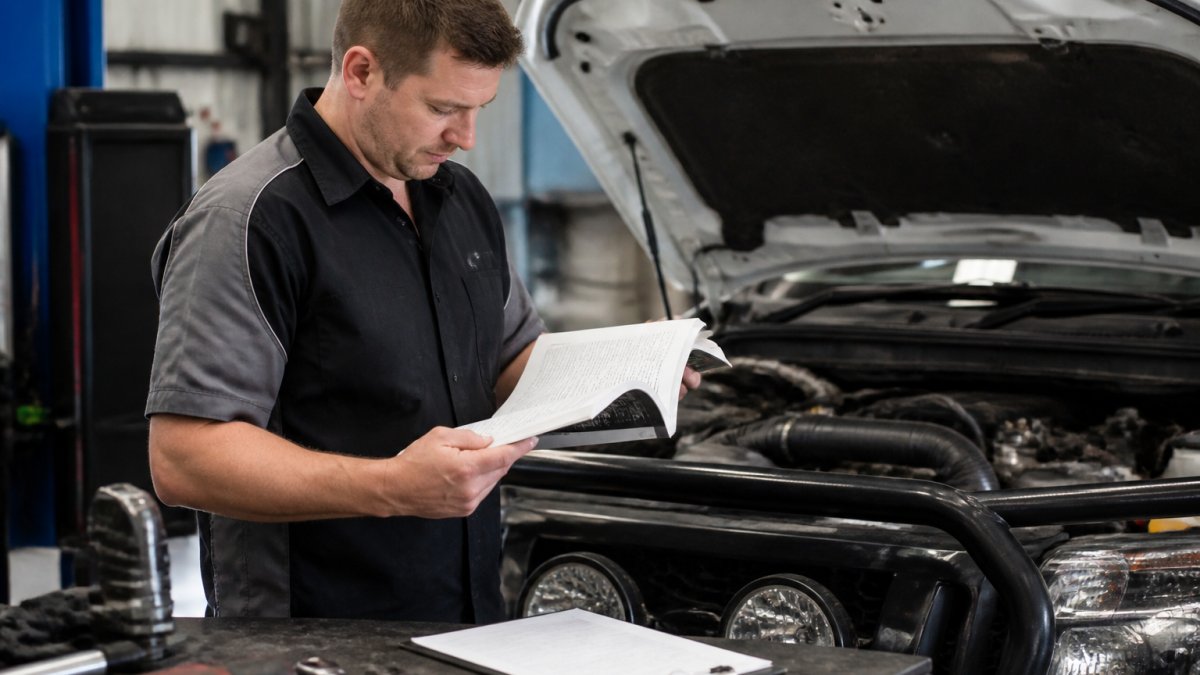
Logbook Servicing and Your Australian New-Car Warranty
If a warranty claim is ever questioned, a complete service history is your evidence. A missing stamp is harder to argue than a present one.
How to Turn the Logbook Into a Workable Plan
A stamped logbook protects resale value and warranty claims. It also tells the next mechanic exactly what has and has not been done.
What a Scheduled Service Actually Includes
A logbook service is not just an oil change. A typical scheduled service includes:
- Replacement items: engine oil, oil filter, and at set intervals air filter, cabin filter, spark plugs, brake fluid and coolant.
- Inspection items: brake pads and rotors, tyre tread and pressure, belts and hoses, suspension and steering, battery condition, and fluid levels.
- Diagnostic items: scanning for stored fault codes and checking warning lights.
A basic service covers the replacement items due at that interval plus a safety inspection. A major service adds the larger replacement items and a longer inspection. Knowing the difference helps you compare quotes fairly and avoid paying for work your logbook does not call for yet.
The 30,000 km Service Checklist: What to Expect
Typical items on a 30,000 km service checklist:
- Engine oil and oil filter replaced
- Air filter inspected, replaced if dirty
- Cabin filter checked
- Brake pads and rotors measured
- Tyre tread, pressure and wear pattern checked
- Wheels rotated and balanced if needed
- Fluid levels checked: coolant, brake fluid, transmission fluid, washer fluid
- Battery condition and terminals tested
- Belts and hoses inspected for cracks
- Suspension and steering checked
- Warning lights scanned with a diagnostic tool
Weekly and Monthly Car Checks You Can Do Yourself
Weekly:
- Check tyre pressure when tyres are cold
- Look at tyre tread depth and for uneven wear
- Walk around the car and check all lights
- Look under the car for fresh drips
Monthly:
- Check engine oil on the dipstick
- Check coolant level at the reservoir
- Check brake fluid level
- Inspect battery terminals for white or green crust
- Top up washer fluid
- Test wipers for smearing
How Long Does a Car Service Take?
We book longer windows for major services so the car is not rushed. If you need the vehicle back by a set time, tell us when you book.
Adjusting Your Schedule for Mildura Conditions, Age and Heavy Use
If you are unsure what your driving does to your intervals, ask us. We would rather adjust a schedule than replace a gearbox. For a local cost guide before you book, see our breakdown of routine car maintenance costs in Mildura.
Booking Your Next Scheduled Service
The best schedule is the one you actually keep. Pick a date for your next service now, based on whichever comes first, and put it in your calendar with both the kilometre and month figure.
At Mallee Auto & Agricultural Services, our skilled mechanics work on all vehicle types. We use modern diagnostic tools for accurate issue detection. Our pricing is fair and transparent with no hidden charges, and we offer pensioner discounts.
If you are searching for a trusted car service near me, book with us.
Frequently Asked Questions
How often should you service your car in Australia?
Your owner’s manual and logbook provide the service schedule for your model.
Should you service your car by kilometres or time?
Check your logbook for the service schedule for your vehicle.
What does a 30,000 km service checklist usually include?
Your manufacturer’s logbook lists the service items for your vehicle.
How long does a car service take?
A routine logbook service usually takes between one and three hours. A basic oil and filter change can be done in about an hour, while a major interval service with brake, fluid and filter work may take most of a day. If extra repairs are found, the workshop should contact you before proceeding. Booking ahead and dropping the car off in the morning gives the mechanic time to complete everything properly.
Your car’s schedule is already written in the logbook. The only question is whether you follow it or let repairs find you first. Get started with Mallee Auto & Agricultural Services and book a service that matches your manufacturer’s intervals, with clear pricing before any work begins.

