
Last Updated: October 31, 2026
Quick Summary
Common causes of suspension clunking include worn ball joints, sway-bar links and bushings, control-arm bushings, struts and strut mounts, and loose hardware. Match the noise to the moment it happens, then book an inspection so a technician can confirm the fault before parts are replaced.
- A clunk is a symptom, not a diagnosis, since several parts can produce a nearly identical sound.
- Worn ball joints usually make a heavier, lower knock than a sway-bar rattle.
- A failed sway-bar link often produces a light rattle over small bumps.
- Push down on each corner and release; the car should settle within one or two rebounds.
- Stop driving if the steering suddenly feels loose or a wheel visibly leans in or out.
Table of Contents
- Why Your Car Makes Clunking Noises and What It Means
- Car Clunking Over Bumps: The Most Common Suspension Causes
- Bad Ball Joint Symptoms You Should Not Ignore
- Clunking Noise When Turning: Steering and CV Joint Clues
- Loose Hardware, Tie Rods and Wheel Bearings
- Safe Checks You Can Do Before a Suspension Inspection
- Is It Safe to Drive? Urgency and Repair Guidance for Mildura Drivers
- Book a Suspension Inspection at Mallee Auto & Agricultural Services
- Frequently Asked Questions
Why Your Car Makes Clunking Noises and What It Means
A clunk is a sound of metal hitting metal, and in a front suspension it almost always means something has worn loose.
Suspension clunking is a knocking or thumping noise from the suspension or steering when the car travels over bumps, turns, or changes direction.
The first thing to understand is that a clunk is a symptom, not a diagnosis.
Car Clunking Over Bumps: The Most Common Suspension Causes
Car clunking over bumps points to parts that carry load and absorb movement: ball joints, sway-bar links, control-arm bushings and struts. Each wears differently and each sounds slightly different. Here’s the order we work through.
- Worn ball joints – a heavy, dull knock over bumps or when braking
- Sway-bar links and bushings – a lighter rattle or knock on uneven ground
- Control-arm bushings – a thud or clunk with vague steering
- Struts, shocks and strut mounts – a knock plus bouncing or a creak
- Loose hardware – a sharp clink or rattle that comes and goes
The location matters too. If you want a wider list of warning signs, our guide to the 7 signs of faulty car suspension covers what else to watch for.
Worn Ball Joints
Ball joints connect the control arm to the steering knuckle and let the wheel move up and down while steering. They wear out slowly, and the first sign is usually a knock over bumps or a clunk when you brake.
A worn ball joint is also a safety issue. If it fails completely, the wheel can separate from the suspension, so it should not be left for later.
Sway-Bar Links and Bushings
Sway-bar links, also called drop links, connect the sway bar to the suspension. They are small, cheap parts that take a beating on rough roads and fail often.
A failed link usually produces a light rattle or knock over small bumps and a clunk when one wheel hits a pothole. Sway-bar bushings wear the same way and make a similar noise.
Control-Arm Bushings and Mounts
Control-arm bushings are rubber mounts that let the control arm pivot while soaking up vibration. When the rubber cracks or perishes, the arm moves more than it should.
You’ll notice a thud over bumps, steering that feels vague, and sometimes uneven tyre wear. Heat can cause rubber bushings to age faster than many drivers expect.
Struts, Shocks and Strut Mounts
Struts and shock absorbers control how the car moves over bumps. When they wear, the car bounces more and the tyres lose contact with the road.
A worn strut mount, the bearing and rubber at the top of the strut, often makes a knock or creak when you turn the wheel. If the clunk comes with a floaty, bouncy ride, the struts are a prime suspect.
Bad Ball Joint Symptoms You Should Not Ignore
Bad ball joint symptoms include a clunk over bumps, a knock when braking, uneven or cupped tyre wear, and steering that wanders. Any one of these deserves a check.
Here’s what separates a ball joint from other suspects:
- The noise is heavier and lower than a sway-bar rattle
- It shows up over bumps and when braking
- The steering feels loose or vague
- Tyres wear unevenly on the inside edge
Watch out: a ball joint that is close to failure can let the wheel collapse. If you hear a loud knock and the steering suddenly feels different, stop driving and get it inspected.
Clunking Noise When Turning: Steering and CV Joint Clues
A clunking noise when turning usually points to steering components or CV joints, not the shocks. The clue is timing: if the noise only appears mid-turn, look at these parts first.
- Tie rods – a clunk or knock when you turn the wheel, plus vague steering
- CV joints – a rhythmic clicking on full lock, worse on tight turns
- Strut mounts – a creak or pop as you turn the wheel
- Steering rack – a knock over bumps that gets worse with wear
CV joints are the giveaway when the noise is a repeating click rather than a single clunk. That click means the joint’s bearings are worn and the joint needs replacing before it fails.
Loose Hardware, Tie Rods and Wheel Bearings
Loose hardware is the cheapest possible cause and the easiest to miss. A loose strut bolt, a worn tie rod end or a failing wheel bearing can all mimic a suspension clunk.
Wheel bearings usually make a hum or growl that changes with speed, not a clunk. Tie rod ends make a knock when you turn or hit bumps.
Because brake and suspension hardware sit side by side, a proper inspection can check both. If the check turns up worn brake parts, you can book car brake repair Mildura at the same time.
Safe Checks You Can Do Before a Suspension Inspection
You can gather useful clues before you book anything, and doing so helps a technician start in the right place. These checks take about ten minutes, need no tools beyond a torch, and are limited to what is safe on a parked car.
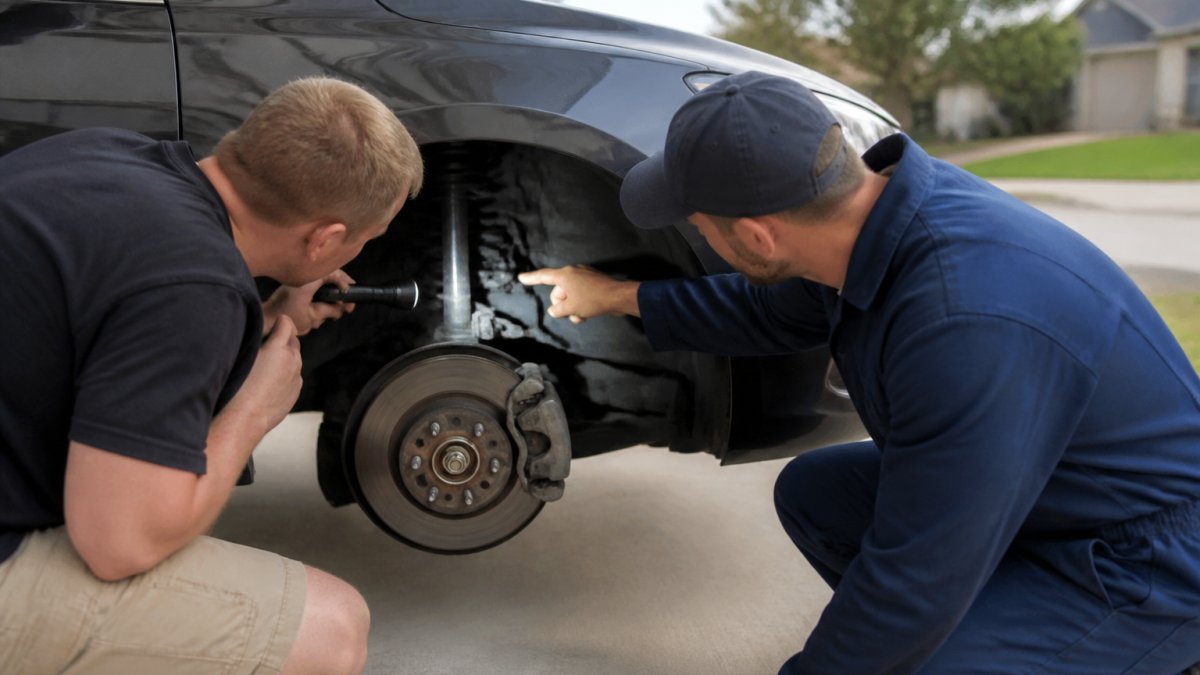
Before you start: park on flat, firm ground, set the handbrake, select park or first gear, and chock the wheels if you have chocks.
What to observe while parked
- Bounce test: push down hard on each corner and release. The car should settle within one or two rebounds. If it keeps bouncing, the struts or shocks on that corner are suspect.
- Ride height: compare the gap between the tyre and the guard on each side. A sagging corner can point to a broken spring or collapsed mount.
- Visible rubber: shine a torch behind each wheel and look at the sway-bar bushes and control-arm bushes. Cracked, perished or missing rubber is a common finding, and heat speeds up that ageing.
- Strut tops: open the bonnet and look at the top mounts. Shiny rub marks, cracked rubber or a bolt that looks disturbed are worth noting.
Match the noise to the moment
Write down when the clunk happens, because the timing narrows the list faster than the sound itself:
- Over speed humps or rough bitumen: ball joints, sway-bar links, control-arm bushes or strut mounts.
- While turning, especially on full lock: CV joints, tie-rod ends or strut-top bearings.
- When braking: ball joints or control-arm bushes loaded under deceleration.
- At low speed on smooth ground: often a loose component or a worn bush that moves under small inputs.
- A single thud after a sharp bump: commonly a worn bush or a loose strut bolt.
What not to do
Do not pry components with a screwdriver, do not loosen or tighten suspension bolts to “test” them, and do not drive with the bonnet unlatched after checking strut tops.
When you book, tell the workshop the noise timing, the corner it seems to come from, and anything you observed. You can also arrange routine car maintenance near me Mildura while the car is in the workshop.
Is It Safe to Drive? Urgency and Repair Guidance for Mildura Drivers
Some clunks can wait a week. Others should not move another kilometre. The deciding factor is rarely the noise alone; it is what the noise comes with. Use the table below as a guide, then read the reasoning underneath because the combination of symptoms matters more than any single row.
| Noise or symptom | Likely cause | Urgency |
|---|---|---|
| Light rattle over small bumps, steering normal | Sway-bar links or bushes | Book within a week or two |
| Dull knock over bumps, vague steering | Ball joints or control-arm bushes | Book within days |
| Clicking on full lock | CV joint | Book soon, avoid tight turns |
| Loud knock plus steering change or pulling | Ball joint near failure | Stop driving |
| Clunk plus bouncy, floaty ride | Struts or strut mounts | Book within days |
| Clunk plus severe vibration or a wheel that feels loose | Wheel bearing, loose hardware or a failing joint | Stop driving |
When to stop rather than book
Stop driving and arrange prompt assistance if any of the following appear alongside the clunk:
- The steering suddenly feels loose, vague or different from side to side.
- The car pulls to one side under braking or acceleration.
- A wheel visibly leans in or out at the top.
- You hear a loud knock followed by a change in handling.
- Severe vibration or a wheel that feels like it is moving independently.
These signs point to a component that may be close to failure. A ball joint that lets go can separate the wheel from the suspension, and that is not a risk worth taking on a road shoulder.
What a suspension inspection involves
A proper inspection is more than a quick look. A technician will typically:
- Road-test the car to reproduce the noise and note the conditions.
- Raise it on a hoist and check each joint, bush and mount for play, cracking or looseness.
- Load the suspension with a pry bar or a dedicated tool to reveal movement that is invisible at rest.
- Check related items such as tie-rod ends, wheel bearings, strut tops and hardware torque.
- Confirm the fault before quoting, so good parts are not replaced on a guess.
After the repair
If steering or suspension components are replaced, a wheel alignment is often needed to reset the geometry and protect the tyres. Ask whether an alignment is included or recommended for the work being done.
Pricing depends on the work required, so it is best to check the Mallee Auto & Agricultural Services website for current prices or request a quote before any work starts.
Book a Suspension Inspection at Mallee Auto & Agricultural Services
A suspension clunk is easy to live with and easy to ignore. It is also one of the few noises that can turn into a safety failure without much warning.
At Mallee Auto & Agricultural Services in Mildura, Victoria, we use modern diagnostic tools to find the actual cause. You get fair, transparent pricing and pensioner discounts.
Get started with Mallee Auto & Agricultural Services and book a suspension inspection today.
Frequently Asked Questions
What does a bad ball joint sound like?
A worn ball joint usually produces a dull metallic clunk or knock when you drive over bumps, turn the steering wheel or brake sharply. It can also cause a rattling sound at low speeds and vague, wandering steering. Because a failed ball joint can separate and cause a loss of control, have any repeat clunk from the front end checked by a mechanic rather than waiting for it to worsen.
Can worn sway-bar links cause suspension clunking?
Yes. Sway-bar links, also called drop links, are a very common source of suspension clunking. Their small ball joints and bushings wear with age, and the result is a rhythmic knock or rattle over uneven roads and speed humps. A mechanic can usually confirm the fault during a suspension inspection.
Is it safe to drive a car with a clunking suspension?
It depends on the cause. A worn sway-bar link is annoying but rarely dangerous in the short term. A failing ball joint, tie rod or strut mount is a different story and can affect steering and braking. If the clunk comes with wandering steering, uneven tyre wear or a knock when turning, stop driving and arrange an inspection. When in doubt, have it checked before your next long trip.
When should I book a suspension inspection?
Book a suspension inspection as soon as a clunk becomes repeatable, meaning you can trigger it on the same bump or turn each time. Also book if you notice uneven tyre wear, a pulling steering wheel or a knock that has grown louder over a few weeks. Early diagnosis usually means a cheaper repair, and a mechanic can identify which components are worn before any work begins.

