
Quick Summary
The best brake pads for towing vehicles depend on your load and terrain, not one universal product. Semi-metallic pads generally offer stronger cold bite and better heat tolerance for heavy, frequent towing, while ceramic pads suit lighter towing with quieter, lower-dust braking. Always match the compound to your vehicle’s manufacturer specification.
- Towing adds load, so brakes absorb more energy, heat and wear on every stop.
- Semi-metallic pads generally tolerate sustained high-temperature braking better than ceramic pads.
- Ceramic pads usually produce less dust and noise and wear more slowly in light duty.
- Check pad part numbers for your make, model, year and axle before buying.
- Brake fade is most likely on long downhill sections, so use a lower gear to let the engine assist.
Table of Contents
- Why Towing Puts More Demand on Your Brakes
- Ceramic vs Semi-Metallic Brake Pads for Towing
- Heat Buildup, Brake Fade and Pedal Feel Under Load
- Front Versus Rear Brake Wear When Towing
- Top Brake Pad Options Compared for Towing Vehicles
- Brake Inspection Before Towing: What to Check
- Choosing Brake Pads for Your Caravan Setup
- Booking a Brake Check Before Your Next Tow
- Frequently Asked Questions
Why Towing Puts More Demand on Your Brakes
Last Updated: November 11, 2026
Towing changes the physics of stopping. A loaded caravan or trailer adds to what your brakes must slow down, and the brake pads on your towing vehicle absorb that extra energy every time you slow for a corner or a junction. Choosing the best brake pads for towing vehicles starts with understanding that load.
The effects of this are common on towing vehicles, particularly those covering long highway routes with a van behind them, which often return with worn pads and glazed rotors that were fine for daily driving. The extra load is not dramatic on any single stop, but it repeats hundreds of times over a long trip.
The extra demand shows up in three ways:
- Longer stopping distances: Mass increases momentum, so the same pedal pressure stops the vehicle more slowly.
- Higher heat: Friction converts that extra energy into heat, which the pads and rotors must dissipate.
- Faster wear: Pad material wears more quickly under sustained high-temperature friction.
Pad selection matters most in these conditions. A pad that performs well around town may fade on a long descent, and that is the gap this comparison is designed to close.
Ceramic vs Semi-Metallic Brake Pads for Towing
Ceramic and semi-metallic pads are the two compounds most often compared for towing, but the useful comparison is not which one is ‘better’ in the abstract. It is how each behaves on cold bite, heat tolerance, wear, dust, noise and rotor compatibility under the load and terrain you actually tow. The differences are real but product-specific, so treat the table below as a framework for asking the right questions rather than a ranking.
| Attribute | Ceramic pads | Semi-metallic pads |
|---|---|---|
| Cold bite | Moderate; can feel less aggressive on the first stop | Generally stronger from cold, which many towers value with a loaded trailer |
| Heat tolerance | Consistent up to a point, then fades; formulation varies widely | Metal fibres help dissipate heat, so they often tolerate sustained high-temperature work better |
| Wear rate | Usually slower wear and longer service life in light duty | Can wear faster, and some formulations are harder on rotors |
| Dust | Less dust, lighter in colour | More dust, often darker and more visible on wheels |
| Noise and vibration | Quieter in most applications | More prone to squeal and vibration, especially when cold |
| Rotor compatibility | Gentler on rotors in normal use | Some semi-metallic formulations accelerate rotor wear; check the manufacturer’s rotor specification |
A common pattern is that ceramic pads suit drivers who want smooth, quiet braking and light-to-moderate towing, while semi-metallic pads suit heavier, more frequent loads where bite and heat tolerance take priority. That is a starting point, not a rule. Two ceramic pads from different brands can behave very differently, and a well-specified semi-metallic pad can be quieter than a cheap ceramic one.
Watch out: some vehicles are designed around a specific pad compound, and changing it can alter pedal feel, wear rates and rotor life. Check the manufacturer’s specification for your make, model, year and axle before buying, and confirm the pad is listed for your brake configuration rather than assuming a compound is universally suitable.
For Australian towing, the conditions that matter most are long descents, hot ambient temperatures and sustained load. A pad that performs well around town may fade on a long downhill section, so match the compound to the worst duty cycle you regularly tow, not the easiest.
Heat Buildup, Brake Fade and Pedal Feel Under Load
Brake fade occurs when pads and rotors overheat and friction drops, so the pedal feels like it needs more effort to achieve the same stop. It is most likely on long downhill sections, such as the descents in the ranges, where the brakes are applied continuously.
Warning signs include a spongy or soft pedal, a longer pedal travel and a burning smell after a descent. If you notice any of these, slow down, use a lower gear to let the engine assist, and allow the brakes to cool before continuing.
Front Versus Rear Brake Wear When Towing
On most towing vehicles, the front brakes do the majority of the work because weight shifts forward under braking. When towing, the trailer’s weight pushes down on the tow ball, which can increase the load on the rear axle and change the balance of braking.
Front and rear pads can wear at different rates, and this varies by vehicle and by how the trailer is loaded. Check both axles at every service rather than assuming they wear evenly. Uneven wear between sides can also point to a sticking caliper or a rotor problem.
Top Brake Pad Options Compared for Towing Vehicles
No single pad is the ‘best’ for every towing vehicle. For comparison, see the daily-driving pad recommendations alongside the options below. Fitment depends on make, model, year, axle, brake configuration and loaded towing mass, and Australian availability varies.
| Option | Compound | Best for | Key limitation |
|---|---|---|---|
| ACDelco 14D785CH | Ceramic | Heavy towing with a ceramic preference | Price and fitment not verified for Australian models |
| EBC Stage 9 Towing Kit | Yellowstuff 4000 series | Matched towing brake kit | Kit contents and Australian availability need checking |
| PowerStop Carbon Fibre | Carbon fibre | Wear resistance on travel trailers | Specific model and price not stated |
| Wagner Severe Duty | Severe-duty | Towing drivers wanting a severe-duty option | Evidence is a forum recommendation |
| Mallee Auto & Agricultural Services | Installed and serviced in-house | Towing vehicles serviced locally in Mildura | Quote based on your vehicle |
Fitment checklist before you buy
Before comparing brands, confirm the following for your vehicle and trailer setup:
- Vehicle details: make, model, year, engine and drivetrain.
- Axle and brake configuration: front and rear pad part numbers, rotor diameter and thickness, and whether the vehicle has a factory towing package.
- Loaded towing mass: the actual ball weight and trailer mass you tow, not the brochure maximum.
- Trailer braking system: electric, electric-over-hydraulic or mechanical, and whether the controller is set correctly.
- Duty cycle: how often you tow, typical terrain and ambient temperatures.
- Australian compliance: confirm the pad and any brake upgrade meet the requirements applicable to your vehicle and trailer, and check with a qualified workshop if you are unsure.
Pros and cons of each option
Pads alone do not fix weak braking. Rotors, calipers, brake fluid and the trailer brake controller all affect stopping performance, so a whole-system inspection is worth considering rather than a pad swap alone.
Brake Inspection Before Towing: What to Check
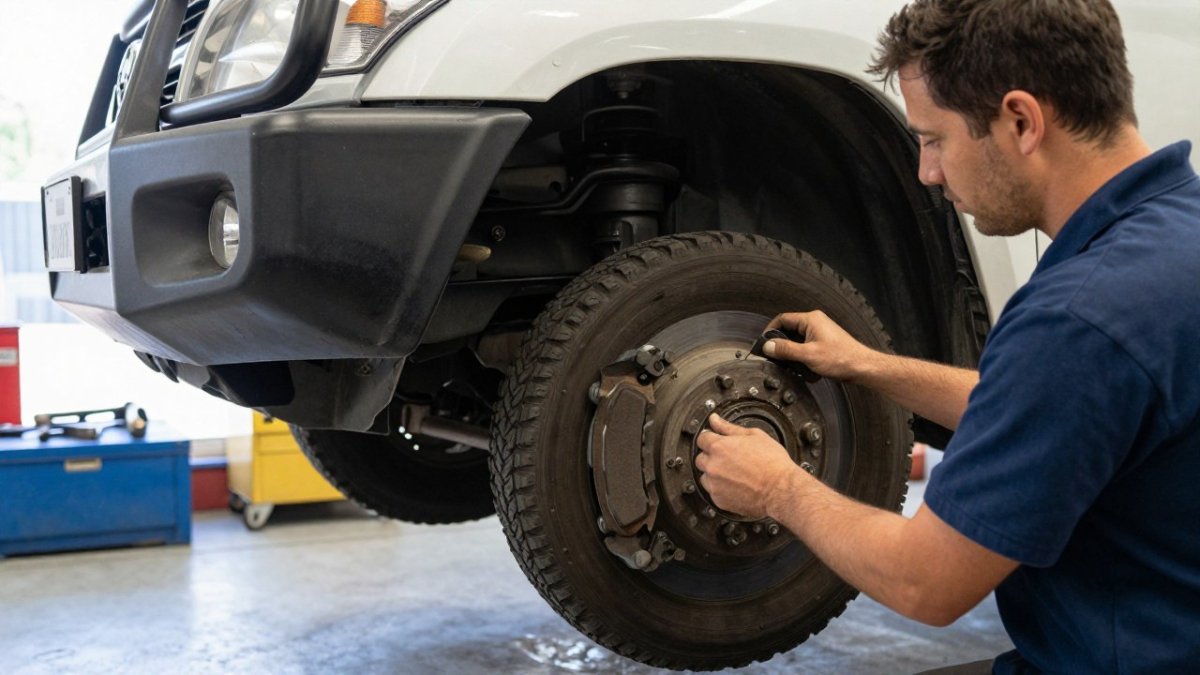
Before a long tow, inspect the pads, rotors, calipers and brake fluid on both axles. If you are getting ready for an inspection, this step-by-step checklist covers the brake checks in order. A guide to tell whether your brakes need replacing walks you through the signs to look for. Look for pad thickness, scoring or glazing on the rotor, and any fluid leaks. Our rotor replacement guide explains when rotors need replacing alongside the pads. Brake fluid that has absorbed moisture can reduce performance under heat, so check its condition as well as its level.
Choosing Brake Pads for Your Caravan Setup
For caravan setups, match the pad compound to your typical load and terrain. Frequent heavy towing in hilly country favours compounds with strong heat tolerance. Occasional towing on flat roads may suit a quieter ceramic pad.
Always fit pads designed for your vehicle and check that the brake controller on the caravan is set correctly. You can also review what to expect from a logbook service quote before booking. Pads alone cannot fix a poorly set-up trailer brake system.
Booking a Brake Check Before Your Next Tow
If your brakes feel different, or you are planning a long trip, a professional inspection is the simplest next step. Mallee Auto & Agricultural Services offers workshop inspections in Mildura, and pensioner discounts are available. Call us to discuss your vehicle and the brake service it needs.
Frequently Asked Questions
What type of brake pads are best for towing?
For most towing vehicles, ceramic or semi-metallic pads rated for heavy duty use are the usual choices. Ceramic pads tend to run quieter and produce less dust, while semi-metallic pads generally handle sustained heat better under heavy loads. The right choice depends on your vehicle, the loaded weight of your trailer or caravan and how often you tow. Check that any pad you consider is specified for your vehicle before buying, and have a mechanic confirm fitment and rotor compatibility.
Are ceramic or semi-metallic brake pads better for towing?
Neither is better in every situation. Semi-metallic pads usually offer stronger bite and better heat tolerance, which helps on long descents with a heavy load. Ceramic pads offer smoother, quieter braking and lower dust, which many drivers prefer for daily use. If you tow often in hilly country or near Mildura’s warmer months, prioritise heat resistance. If towing is occasional, ceramic may suit you well. Discuss your towing pattern with your mechanic before deciding.
How often should brake pads be checked when towing?
Check brake pads before any significant towing trip and at every routine service. Towing increases wear and heat, so pad thickness can drop faster than with normal driving. Ask your mechanic to measure pad thickness, inspect rotors for scoring and check brake fluid condition. If you tow regularly, inspection every few months is a sensible approach. Address any squealing, grinding or a soft pedal promptly rather than waiting for the next service.
Should brake pads and rotors be replaced together?
Often they should, especially if the rotors are worn below their minimum thickness, scored or warped. New pads on worn rotors can wear unevenly and reduce braking performance. Your mechanic can measure rotor thickness and surface condition during inspection and advise whether resurfacing or replacement is needed. Replacing pads and rotors together can also give more consistent braking response, which matters when you are carrying extra load.

