
Last Updated: November 10, 2026
Quick Summary
Worn suspension parts such as shock absorbers, control arms and bushings can let a tyre bounce or tilt, causing uneven wear like cupping, feathering or one-sided shoulder wear. Because suspension problems tyre wear can look similar to pressure or rotation issues, check those first, then inspect the suspension.
- Check tyre pressure and rotation history before blaming the suspension
- Cupping often points to worn shock absorbers or struts
- Feathering usually points to toe out of specification from worn bushings or tie rods
- Replace worn joints or bushings first, then re-align, or the alignment will not hold
- A simple bounce test shows the car should settle after one or two rebounds
Table of Contents
- How Suspension Components Keep Your Tyres on the Road
- Tyre Wear Patterns and What They Tell You
- Uneven Tyre Wear Causes Beyond the Suspension
- Wheel Alignment and Tyre Wear: How the Two Connect
- A Safe Suspension Inspection You Can Do at Home
- Mildura Driving Conditions and Why Local Checks Matter
- Booking Your Suspension and Alignment Check in Mildura
- Frequently Asked Questions
How Suspension Components Keep Your Tyres on the Road
Your tyres are the only part of your car that touches the road, so any suspension problems tyre wear will show up there first. Every bump, corner and brake pass runs through them. Many tyre problems start with the suspension rather than the tyres themselves.
The suspension system holds the wheels in the right position as the road moves underneath them. The main parts include shock absorbers, struts, control arms and bushings. When any of these wear out, the tyre can lose full contact with the road. A tyre that bounces or tilts wears unevenly, and it wears faster than it should.
- Shock absorbers and struts control how the wheel rises and falls after each bump
- Control arms hold the wheel in place at the correct angle
- Bushings are rubber or polyurethane pieces that absorb movement between parts
- Ball joints and tie rods keep steering and wheel angle accurate
Worn parts can change the wheel angle slightly, which can lead to uneven tyre wear over time.
Tyre Wear Patterns and What They Tell You
Tyres show their history in the tread. Reading the wear pattern is one of the quickest ways to spot a suspension problem, but a pattern points to a likely cause rather than a confirmed one. The same visual symptom can come from a worn shock absorber, a bent or worn control arm, an incorrect alignment setting, or simply a pressure or rotation habit. The useful question is not ‘what does this look like’ but ‘what else could produce this, and what do I check next’.
The table below sets out the common patterns, the suspension parts most often behind them, and the non-suspension causes that can look similar.
| What you see | Most likely suspension link | Non-suspension causes that look similar |
|---|---|---|
| Scooped dips spaced around the tread (cupping) | Worn shock absorbers or struts letting the wheel bounce | Wheel imbalance, bent rim, loose wheel bearing |
| Wavy, rounded dips with a softer edge (scalloping) | Worn shocks combined with a lightly loaded or high-speed driving pattern | Balance problems, aggressive braking habits |
| Tread blocks sharp on one side and smooth on the other (feathering) | Toe out of specification, usually from worn control arm or tie rod bushings | Incorrect toe set after a kerb strike, not a suspension wear problem |
| One shoulder wearing faster than the other | Camber drift from worn control arms or ball joints | Persistent under-inflation or a load pushed to one side |
| Centre worn, edges intact | Not usually suspension | Over-inflation, the most common cause |
| Both edges worn, centre intact | Not usually suspension | Under-inflation, especially on utes carrying loads |
A practical way to narrow it down is to work through three checks in order. If you hear knocking or clunking during a home check, a guide to diagnosing those specific noises can help you pin down the source. First, confirm the pressure is correct for the load you are carrying, because under-inflation and over-inflation mimic several suspension patterns. Second, check the rotation history: if the front tyres have been left in place for a long time, the wear will look like a suspension problem even when it is not. Third, look for the component that would produce the pattern you see, using the inspection steps later in this article. Only when the pressure and rotation are right, and the pattern remains, is the suspension the strongest suspect.
Watch out: a scalloped tyre that is only mildly worn is not proof of a failed shock absorber on its own; a workshop should test the damper and check the wheel balance before any part is replaced. To learn how long worn shock absorbers last and when they should be replaced, see our guide.
Unsealed farm tracks and rough gravel shoulders can produce cupping on tyres that otherwise look healthy. If your car does most of its work on that kind of surface, note the wear pattern and the road type when you book in, as this history can help narrow the diagnosis.
Uneven Tyre Wear Causes Beyond the Suspension
Not every uneven tyre has a suspension fault. Before you blame the suspension, check these common causes:
- Incorrect tyre pressure: Under-inflation wears the outer edges. Over-inflation wears the centre.
- Skipped tyre rotations: Front tyres on front-wheel-drive cars often wear faster than the rear ones.
- Wheel balance problems: These usually cause vibration and patchy wear rather than a clear pattern.
- Hard braking and cornering: Regular aggressive driving speeds up wear on the front tyres.
- Overloading: Heavy loads, including farm gear or trailers, push more weight through the tyres.
A simple way to separate these from a suspension issue is to check the pressure and rotation history first. If the wear persists after those are corrected, the suspension is the next suspect.
Wheel Alignment and Tyre Wear: How the Two Connect
Wheel alignment sets the angle of each wheel relative to the car and the road. Three settings matter for tyre wear. Toe is the inward or outward angle of the wheels when viewed from above; even a small amount of toe means the tyre is slightly dragged sideways as it rolls, which scrubs tread off quickly.
The mechanism is straightforward. A tyre is designed to roll straight, with its contact patch flat against the road. Once any of these angles moves out of specification, the contact patch is no longer flat, and one edge carries more load and more scrubbing than the other. Over thousands of kilometres that uneven load becomes the feathering, shoulder wear or one-sided wear you see on the tread.
Worn suspension parts are a common reason alignment drifts. A worn control arm bushing can allow the wheel to shift under braking or cornering, so the angle changes each time the car takes a corner. A worn ball joint or tie rod end can let toe creep out of specification between checks. This is why a workshop that checks alignment alone may miss the cause. A workshop alignment check measures the three angles against the manufacturer’s specification.
If the inspection finds worn joints or bushings, the usual sequence is to replace the worn part first and then re-align the car. Before committing, you can read whether suspension repair is worth paying for on an older car. Re-aligning over a worn joint wastes the job, since the setting will not hold. A workshop should be able to explain which measurements were taken, what was out of specification, and which parts were replaced.
Watch out: a wheel alignment that has just been corrected can drift again quickly if a suspension part is still worn, so ask the workshop whether the joints were checked before the alignment was set.
For drivers in Mildura, the combination of rough rural roads, kerbs at car parks and heavy loads on utes can knock alignment out of specification. Regular checks after a kerb strike or a pothole are a practical habit that costs far less than replacing a set of tyres worn on one edge.
A Safe Suspension Inspection You Can Do at Home
You can do a basic visual check safely at home. This does not replace a workshop inspection, but it can show you when to book one.
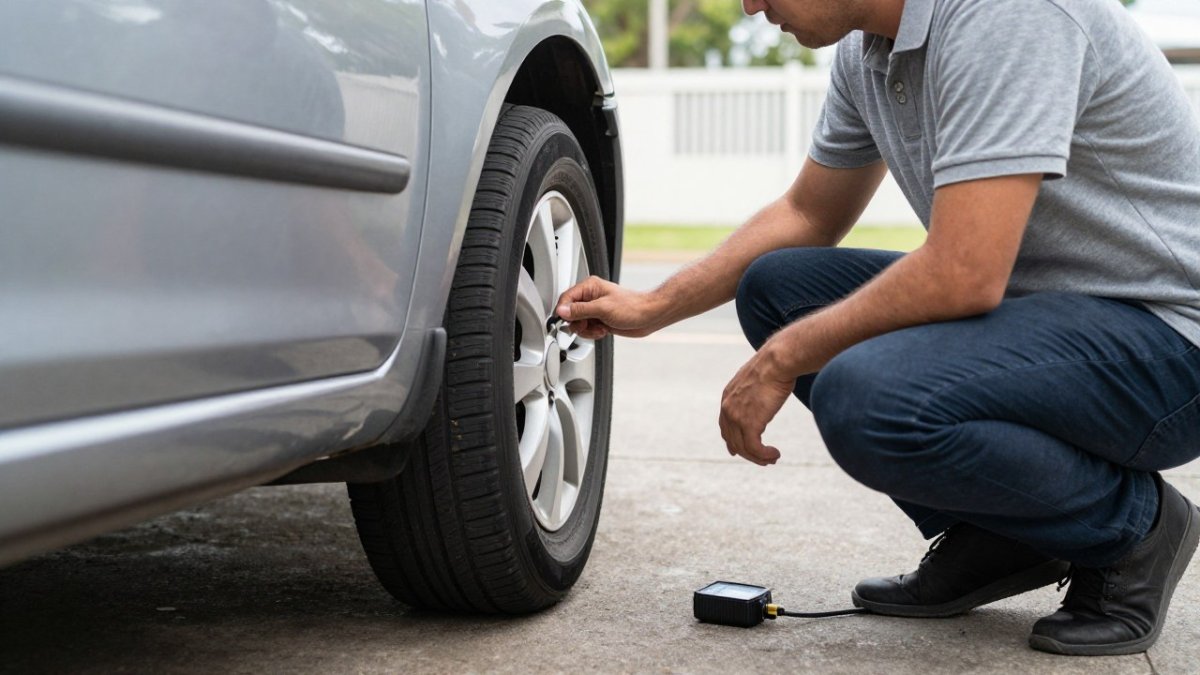
- Park on flat, level ground and apply the handbrake. Chock the wheels if possible.
- Check tyre pressure when the tyres are cold. Use the figure on the driver’s door sticker.
- Look at the tread pattern across the full width of each tyre. Run your hand across it slowly.
- Bounce each corner of the car firmly and release. The car should settle after one or two rebounds. Continuous bouncing suggests worn shock absorbers.
- Look for oil on the shock absorbers or struts. Oily, wet casings usually mean the unit has failed.
- Check the steering by turning the wheel slowly from side to side. Excess play or clunks point to worn joints.
- Listen while driving slowly over a bump in a quiet street. Knocks, clunks or rattles need a closer look.
Do not work under a car supported only by a jack. Our list of warning signs that mean the car needs professional attention shows which findings should prompt a workshop visit. Use proper stands, or leave the lifting to a workshop.
Mildura Driving Conditions and Why Local Checks Matter
Mildura’s conditions can put extra load on suspension and tyres. Rural roads, gravel shoulders and unsealed farm tracks are common in the Mallee, and summer heat can soften rubber bushings and dry out tyre compounds faster.
Harvest season and farm work add weight. Utes and four-wheel drives that carry tools, water or machinery often run heavier than the manufacturer intended. That load speeds up wear on shocks and bushings.
Local checks matter because wear builds up over the same routes you drive every week. A workshop familiar with these conditions can help you judge which repairs can wait and which cannot.
Booking Your Suspension and Alignment Check in Mildura
If your tyre tread looks uneven, or the car bounces, pulls or clunks, book a suspension and alignment check soon. Early repairs are usually cheaper than replacing tyres that have worn out too quickly. Waiting can also turn a worn bushing into a failed control arm, which is a safety issue.
Mallee Auto & Agricultural Services provides automotive repair and maintenance in Mildura, with skilled mechanics who use modern diagnostic tools for accurate issue detection. For current details of what is available, visit our website.
Pricing depends on the vehicle and the work needed, so we recommend checking the current pricing on our website or requesting a quote before you bring the car in. We also offer pensioner discounts.
Get your tyres and suspension checked before the wear gets worse. Book a check with Mallee Auto & Agricultural Services and keep your car safe on the road. You can find our local automotive repair and tyre service options in Mildura on our website.
Frequently Asked Questions
How do suspension problems affect tyre wear?
Suspension components hold the tyre flat on the road and keep it moving in a controlled way. When shock absorbers, struts, control arms or bushings wear out, the tyre can bounce or tilt instead of staying in full contact. That bouncing produces cupping or scalloping across the tread, while worn parts that change the wheel angle can produce feathering or edge wear. Replacing the worn component alone may not stop the wear, so the tyres should be checked as well.
Can worn shock absorbers cause uneven tyre wear?
Yes. Worn shock absorbers let the wheel bounce after bumps, so the tyre lifts and slams back onto the road repeatedly. This typically leaves a scalloped or cupped pattern, often in a repeating dip-and-ridge shape around the tyre. A bounce test is a quick first check: push down firmly on each corner of the car and let go. If the car keeps rocking more than once or twice, the dampers are likely worn and should be inspected by a mechanic.
How can I tell whether uneven tyre wear is caused by suspension or wheel alignment?
Look at the pattern. Feathering, where the tread edges are sharp on one side and smooth on the other, is most often linked to alignment toe settings. Cupping and scalloping point more towards worn dampers or loose suspension parts. Wear concentrated on the inner or outer edge usually indicates a camber issue. Many faults involve both systems, so a workshop check of the suspension and alignment together gives the most reliable answer.
Is it safe to drive with suspension problems and unevenly worn tyres?
Driving with significant suspension wear reduces braking control and makes handling less predictable, particularly in wet or gravel conditions. Worn tyres lose grip faster in an emergency stop. If the car pulls to one side, vibrates at speed or shows severely worn tread, arrange an inspection promptly rather than waiting for the next scheduled service. Continuing to drive on badly worn parts can also damage other components.

