
Last Updated: November 3, 2026
Quick Summary
You should replace ball joints when they show measurable play beyond the manufacturer’s limit, a torn boot with grease loss, or both, not at a set mileage. Clunking over bumps, vague steering, uneven tyre wear or a shimmy at speed mean you should book an inspection before driving further.
- Mildura’s long highway runs, rough unsealed roads and heavy loads wear ball joints faster than mileage alone suggests.
- A torn grease boot with grease loss is a reason to inspect closely even when the joint feels tight.
- Play at or beyond the manufacturer’s limit, or clunking plus visible play, means replace before long trips.
- On many modern vehicles the ball joint comes as part of the whole control arm, changing the job and cost.
- A wheel alignment is mandatory after ball joint replacement to reset wheel geometry and prevent rapid tyre wear.
Table of Contents
- How Ball Joints Work and Why Mildura Roads Test Them
- Symptoms of Bad Ball Joints You Should Never Ignore
- How to Inspect and Diagnose Ball Joint Wear Safely
- Clear Replacement Thresholds and Urgency Levels
- Ball Joint Replacement Cost in Australia and What Affects It
- Wheel Alignment After Suspension Repair: Why It’s Not Optional
- Book a Ball Joint Inspection at Mallee Auto & Agricultural Services
- Frequently Asked Questions
How Ball Joints Work and Why Mildura Roads Test Them
A ball joint is a pivoting joint that connects your vehicle’s control arm to the steering knuckle, letting the suspension move up and down while the wheels turn, and it’s the part you replace ball joints on when they wear. When you’re working out when to replace car ball joints in Mildura, the first thing to understand is that our roads push these parts harder than most.
Here’s why. Ball joints sit under constant load. Every bump, pothole and gravel shoulder sends force straight through them.
Mildura driving adds three stressors:
- Long, straight highway runs at sustained speed
- Rough unsealed roads and farm tracks
- Heavy loads, from trailers to harvest equipment
Heat and dust wear the grease seals. Once a seal fails, grit gets in and the joint wears fast. The Australian Design Rules for vehicle safety set the standards these parts are built to, but no standard survives a failed seal on a dusty track.
So mileage alone tells you very little. Condition tells you everything.
Symptoms of Bad Ball Joints You Should Never Ignore
Clunking over bumps is the classic sign of a worn ball joint. If you hear a knock when you turn or hit a pothole, get it checked before you drive further.
Watch for these symptoms of bad ball joints:
- Clunking or knocking over bumps and while cornering
- Steering looseness, where the wheel feels vague or wanders
- Vehicle pulling to one side on a flat road
- Uneven tyre wear, especially rapid inside tyre wear
- A squeak or creak when the suspension moves
One more symptom is easy to miss: a shimmy or vibration through the steering wheel at speed. That points to excessive play in the joint.
If you notice any of these, don’t wait. A ball joint can fail suddenly, and a failed joint at highway speed means you lose steering control on that wheel. That’s a safety issue, not a maintenance one.
If you’re also noticing other suspension noises, our guide to the signs of faulty car suspension covers what else to check.
How to Inspect and Diagnose Ball Joint Wear Safely
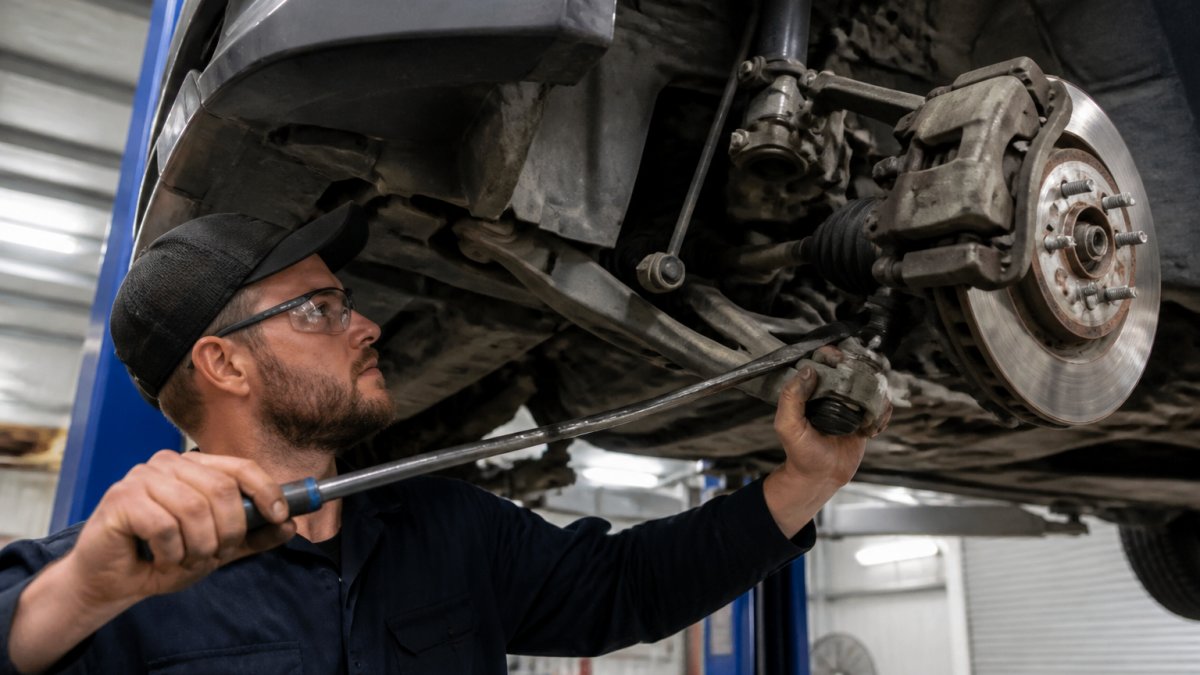
A visual check on the ground tells you almost nothing. You need the weight off the suspension and the wheel free to move. That’s why a proper diagnosis is usually carried out on a hoist.
Here’s a safe sequence for checking ball joints:
- Raise the vehicle and support it correctly on a hoist or stands
- Check the grease boot for cracks, splits or leaking grease
- Grip the wheel at top and bottom and rock it to feel for play
- Use a pry bar under the control arm to load the joint and watch for movement
- Compare both sides, since joints usually wear at similar rates
Watch out: never put your hands or body under a vehicle held only by a jack. A jack is for lifting, not supporting.
What most guides miss is that inspection limits are not universal. Acceptable play, the correct loading method and even the point at which a joint is condemned vary by vehicle and suspension design. Some joints are load-bearing and some are not, and the test differs: a load-bearing joint is checked with the suspension loaded, while a non-load-bearing joint is checked with the suspension hanging free. Getting that wrong gives a false pass or a false fail. Always refer to the manufacturer’s service information for the specific procedure and wear limits before condemning a part.
A common pattern in Mildura is that dust and heat degrade the grease boot before obvious play develops. A torn boot with grease loss is a reason to inspect closely even if the joint feels tight on a quick rock test. That is why we check boots, play and noise together rather than relying on one symptom.
A driveway check has real limits. You can observe clunking, steering looseness and uneven tyre wear from the driver’s seat, and you can look for a split boot with a torch. But lifting a vehicle and prying suspension components without correct equipment is hazardous, and feeling play by hand is easily misread. If you are unsure, stop and book a professional inspection. If clunking is your main complaint, our guide to diagnosing suspension clunking noises walks through the causes in more depth.
Clear Replacement Thresholds and Urgency Levels
There’s no single mileage number that means “replace now.” You need to replace ball joints when they show measurable play beyond the manufacturer’s limit, a torn boot with grease loss, or both. Use this guide to judge urgency:
| Condition | Urgency | Action |
|---|---|---|
| Torn boot, no play yet | Monitor | Re-grease and inspect at next service |
| Slight play within limits, no noise | Plan soon | Book inspection and re-check at every service |
| Play at or beyond the manufacturer’s limit, or clunking plus visible play | High | Replace before long trips |
| Excessive play, a loose wheel, or steering that wanders badly | Stop driving | Book immediately |
Ball joint wear is often described in three levels: watch, plan, and stop. Many owners sit in “watch” for a long time before anything needs doing. The key distinction is between symptoms that warrant prompt inspection, a new clunk, vague steering, uneven tyre wear, and confirmed excessive play that requires replacement. A noise alone does not condemn a joint; a measured wear limit does.
Two more points matter. First, replacing one joint does not automatically mean doing the pair. Replacement decisions depend on the condition and design of each joint. Both sides often wear at similar rates, and a fresh joint beside a worn one can change the handling balance, so many workshops recommend the pair when the opposite side is close to its limit. Ask for the condition of both sides to be shown to you.
Second, on many modern vehicles the ball joint comes as part of the whole control arm, not as a separate part. That changes both the job and the cost, and it means the replacement threshold applies to the assembly rather than a pressed-in joint. Always confirm the design for your vehicle before comparing quotes.
If you’re weighing up repair on an older vehicle, our guide to whether suspension repair is worth it for older cars helps you decide.
Ball Joint Replacement Cost in Australia and What Affects It
Ball joint replacement cost in Australia depends on the vehicle, the part design and the labour time involved. We won’t quote a figure here, because a price for a small hatchback and a price for a farm ute have nothing in common. What we can do is explain what drives the number.
Cost comes down to four things:
- Part type: a standalone ball joint costs less than a full control arm assembly
- Labour time: some vehicles need more disassembly to reach the joint
- Pair versus single: doing both sides at once adds parts but saves repeat labour
- Alignment: a wheel alignment should follow any suspension repair
Ask for a ballpark before you commit. A fair workshop will explain what’s included and what isn’t, and won’t pad the bill with repairs you don’t need. For current prices, see the Mallee Auto & Agricultural Services website.
Wheel Alignment After Suspension Repair: Why It’s Not Optional
A wheel alignment is mandatory after ball joint replacement. New joints change the wheel geometry, and driving on the old alignment scrubs your tyres and pulls the steering off-centre.
Skipping it is a false economy. You’ll pay for new tyres sooner, and the vehicle won’t handle the way it should. Alignment resets the angles so the wheels point straight and wear evenly.
This matters more on our roads. Uneven terrain and rough shoulders already work the suspension hard. A misaligned front end adds rapid tyre wear on top of that. If you want to understand how the whole system works together, our guide to improving car handling through suspension explains the connection between joints, alignment and control.
Book a Ball Joint Inspection at Mallee Auto & Agricultural Services
Don’t guess at a clunk. A ball joint that’s starting to fail gives you warning, and a proper inspection confirms what’s actually worn before anything lets go.
At Mallee Auto & Agricultural Services, we inspect suspension and steering with modern diagnostic tools to identify the fault accurately. We aim for fair, transparent pricing with no hidden charges and offer pensioner discounts. We service cars, trucks, bikes and farm machinery across Mildura and the Mallee.
If you’re hearing a knock or feeling looseness in the steering, book a professional car maintenance appointment in Mildura and we’ll check it properly.
Frequently Asked Questions
What are the common symptoms of worn ball joints?
Worn ball joints usually announce themselves with a clunking or knocking noise over bumps, steering that feels loose or vague, and a vehicle that pulls to one side. You may also notice uneven or rapid tyre wear, especially on the inside edge. In Mildura, where rough patches and gravel shoulders are common, these symptoms can appear earlier than expected. Any of these signs warrants a professional inspection before the joint fails completely.
Is it safe to drive with a bad ball joint?
It is not safe to keep driving on a badly worn ball joint. Excessive play can cause the suspension to collapse, leading to loss of steering control and a sudden failure that puts you and others at risk. If you hear loud clunking, feel pronounced steering looseness, or see visible play in the joint, have the vehicle inspected immediately. A mechanic can confirm whether replacement is urgent or whether the joint can be monitored for a short time.
How much does ball joint replacement cost in Mildura?
Ball joint replacement cost in Australia varies with the vehicle, the number of joints being replaced, and labour time. A front pair often costs more than a single joint, and some vehicles require additional parts. For a current quote, check the Mallee Auto & Agricultural Services website or contact the workshop with your vehicle details. Replacing one joint versus a pair also affects the total.
Do I need a wheel alignment after replacing ball joints?
Yes. Wheel alignment after suspension repair is essential because replacing a ball joint disturbs the suspension geometry. Without a proper alignment, you risk uneven tyre wear, pulling, and reduced steering control. An alignment is commonly recommended as part of this type of job. Skipping it can undo the benefit of the new joint and cost you more in tyres down the track.
A worn ball joint won’t fix itself, and the cost of ignoring one is far higher than the cost of a check. Get it inspected before your next long drive. Get started with Mallee Auto & Agricultural Services and keep your vehicle safe, straight and reliable on the road.

